

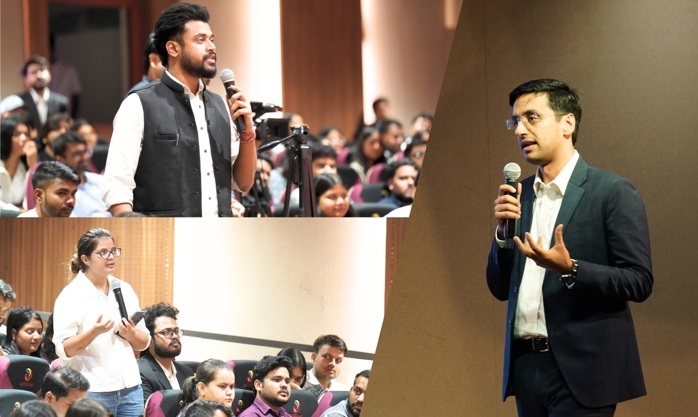
NIA Special Public Prosecutor Gautam Khazanchi Conducts Masterclass on Bail Jurisprudence at Galgotias University
TEN NEWS NETWORK
Greater Noida, 15 June 2026 : Special Public Prosecutor for the National Investigation Agency (NIA), Advocate Gautam Khazanchi, engaged a packed auditorium of law students at Galgotias University in a detailed discussion on bail jurisprudence, constitutional safeguards under Article 22, PMLA, and the evolving complexities of criminal litigation in India.
The distinguished lecture examined contemporary issues surrounding criminal justice, liberty, due process, economic offences, and the interpretation of state powers within the Indian legal system. The session brought students into discussion with one of the most debated areas of contemporary criminal law, particularly the judicial balancing of individual liberty with the interests of justice.
During the lecture, Advocate Gautam Khazanchi discussed the constitutional foundations governing bail in India and explained how judicial interpretation has evolved through landmark precedents. Referring to courtroom practice and contemporary legal developments, he examined the principles that guide courts while granting or refusing bail in criminal cases.
The discussion also examined constitutional safeguards under Article 22 of the Indian Constitution, including protections relating to arrest, detention, legal representation, and procedural rights available to accused persons within the criminal justice system.
A major focus of the lecture was the Prevention of Money Laundering Act (PMLA) and the role of the Enforcement Directorate (ED) in financial crime investigations. The session explored the stringent “twin conditions” governing bail under the PMLA, recent judicial developments, procedural complexities in financial crime litigation, and the practical challenges faced by defence lawyers while representing clients in such matters.
Drawing from professional experience, he also discussed the changing nature of investigation processes, the increasing complexity of economic offences, and the growing importance of constitutional safeguards in cases involving financial and national security-related matters.
Students listened with rapt attention throughout the session and actively participated in an engaging question-and-answer discussion on constitutional rights, ED investigations, judicial interpretation, bail jurisprudence, and courtroom strategy.
The lecture closely follows the recently concluded International Conference on Comparative Law organised by the School of Law at Galgotias University in collaboration with the School of Business and Law, Edith Cowan University, Australia. The conference brought together Supreme Court judges, legal scholars, senior advocates, academicians, and practitioners to deliberate on constitutional law, arbitration, governance, technology, business regulation, human rights, and international legal frameworks.
Dr. Dhruv Galgotia, CEO, Galgotias University, said, “This lecture closely follows the International Conference on Comparative Law at Galgotias University and continues our effort to provide students regular opportunities to engage with leading judges, legal scholars, senior advocates, and practitioners working on contemporary legal and policy issues. Discussions around criminal law today increasingly involve constitutional rights, financial regulation, technology, digital evidence, and national security. Exposure to such conversations helps students better understand how legal principles are interpreted and applied within real judicial and investigative contexts.”
The School of Law at Galgotias University has been steadily expanding its academic and industry engagement initiatives through lectures, moot courts, policy discussions, legal aid programmes, research conferences, and interactions with judges, senior advocates, policymakers, and legal practitioners.
The lecture is one more step in the School of Law’s continuing focus on building a contemporary, practice-oriented, and globally engaged legal education ecosystem that exposes students to real-world legal developments, courtroom realities, and evolving judicial discourse.

Comments are closed.