
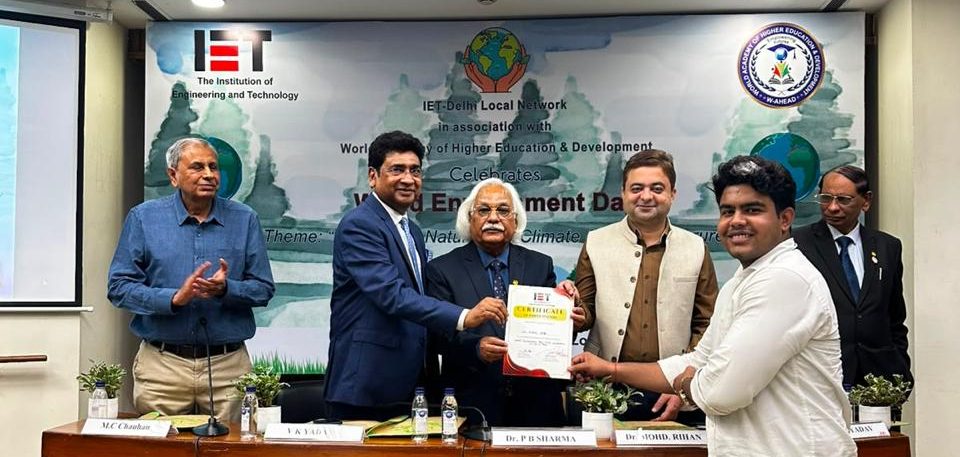
IET (Delhi Local Network) and World Academy of Higher Education and Development W-AHEAD organise World Environment Day- 2026
New Delhi: June 5, 2026: Acknowledging the Tripple Planetary Crisis comprising of Climate Change, Pollution and serious loss of Biodiversity, the World Academy of Higher Education and Development, W-AHEAD, in collaboration with the Institution of Engineering and Technology UK- Delhi Network organised this year’s celebration of the World Environment Day-2026 at India International Centre, New Delhi to recognise the important role of the collective action by Governments, Society and Corporate towards strategic and meaningful initiatives to take the challenge of Climate Change head on and engage, with an utmost sense of urgency, in actions and initiatives that will not only herald the climate change but help achieve the goal of a bright and blissful future for the global humanity.
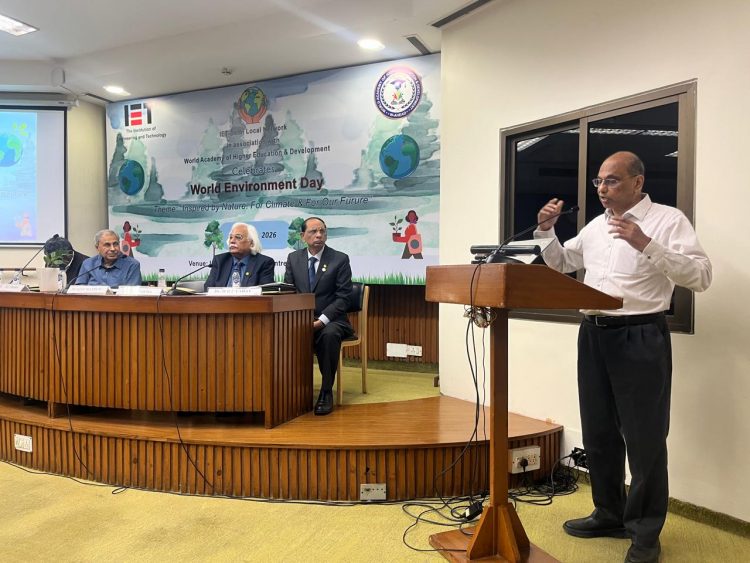
World Environment Day (WED), observed annually on June 5, serves as the United Nations’ primary vehicle for encouraging worldwide awareness and action for the protection of our environment. Since its inception in 1973, it has grown into the largest global platform for environmental outreach, involving over 150 countries. The 2026 World Environment Day celebration focused on the advocacy for urgent need for climate action. As the planet nears the critical 1.5°C threshold of global warming, the theme emphasizes that nature is not merely a resource, but our most powerful partner in climate resilience and the only source of our livelihood and existence. Whether through forest restoration, wetland preservation, environmental pollution control, water resilient agriculture, sustainable soil management or an accelerated advancement of circular economy pathways, all stakeholders are called upon to mount actions and initiatives for utilizing nature-based solutions to mitigate the effects of a rapidly changing climate on one hand and promotion of sustainability and circularity on the other.
The joint W-AHEAD and IET(DLN) celebration of the World Environment Day-2026 at IIC New Delhi was inaugurated by the Chief Guest Dr Ajay Mathur, Former Director General of International solar Alliance and was coordinated by Er Aman Rajput, Honorary Secretary, IET(DLN). The celebration was attended by a galaxy of eminent professionals and young inspired minds of students of engineering and technology that included Er N Venkatesan, Former Member Railway Board & Secretary to Govt of India, Er RK Bagrodia, Chairman Winsome Ltd, Er RK Yadav, Managing Director Kutch Railway Company Ltd, Prof Abdul Quaiyum Ansari, Sr Member IEEE and Professor of Electrical Engineering, JMI New Delhi, Innovator Er RP Singh and Environmental Expert Mr Shubhansh Tiwari.
A roundtable on the main theme of this year’s World Environment Day 2026, namely, “Inspired by Nature: For Climate & For Our Future” was addressed by eminent speakers from government agencies, experts from academia and corporate. These included eminent academician Prof PB Sharma, President W–AHEAD, Vice Chancellor of Amity University Gurugram and past President of AIU, Er MC Chauhan, Chairman Delhi Local Network of IET, himself an eminent engineer, former General Manager of Indian Railways, eminent Solar energy technologist Dr Mohd Rihan, Director General, National Institute of Solar Energy, NISE New Delhi, eminent technocrat Er VK Yadav, former Chairman Railway Board, eminent engineer Er Pradeep Chaturvedi, Vice President of Indian National Academy of Engineering, eminent engineer Er RN Rajput, former Chairman of IET(DLN) and eminent environmentalist Dr HRP Yadav, former secretary and DG of IE(I) currently Head of Civil and Environmental Engineering at Amity University Gurugram.
It was reminded that India, as one of the world’s fastest-growing economies, is at the forefront of the environmental transition through:
How You Can Contribute:
World Environment Day is designed to be a “people’s movement.” Here are five high-impact ways to take part in strengthening the mission #NowForClimate:
“The Earth is sending us strong signals, rising seas, often breaking wildfires and heatwaves, rapidly diminishing water tables, fast melting glaciers, mountains of waste and on top of all this crowded healthcare centres and super-speciality hospitals. The question is no longer weather change is coming, but how we guide it. This World Environment Day, we must choose to be the signal of change and take a pledge for mitigating the triple crisis that the humanity globally is facing.
“
The Celebration also included a Delhi Declaration adopted on the World Environment Day 2026 that Acknowledged that the current linear, “take-make-dispose” economic model is structurally unsustainable and that the Asia-Pacific region, that includes India, being both an engine of global growth and the most vulnerable climate frontier, must lead the systemic shiftto cause a major departure in our approach to mitigating the Climate Crisis. The Delhi Declaration prescribed a Global Mandate for Shared Responsibility, committing ourselves to a clear global agenda defined by Relevance, Responsibility, and Rapid Action, aimed at securing a prosperous, harmonious, and equitable future for all. We recognize that the responsibility for the crisis, and for the solution, is distributed across governments, industry, academia, and every global citizen and thus called for commitment with conviction and collective call for action as hereunder: I. Commitment to Systemic Circularity and Shared Responsibility for Responsible Consumption and proposed fundamental transition from a linear to a Circular Economy across all sectors, making the elimination of waste a core tenet of policy and production, reinforced by a commitment to Shared Societal Responsibility. Implement ambitious, National Circularity Mandates (NCMs) with a firm resolve and commitment to national and global mandates for 4 Rs, namely Reduce, Repair, Recycle and Reuse and mandating material recovery targets (e.g., 100% Waste Water Treatment, Recycle and Reuse; 100% Clean Energy Generation and a minimum of 50% material recapture and reuse for key resources) by 2035. II. Extended Producer Responsibility (EPR): Strengthen and enforce truly binding EPR laws globally, ensuring that industries bear the full financial and logistical cost of managing and recycling the entire lifecycle of their products. Further mandating that the Government, Industry and Corporate CSR to collectively fund path breaking research and technology innovations that strengthen natural resource recovery, including precious metals from used products and devices.III. Promotion of Responsible Consumption: Launch national and global campaigns to foster a culture of Responsible Consumption, Aparigriha, i.e. possessing as much as necessary and consuming as much as needed, encouraging conscious consumer choices, extending product life, and recognizing that citizen action is critical to aggressively reducing waste across all across of the supply chain.
IV. Mandate for Green Technology Solutions and Relevance-Driven Innovation: Governments and Corporate should prioritize R&D funding for and remove regulatory barriers against high-impact, scalable Green Technology Solutions, including advanced Bio-Energy systems, Future Biofuels, Green Hydrogen, High Energy High Storage and Long Life Batteries for EVs, localized smart micro-grids, carbon capture technologies, and sustainable water purification systems and ground water recharging systems, Amrit Jalasayas in good numbers in each district of India and ETPs for industrial waste water treatment and mandate zero discharge of industrial effluents to rivers and water bodies.The Delhi declaration further added that the climate transition must be adequately and equitably financed by internalizing the environmental costs of polluting activities and proposed to implement a global, progressive Carbon Tax and eliminate all subsidies for fossil fuel production by 2030, redirecting these funds entirely into renewable energy infrastructure, climate adaptation, and resource efficiency projects. Establish a dedicated fund for climate adaptation and resilience in climate-vulnerable nations, prioritizing investment in protective infrastructure against sea-level rise and extreme weather events. Mandate Green Labelling for ecofriendly and circularity of all products and ensure that public sector procurement prioritizes materials and services that adhere to certified circular and low-carbon standards, utilizing government spending as a powerful market signal. The declaration asserted that the transformation of our economic systems requires national and global campaigns for sensitization of young, inspired minds from schools to universities of responsibility to use the power of education and science and technology innovations for sustainable solutions for environmental protection and for strengthening the mission of circularity and urged universities and research institutions to establish Green-Tech Research and Innovation Labs, embedding a practical, cross-disciplinary research agenda that prototypes localized solutions on campus for immediate community deployment of Greentech solutions and innovative cost effective technologies.
“Let us lead by example, collaborating and co-creating a bright future for the current generation and for the generations to come”.

Comments are closed.