
‘Thrones of power to temples of service’: India rewrites the grammar of governance

New Delhi, Dec 1 (IANS) In a nation that once measured authority by the grandeur of its titles, something subtle yet seismic is unfolding.
Raj Bhavans, the colonial-era palaces that housed Governors in regal splendour, are steadily being rechristened “Lok Bhavan” – the People’s House.
What sounds like a mere linguistic footnote is, in truth, the latest verse in a decade-long poem Prime Minister Narendra Modi has been composing about the very soul of public office.
The majestic avenue once called Rajpath – literally the Path of Rule – awoke one morning in 2022 as Kartavya Path — the Path of Duty. A six-kilometre stretch of asphalt now preaches every day to millions that power is not a privilege to parade but a responsibility to shoulder.
In 2016, the Prime Minister himself vacated 7, Race Course Road – a colonial address dripping with exclusivity – and moved into Lok Kalyan Marg; the Road of People’s Welfare. A quiet declaration that the highest home in the land belongs, first and foremost, to the citizen.
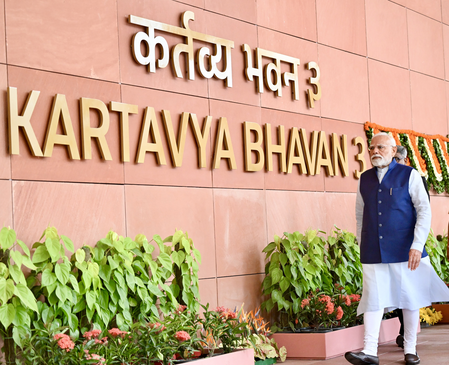
Walk today into the nerve centre of Indian administration, and you will no longer find the Central Secretariat. In its place stands “Kartavya Bhavan” – the House of Duty – where files move not under the shadow of imperial domes but beneath nameplates that remind every officer, you are here to serve, not to rule.
Even South Block and North Block, the twin fortresses of bureaucracy, now share a new campus called “Seva Teerth” – the Pilgrimage of Service. A workplace reimagined as sacred ground where policy is not wielded as a weapon but offered as worship to 1.4 billion people. These are not random renamings by an image-obsessed government. They are deliberate strokes on a canvas that began taking shape the day Narendra Modi took oath in 2014.
One by one, the old symbols of satta – dominion, control, distance – are being replaced by the vocabulary of seva and kartavya: service and duty, closeness and answerability.
Symbols, of course, are only the surface. Yet in India, where culture runs deeper than the Constitution, a name change is often the first whisper of a change in nature.
When buildings that once intimidated now welcome, when roads that once celebrated rulers now celebrate responsibility, something inside the collective psyche shifts. India is teaching herself a new lesson; government is not a throne to be occupied but a trust to be honoured.
And under this quiet linguistic revolution, an old democracy is learning, name by name, street by street, to place the people where they always belonged – at the very centre of power.
–IANS
sktr/dan

Comments are closed.