
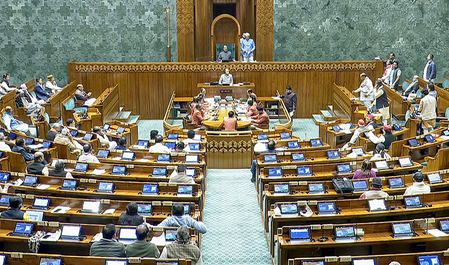
Lok Sabha to continue SIR discussion today, Amit Shah to speak at 5 pm

New Delhi, Dec 10 (IANS) The discussion on the Special Intensive Review (SIR) in the Lok Sabha will continue on Wednesday, and Union Home Minister Amit Shah will address the House on the electoral reforms at 5 p.m.
The Lower House of the Parliament initiated a discussion on Tuesday on the SIR process being carried out by the Election Commission of India (ECI) in 12 states/UTs — an exercise that has drawn widespread criticism from the Opposition.
Union Parliamentary Affairs Minister Kiren Rijiju took to X and announced that the Home Minister will speak on the SIR process at 5 p.m. in the Lok Sabha.
Earlier on Tuesday, Congress MP Manish Tewari opened the debate in the Lok Sabha and raised concerns over the use of public funds in the run-up to elections. He questioned the practice of cash transfers to voters.
“You cannot win elections at the cost of the national exchequer or the state exchequer. This will bankrupt our democracy, our country,” he said, warning that such measures undermine the integrity of the electoral process. He further argued that the Election Commission of India (ECI) has “no legal basis to conduct SIR” and pressed for greater transparency, asking why the Commission is not providing machine-readable voter lists to political parties.
He made a three-pronged demand: The Election Commission officers’ selection law must be amended. The Chief Justice of India and the Leader of Opposition in the Rajya Sabha must be in the selection panel. “SIR, be stopped immediately, a blanket ban must be imposed on direct cash transfer before the election, it is against democracy,” Tewari said.
Responding to these remarks, BJP MP Sanjay Jaiswal accused the Opposition of raising the issue of SIR and “vote-chori” merely to divert attention from their heavy losses in the recently concluded Bihar elections.
Jaiswal claimed that the earliest example of “vote-chori” occurred in 1947, when Jawaharlal Nehru was appointed Prime Minister despite most members of the Congress Working Committee supporting Sardar Vallabhbhai Patel for the position.
Jaiswal extended his argument by citing other episodes, which he described as examples of Congress-led “vote chori”, including the imposition of Emergency in 1975 and the controversial 1987 elections in Jammu and Kashmir.
Additionally, during the debate on electoral reforms — often referred to by Congress as the debate on SIR (Special Intensive Revision) — Lok Sabha LoP Rahul Gandhi raised pointed questions: “Why was the Chief Justice of India removed from the selection panel of the Election Commissioner? What motivation could there be to remove the CJI? Do we not believe in the CJI? Of course, we do. Then why is he not in the room?”
“I sit in that room. It is called a democratic decision, but on one side sit Prime Minister Narendra Modi and Home Minister Amit Shah, and on the other side, the Leader of the Opposition. I have no voice in that room. What they decide is what happens. Why are the Prime Minister and Amit Shah so keen on choosing exactly who the Election Commissioner will be?” he further elaborated.
“This is unprecedented. No Prime Minister has ever done this in India’s history. In December 2025, this government changed the law to ensure that no Election Commissioner could be punished for any action taken while in office. Why would the Prime Minister and Home Minister give such immunity? Why grant a privilege that no Prime Minister has ever given before?” he went on to allege.
Making a sharp remark against the BJP in his speech, Gandhi declared: “There is no bigger anti-national act than stealing votes.”
Meanwhile, BJP MP Nishikant Dubey, while participating in the SIR debate, accused the Congress of having weakened key constitutional institutions through amendments carried out during the 1970s. He strongly rejected Rahul Gandhi’s claim that national institutions have been “captured by the Rashtriya Swayamsevak Sangh (RSS)”.
During his speech in the House, Dubey had referred to the 1976 Swaran Singh Committee and the subsequent 42nd Constitutional Amendment, arguing that the move significantly weakened the autonomy of institutions during the Emergency.
He alleged that even the office of the President was reduced to a ceremonial role through Congress-led amendments.
–IANS
sd/dpb

Comments are closed.