
Delhi’s Urban Transformation Push: Single-Window Clearance | New TOD Policy
TEN NEWS NETWORK

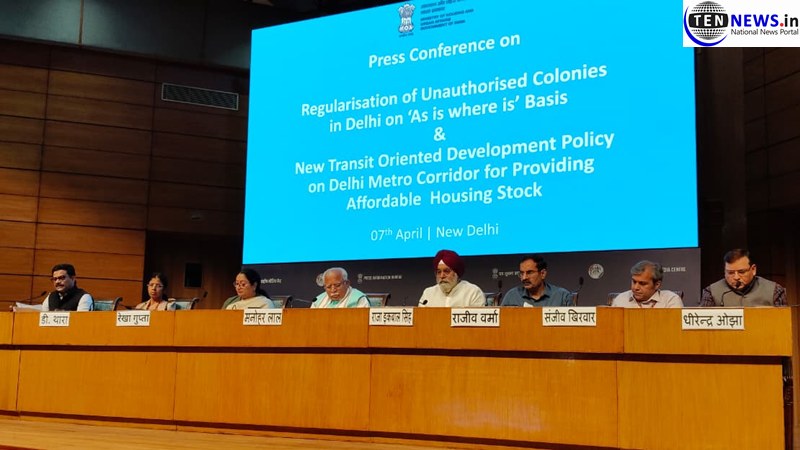
New Delhi News (07 April 2026): In a major policy reform aimed at transforming Delhi’s urban landscape and promoting sustainable, transit-centric development, the Delhi Development Authority (DDA) has introduced significant changes under its Transit Oriented Development (TOD) Policy. The new framework focuses on simplifying procedures, introducing single-window clearances, rationalizing charges, and ensuring time-bound approvals to accelerate development projects along metro corridors and mass transit networks.
The revised TOD policy introduces a dedicated TOD Committee under the leadership of the Vice Chairman (VC), DDA. This committee will comprise representatives from all concerned stakeholder departments and service-providing agencies, ensuring seamless coordination and faster decision-making. Agencies that typically play a role in development approvals, including municipal authorities, water and sewerage agencies, fire services, and other infrastructure providers, will now work together through a unified platform.
This collaborative structure aims to remove bureaucratic hurdles that developers and landowners often face while seeking approvals for large-scale urban development projects. Earlier, applicants were required to approach multiple agencies individually, resulting in delays, procedural complexities, and increased compliance burden. With the formation of the TOD Committee, the process is expected to become more efficient, transparent, and predictable.
One of the most significant features of the revised policy is the introduction of a single-window application system. Under this mechanism, citizens, developers, and landowners seeking to develop their land under TOD norms will be required to submit their applications at a single point. All necessary approvals from different departments will be processed internally through the committee, eliminating the need for applicants to visit multiple offices or coordinate separately with different agencies.
The policy also provides for time-bound approvals, which is expected to significantly reduce project delays and enhance ease of doing business in the capital. By setting clear timelines for decision-making, the DDA aims to ensure that development proposals move forward without unnecessary administrative bottlenecks. This reform is expected to benefit not only developers but also end-users such as homebuyers and commercial investors, who often face delays due to prolonged approval processes.
Another major reform under the policy is the simplification of TOD charges. Previously, developers had to pay separate charges to multiple agencies for different approvals, including water and sewerage connections, sanction fees, land use changes, additional Floor Area Ratio (FAR), and conversion charges from leasehold to freehold. The fragmented payment structure often created confusion and increased the cost of compliance.
To address this, the DDA has proposed a single consolidated TOD charge. This unified charge will encompass multiple components, including water and sewerage charges, sanction charges, land use change fees, levy and additional levy for additional FAR, and conversion charges for leasehold to freehold properties. By consolidating these payments, the policy aims to simplify the financial structure and reduce administrative complexity.
The simplified charge structure is expected to bring greater transparency and predictability in project costs. Developers and landowners will now have clarity regarding total charges at the initial stage itself, enabling better financial planning and faster project execution. The move is also likely to reduce disputes and delays related to payment approvals.
The TOD policy is designed to promote development around mass transit infrastructure such as metro stations, bus corridors, and major transit hubs. The objective is to create high-density, mixed-use developments that integrate residential, commercial, institutional, and recreational spaces within walking distance of public transport. Such development reduces dependence on private vehicles and promotes sustainable urban mobility.
Urban development experts believe that Transit Oriented Development plays a crucial role in addressing Delhi’s growing population and infrastructure demands. By encouraging vertical growth near transit corridors, the city can optimize land use, reduce urban sprawl, and improve connectivity. The revised policy is expected to unlock the potential of underutilized land parcels located near metro lines and transit corridors.
The policy also aligns with broader urban sustainability goals, including reducing traffic congestion, lowering carbon emissions, and improving air quality. By encouraging people to live and work near public transport hubs, TOD projects help reduce travel distances and promote environmentally friendly commuting options.
Another important benefit of the revised TOD policy is the potential boost to the real estate sector. Faster approvals and simplified charges are expected to encourage developers to undertake new projects, particularly in areas located along metro corridors. This could lead to increased housing supply, improved commercial infrastructure, and enhanced urban amenities.
The policy is also expected to benefit homebuyers and investors. Faster project approvals and streamlined procedures can help reduce project delays, ensuring timely delivery of housing units and commercial spaces. This, in turn, can enhance buyer confidence and promote investment in the real estate sector.
Officials believe that the revised TOD policy will serve as a catalyst for planned urban growth in Delhi. By integrating land use planning with public transport infrastructure, the city aims to create vibrant, accessible, and sustainable urban neighborhoods. The policy also supports the vision of creating walkable communities with better public spaces, improved infrastructure, and enhanced quality of life.
With the introduction of a single-window clearance system, simplified TOD charges, and time-bound approvals, the Delhi Development Authority’s revised TOD policy marks a significant step toward modernizing urban development processes in the capital. The reforms are expected to accelerate project implementation, attract investment, and contribute to Delhi’s long-term urban transformation.
As Delhi continues to expand and modernize, the revised TOD policy is likely to play a pivotal role in shaping the city’s future, ensuring efficient land utilization, improved connectivity, and sustainable development aligned with global urban planning standards.
Dear Readers and Viewers, Please note that tennews.in: National News Portal daily publishes latest and top ten news from government, politics, national, business, education, technology, lifestyle, entertainment, health etc ten categories. You may submit your e mail and subscribe it to get updates on your e mail. Please also subscribe TEN NEWS NATIONAL YouTube Channel.

Comments are closed.