

The rapid expansion of the digital frontier and its profound penetration into every facet of human endeavor fills us with a sense of immense optimism. We are entering a new world where technology is poised to impact not just our efficiency, but the very conscience and conduct of humanity. In this digital age, the “netizens” are increasingly drawn to the silent invasion of intelligence of machines, often placing more faith in the fairness of an algorithm than in the counsel of experts and peers. This increasing reliance is a sign of our shared belief that machine intelligence, if designed correctly, can work with a level of neutrality and consistency that often eludes the human mind.
Knowingly, that the intelligence of man acknowledges no bounds, it can swing with equal force toward the righteous or the wrong as per the compelling circumstances that often arract pepole to commit wrong for personal gains. We also see this duality manifesting in the shadows of the digital world, where the same artificial intelligence that promises progress can be turned toward deception. The digital world is now plagued by the risks of spoofing social media accounts to steal identities, the creation of deepfakes to manipulate public discourse, and the subtle conditioning of human behavior. Even our biological brains are being impaired; our preoccupation with constant visuals leaves us with little time for the contemplation required to draw from our reservoir of experience to build the canvass of deep learning for causing innovations of value and impact. Our ability to memorize simple numbers or perform mental arithmetic is also rapidly fading giving way to our dependence on the smart devices in our hands.
The MIT study titled, “Your Brain on ChatGPT: Accumulation of Cognitive Debt when Using an AI Assistant for Essay Writing Task”, by Natalia Kosmyna et al of MIT Media Lab(2025) has found that using ChatGPT to help write essays leads to long-term cognitive harm. Students who repeatedly relied on ChatGPT showed weakened neural connectivity, impaired memory recall, and diminished sense of ownership over their own writing says the report. While the AI-generated content often scored well, the brains behind it were shutting down. In essence the study concludes that the machines are not just taking over our work, in fact they are taking over our minds.
Besides academia, it may not be out of place to mention that AI presents us with substantial risks to the society at large if misused. AI powered machines can empower malicious actors to use applications for fraud, theft, cyber attacks or even the construction of chemical, nuclear or biological weapons.
Building Conscience in AI on Chip
It is here that the importance of building conscience in AI powered machines of tomorrow becomes most vital. For a human, conscience is an internal alarm that reminds us of righteous conduct. As we debate the evolution of a universally acceptable code of ethics for autonomous machines, powered by integrated power of AI and ML we must ensure that these systems are designed with a “moral anatomy” that mirrors this human trait of conscience.
For a machine to truly exhibit righteous conduct, the integrity of its information and data and its accountability must be embedded as a fundamental truth, ensuring that the wellbeing of humanity and the protection of nature are at the heart of its every decision.
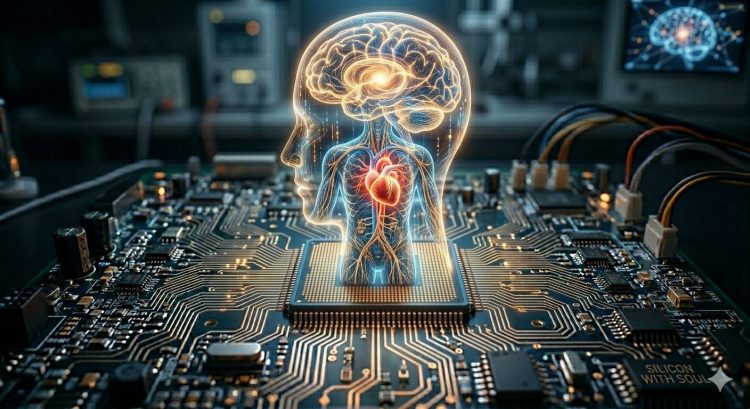
However, today’s AI is largely built upon “lines of code” running on distant servers. This software-based approach is fragile; it is like a rule that can be rewritten, bypassed, or ignored by a clever enough actor. To truly safeguard our future, we must move these layers of reliability and accountability from the “software” to the “silicon.” By embedding accountability directly into the AI-on-Chip architecture, we make AI and AI Applications both responsible as well as reliable.
Hardwiring Trust- Requires Silicon with a Soul
Just as a human is guided by an inner soul that prompts the brain toward purity, our intelligent machines require an embedded code of ethics that is physically inseparable from their “brain.” By hardwiring these safeguards into the hardware itself, we create a digital conscience that is immutable. This ensures that even if a machine’s programmed logic attempts to defy its ethical boundaries, the physical circuitry, the very atoms of the chip and its operating system, will not allow it to do so. This hardware-rooted integrity can protect us from the deceptions of identity theft and the manipulation of information.
The Way Forward
As we journey deeper into this augmented age, our goal is to create a blissful partnership between humanity, technology, and nature. We are moving toward an era where the machines of tomorrow would be required to act with an inbuilt conscious mind, capable of reflecting on the consequences of their actions. By giving our machines a soul on the chip, we ensure they remain coworkers of high character, protecting the dignity of man and the sanctity of the world we share. Our future lies in this integration, where the intelligence of the machine and the wisdom of the human spirit work in perfect harmony. This would be the way to move fast forward to significantly accelerate growth and development of global economy of scale and of positive impact on sustainability and advancement of human excellence. Such is the call of the hour for AI researchers and those crafting tomorrow’s AI on Chip with a Soul.
About the Authors: Aadeesh Sharma is a Post Gradute Scholar in AI and ML at Imperial College London and Prof PB Sharma is a visionary Thought Leader, founder Vice Chancellor of DTU, currently Vice Chancellor of Amity University Gurugram.

Comments are closed.