
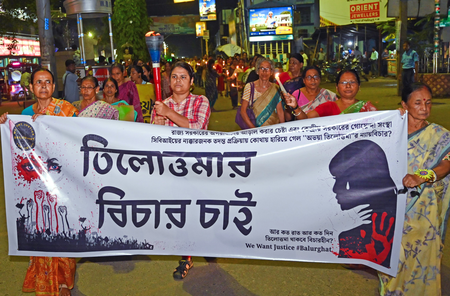
As RG Kar probe intensifies, questions loom over Mamata Banerjee’s role as then Bengal CM

New Delhi, May 20 (IANS) Recent developments reported on the probe into the brutal rape and murder of a young junior doctor at Kolkata’s RG Kar Medical College and Hospital, raise serious questions about governance, accountability, and the legacy of Mamata Banerjee’s rule in West Bengal.
Administrative measures include the suspension of three senior IPS officers and intensified investigations into alleged irregularities involving Sandip Ghosh, the former superintendent at RG Kar Hospital.
The former Chief Minister also held the crucial home and health ministries at the time, thus rendering her open to face scrutiny over systemic failures that are alleged to have enabled such a tragedy.
The 2024 case became emblematic of the vulnerability of women in public institutions and the erosion of trust in state mechanisms meant to protect them.
The brutality of the crime, committed within the premises of a leading medical college, underscored the collapse of basic safety protocols in spaces that should have been secure.
Administrative follow-up was also criticised for allegedly being inadequate and slow, till the High Court sought a CBI probe. And it all happened with a woman Chief Minister at the helm.
Public outrage mounted as details emerged of lapses in hospital administration, alleged cover‑ups, and failures in policing. The victim’s family and civil society groups demanded accountability not only from the perpetrators but also from those in positions of authority who allowed such negligence to fester.
Now, this month’s mandate has not only overwhelmingly gone against the Trinamool Congress regime, but has sent a specific message in Kashipur-Belgachhia Assembly seat where stands the institute, and in Panihati, residence of the victim’s family.
Both saw BJP candidates beat the Trinamool Congress, with the victim’s mother registering victory at Panihati. As BJP leaders had pledged, the new government swung into action soon after assuming office.
Late last week, Chief Minister Suvendu Adhikari announced the suspension of three IPS officers for alleged mishandling of the investigation. This signals recognition at the highest levels that police response was inadequate, if not compromised.
The suspension also highlights a deeper malaise: The reported politicisation of policing in West Bengal. Officers are often accused of toeing the ruling party’s line rather than upholding impartial law enforcement.
In this case, questions abound as to whether political pressure influenced the pace and direction of the investigation. And on Tuesday, the Chief Minister granted sanction for prosecution against the former superintendent in connection with the alleged financial corruption linked to the institution.
Reports suggest that lapses in security, mismanagement of staff, and questionable financial dealings created an environment where accountability was absent.
Investigators are examining whether Ghosh’s alleged irregularities contributed to the unsafe conditions that enabled the crime. His role has become a focal point in understanding how institutional rot may have intersected with broader governance failures.
Critics argue that the concentration of power in Banerjee’s hands meant that lapses in both policing and healthcare governance ultimately reflect on her leadership. The case has thus become a prism through which her administration’s shortcomings are being examined.
Her government has been accused of shielding officials and delaying accountability by other political parties.
Current developments now threaten to erode her image as a leader who champions women’s safety and healthcare reform.
In West Bengal overall, the tragedy also underscores the urgent need for reforms in both policing and healthcare administration.
The incumbent government will simultaneously need to depoliticise the police force, strengthen accountability mechanisms, and ensure swift responses to crimes.
At the same time, it must ensure strict security protocols in hospitals, along with transparent financial practices, and independent oversight to prevent administrative rot.
–IANS
jb/rad

Comments are closed.