

EPCH welcomes India–UK CETA, a New Zero-Duty Gateway for Indian Handicrafts
New Delhi, 15th July 2026: The Export Promotion Council for Handicrafts (EPCH) welcomed the entry into force of the India–United Kingdom Comprehensive Economic and Trade Agreement (CETA), calling it a landmark development that will open a new chapter for Indian handicrafts in one of the world’s most mature and high-value consumer markets. The agreement provides zero-duty access on nearly 99% of India’s exports to the United Kingdom, covering almost the entire trade value. For Indian handicrafts, this is expected to create a major competitive advantage by removing tariff barriers and improving access to UK buyers, importers, retailers, wholesalers, designers and e-commerce platforms.
Speaking on this historic moment, Dr. Neeraj Khanna, Chairman, EPCH , said, “The entry into force of the India–UK CETA today is a transformative milestone for India’s handicrafts sector. The agreement gives Indian handicraft exporters zero-duty access to a high-value and quality-conscious market, enabling them to compete more effectively with other supplier countries. This will strengthen India’s presence in the UK market across home, lifestyle, fashion accessories, furnishing, furniture and other craft-based product categories.”
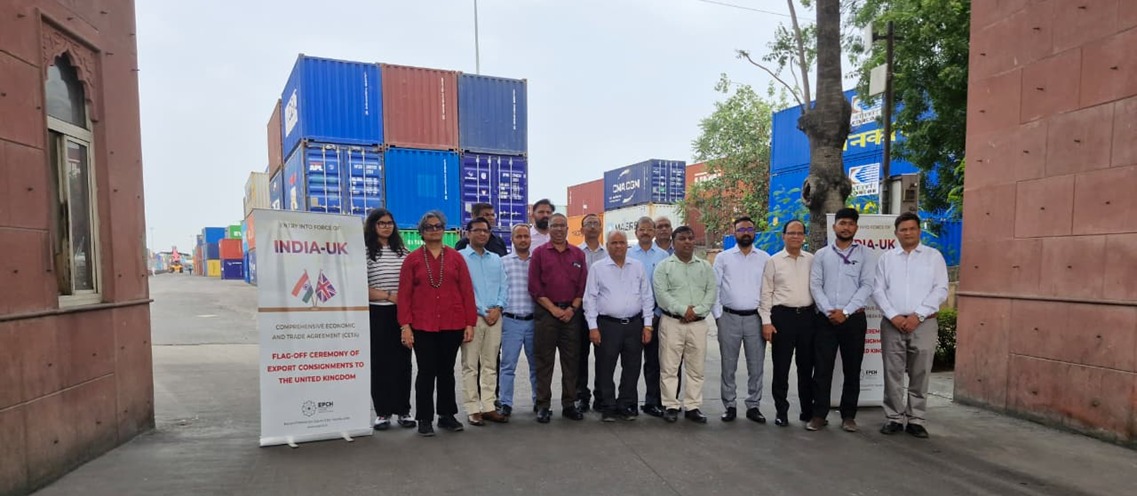
Dr. Khanna further said, “Today marks a historic milestone in India–UK trade relations. The implementation of the India–UK CETA opens new opportunities for India’s handicrafts sector by improving market access and competitiveness in the UK. The dispatch of the first consignments on the very first day of the Agreement reflects the preparedness and confidence of our exporters. These consignments include metal planters, wooden trays, wooden bowls, metal jugs, decorative wooden articles, and other home décor and lifestyle products. We are confident that this landmark Agreement will significantly boost handicrafts exports to the UK in the years ahead.”
Speaking on the occasion, Dr. Rakesh Kumar, Director General in the role of Chief Mentor, EPCH and Chairman, IEML , said, “CETA is not only a trade agreement, but also a market access platform that can significantly strengthen the India–UK handicrafts trade corridor. With tariffs being removed and market access becoming more favourable, Indian exporters now have an opportunity to scale up their presence in the UK through a combination of design innovation, reliable supply chains, warehousing, fulfilment and digital commerce.”
Referring to emerging market access & infrastructure upgrade for Indian handicrafts products in the UK, Dr. Kumar further added, “EPCH-ExpoBazaar has also launched its operations in the UK through a strategic collaboration with Vectra UK Limited. This expansion marks the UK its third overseas market after the United States and Europe. To support its UK operations, ExpoBazaar has established a fully operational third-party logistics warehouse in the country, enabling a Just-in-Time fulfilment model. This will allow retailers and wholesalers across the UK to access ready-to-ship Indian handicraft and lifestyle products with shorter delivery timelines, improved inventory planning and greater supply chain reliability.
Expo Bazaar has already been serving more than 100 boutique stores across the UK through its Netherlands office, generating around £30,000 in monthly sales. With the CETA into force, this is expected to grow to around £100,000 per month while also contributing to the expansion of the manufacturing base in India.”
Sagar Mehta, Vice Chairman, EPCH, said, “The removal of tariff barriers under CETA will provide immediate commercial benefits to handicraft exporters. It will help Indian products become more price-competitive, improve order conversion and encourage UK buyers to expand sourcing from India. EPCH will continue to undertake focused market promotion activities in the UK through international trade fairs, buyer-seller meets, thematic promotions and direct buyer outreach. The Council will work closely with exporters to help them leverage CETA for long-term business partnerships and deeper penetration into the UK retail and sourcing ecosystem.”
Highlighting the strategic approach, Rajesh Rawat, Executive Director, EPCH, said, “The UK has always been a significant market for Indian handicrafts, and the implementation of CETA from today provides the sector with a strong opportunity to expand exports and build deeper market linkages. Now, EPCH will adopt a more focused strategy for the UK market through targeted buyer outreach, product-specific promotions, participation in key trade fairs and closer interaction with importers, retailers, wholesalers, designers and e-commerce platform.
Rawat further added, “The Council will support exporters in understanding UK buyer requirements, product positioning, compliance expectations, packaging standards, sustainability preferences, price competitiveness and digital trade opportunities. EPCH will also encourage member exporters to develop market-specific collections suited to modern UK homes and lifestyles, while promoting Indian handicrafts as handmade, sustainable, design-rich and culturally rooted products. This strategic approach will help convert the benefits of CETA into long-term business opportunities for exporters and sustained livelihood support for artisans and craft clusters.”

Comments are closed.