
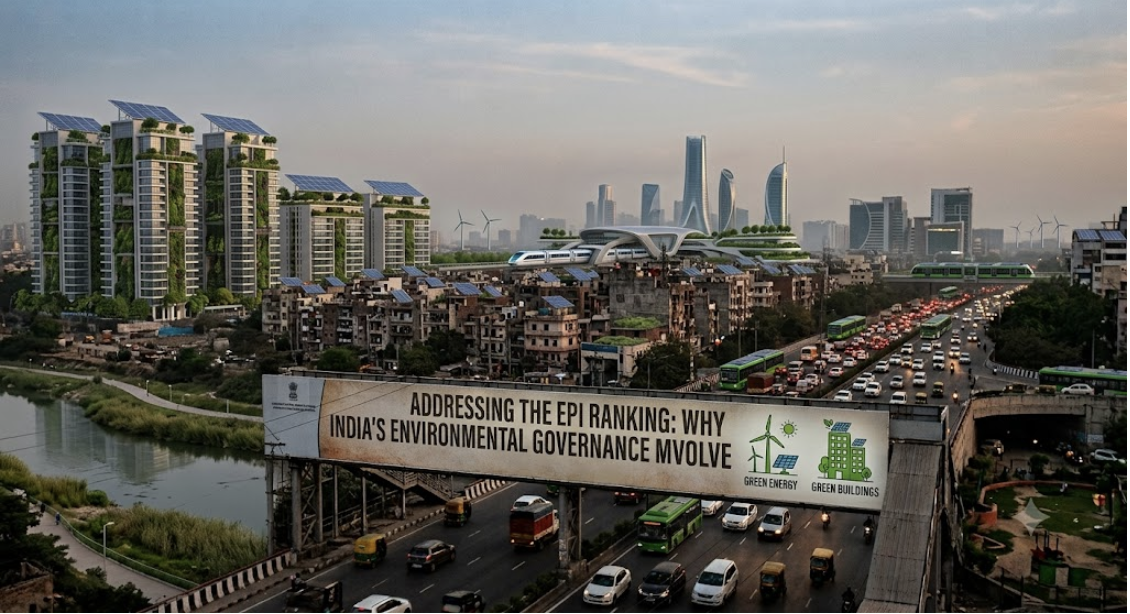
Addressing the EPI Ranking: Why India’s Environmental Governance Must Evolve
The publication of the global Environmental Performance Index (EPI) compiled biennially by researchers at Yale and Columbia Universities placed India at 176th out of 177 countries. For climate scientists, urban planners, and environmental advocates, this dismal placement should come as a no surprise.
While official channels often dismiss the EPI’s methodology as biased or unscientific, the daily realities on the ground tell a different story. Toxic urban smog, polluted rivers and water bodies, traffic jams on roads, poor traffic management, neglect of civic services resulting in flooding of mega cities during rainy season, untreated discharge of wastewater into rivers and poor quality of waste management are visible across the country. Rather than negating the Nation’s rating of EPI, we all must treat this ranking as a wake-up call to transition from superficial compliance to aggressive, enforceable environmental reforms.
The EPI Framework
The Environmental Performance Index measures countries across three primary policy objectives:
• Climate Change Mitigation (30% weightage): Projected emissions, greenhouse gas (GHG) intensity, and decarbonization trajectories.
India scored a EPI rank of 174 in Environmental Health primarily because of severe particulate matter exposure and indoor air pollution caused by flying dust and particulate matter. The situation becomes even more critical with ever increasing fleets of motor vehicles, majority of them plying with Air Conditioning.
Likewise, the Ecosystem Vitality EPI India rank of 171 is largely due to Forest degradation, loss of marine habitats and biodiversity pressure created by increased urbanisation and massive construction activity going on around the country, under massive infrastructure development.
India’s rank of 130 in Climate Change initiatives reflects a rapid growth in absolute carbon emissions despite low per-capita levels. It is important here to realize that though the per capita emissions for India stand at 2.2 tons per capita with its 3.96 trillion-dollar GDP while US is at 14.2 tons per capita for its 30.8 trillion–dollar GDP. As such when it comes to emissions per dollar of GDP, India accounts for 0.80 – 0.90kg while advanced nation like USA accounts for 0.21 – 0.23kg. This clearly indicates that India is emitting 4 times more CO2 emissions when taken on the basis of economy size of the two countries. For a fastest growing economy like India, the need for tightening its environmental protection standards and their strict enforcement cannot be overemphasized.
Why the Ranking should Surprises No One
India’s positioning near the bottom of global environmental indices stems from systemic structural challenges that have prioritized short-term expansion over long-term ecological balance.
1. The Chronic Air Quality Crisis
Urban India regularly dominates international lists of the world’s most polluted cities. Fine particulate matter () and surface ozone routinely exceed World Health Organization (WHO) safety limits by orders of magnitude during winter months. This is driven by vehicle exhaust, industrial emissions, construction dust, and seasonal crop residue burning. It is important to realize that the safe limit to particulate matter, as per WHO has been placed at 5 micrograms per cubic meter while the annual average for India is placed at 40 micrograms per cubic meter. In mega cities like Delhi despite improvement in the annual average in the particulate matter, Delhi still recorded an average of 139 microgram per cubic meter and was ranked as one of the most polluted cities in the World in 2025.
2. Over-Reliance on Fossil Fuels
Despite massive investments in solar and wind capacity, coal continues to generate over 70% of India’s electricity. Expanding power demands driven by urbanization and cooling needs keep fossil fuel consumption rising rapidly. Increasing fleets of motor vehicles fuelled by petrol/ diesel in all cities and even the rural areas further make the situation more critical.
3. Weak Environmental Enforcement
India’s environmental laws require a thorough revision in the light of the global environmental regulations and compliance to meet the sustainable development goals. India’s Water Act was enacted in 1974 while India’s Air Act was formulated in 1981 and Environment Protection Act in 1986. A lot has changed since then in respect of our concern for environmental health. This requires urgent review of the Air, Water and Environmental protection act to meet the pressing needs of making India rapidly rise in environmental performance index.
By the time India celebrates its centenary as Viksit Bharat@2047, let India be a 50 trillion Dollar economy and one of the happiest and healthiest Nation in the World. The Viksit Bharat@2047 vision has placed a great emphasis on environmental sustainability along with economic acceleration and increased urbanization. As such, the regulatory bodies like the Central Pollution Control Board (CPCB) and State Pollution Control Boards (SPCBs) should understand the dire need for major upgradations of its Air, Water and Environmental Protection acts and their enforcement with integrity and unwavering resolve. These regulatory bodies should also realize that mere monitoring is not enough. Strict enforcement of environmental laws and strategic management of environmental health is needed as their guiding philosophy for work excellence and enforcement with integrity.
4. Depletion of Natural Buffers
Rapid infrastructure projects frequently involve forest diversion and wetland encroachment. The degradation of local ecosystems deprives urban centres of natural carbon sinks, biodiversity buffers and natural flood control mechanisms. This can be very well taken care of by massive multilayered plantation of trees and herbs along the expressways and highways and by a sustained focus on circular economy for utilizing waste as much as possible without sacrificing strict quality compliance. Poor quality monitoring during construction and failure of robust quality assurance before issuing completion certificates for construction projects to facilitate early completion often leads to undermine quality standards.
Incremental tweaks will not alter India’s trajectory. Reversing this environmental decline requires a fundamental shift in political priority and public accountability.
Conclusion
Dismissing international indices as methodological flaws provides temporary rhetorical relief, but it does not purify the air, restore polluted rivers, or protect public health. India’s position at the bottom of the Environmental Performance Index is a clear indicator of systemic strain. Sustainable economic growth cannot occur on a degraded ecological foundation; adopting decisive, enforced environmental measures is now an immediate necessity for national well-being.
The Author, Prof PB Sharma is a visionary thought leader, founder Vice Chancellor of DTU and Past President of AIU, currently Vice Chancellor of Amity University Gurugram. The views expressed are the personal views of the author.

Comments are closed.