
Dr. Qazi Ehsan Ali Hails Greater Noida Trauma Summit, Calls for AI Integration in Future Trauma Care
TEN NEWS NETWORK
Greater Noida News (19/09/2026): A two-day Trauma Summit Phoenix – The Great Unburdening in Greater Noida brought together specialists from trauma care, emergency medicine, anaesthesia and critical care, providing a platform for medical professionals to exchange knowledge and discuss ways to strengthen trauma management and emergency response.
The summit was held on September 18 and 19 at the Government Institute of Medical Sciences (GIMS), Greater Noida, and Hotel Expo Inn & Suites. The conference was organized by the Department of Anaesthesia & Critical Care, GIMS, in collaboration with the Department of Emergency Medicine.
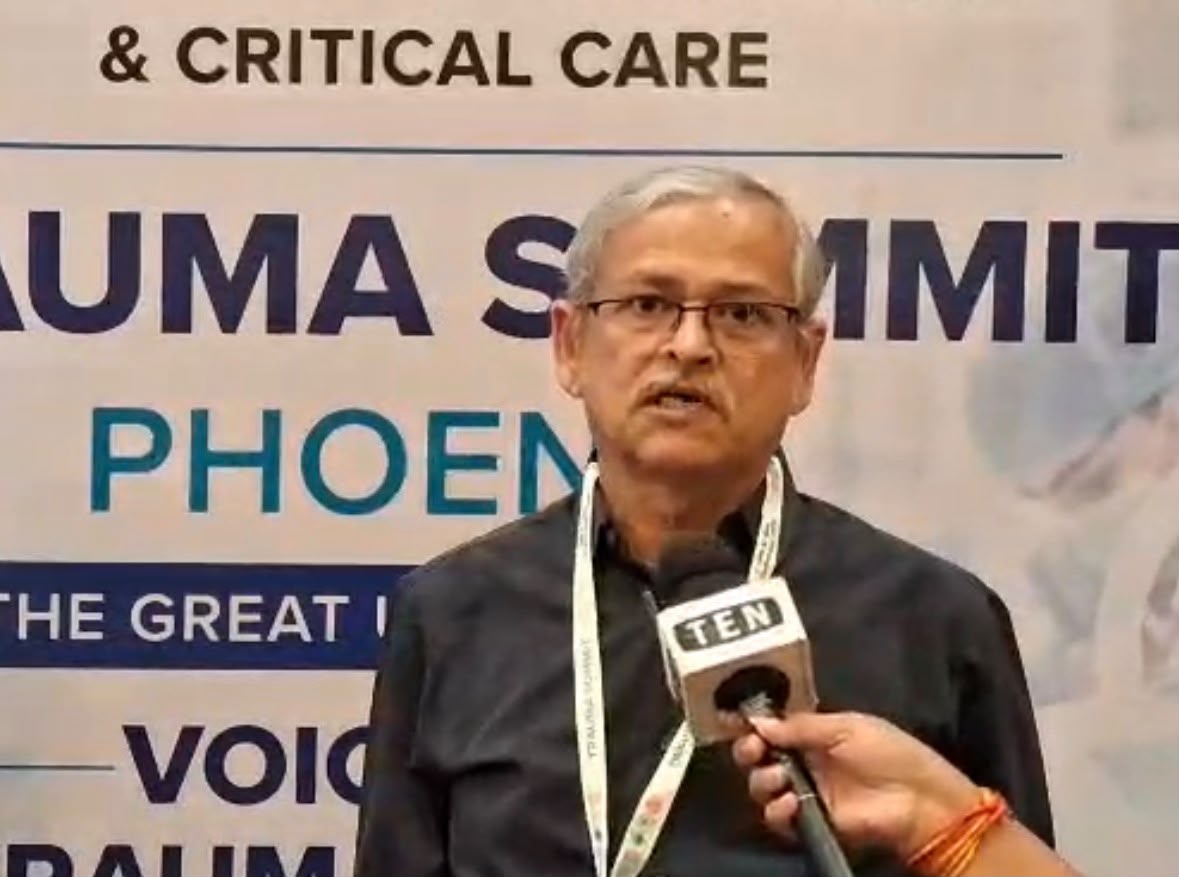
Speaking to Ten News Network, Dr. Qazi Ehsan Ali, Senior Professor in the Department of Anesthesiology and Critical Care at J.N. Medical College, Aligarh Muslim University (AMU), described the summit as a valuable and distinctive initiative with significant potential to strengthen trauma care.
Dr. Qazi Ehsan Ali said conferences of this nature are particularly important because a large number of trauma cases originate from road and highway accidents, making timely emergency intervention and coordinated trauma management crucial for patient outcomes.
He said the summit could prove beneficial not only for patients but also for medical students, teachers and healthcare professionals, by providing opportunities to share practical knowledge, discuss emerging challenges and enhance clinical preparedness.
Dr. Qazi Ehsan Ali said he has been serving at the medical college for around 30 years and has developed expertise in difficult airway management and trauma care. Alongside his academic responsibilities, he serves as Principal of the Paramedical College and Director of the Medical Attendance Scheme (MAS) at AMU.
He further said that he had been nominated by the Uttar Pradesh Government as a co-opted member of the Trauma Summit, allowing him to contribute to the initiative in both academic and administrative capacities.
AI Could Support Future Trauma Management
Discussing the scope for future editions of the summit, Dr. Qazi Ehsan Ali suggested incorporating computer-based patient assessment and Artificial Intelligence (AI) into trauma-care training and clinical discussions.
He explained that key parameters and clinical information of trauma patients could potentially be entered into computer-based systems, allowing AI tools to generate analytical results that may assist doctors in determining appropriate further management.
However, Dr. Qazi Ehsan Ali emphasized that AI should serve as an additional support tool rather than a replacement for clinical judgment. Doctors would continue to conduct comprehensive clinical assessments, while AI-based systems could provide supplementary information to support decision-making and patient management.
The summit featured a comprehensive academic programme comprising expert lectures, panel discussions, paper and poster presentations, as well as three specialized workshops: Simulation in Trauma and Emergency Procedures, POCUS in Trauma with Nerve Blocks, and Mechanical Ventilation.
The scientific sessions on September 19 focused on several critical areas of trauma management, including the golden hour of trauma care, bleeding control, airway management, brain and spinal injuries, polytrauma, and post-initial-treatment patient care. Participants were also awarded 6 UPMC Credit Points.
The programme was held under the patronage of (Brig) Dr. Rakesh Gupta, with Dr. Nazia Nazir serving as Organizing Chairperson and Dr. Samiksha Khanoja as Organizing Secretary.
Several medical experts participated in the summit, including Dr. Rohini, Dr. Sachin Maheshwari, Dr. Ashok Kumar, Dr. Atul Gupta, Dr. Hukam Singh, Dr. Leena Goel, Dr. Jitendra Agarwal, Dr. Apoorv Mittal, Dr. Arun Altiwar, Dr. Rahul Baghla, Dr. Avinash Kumar, Dr. Neetu Bhadoria, Dr. Junaid Maqbool, Dr. Anshul Jain, Dr. Shivani Katiyar, Dr. Pratibha Panjiar, Dr. Sandeep Pandey, Dr. Parul Isar, Dr. Akhilesh Gupta, Dr. Rohit Saxena, Dr. Rambha Pathak, Dr. Ranveer Tyagi, Dr. T. Prabhakar, Dr. Musharraf Hussain, Dr. Sanjeev Bhoi, Dr. L.D. Mishra, Dr. M.C. Mishra, Dr. Rakesh Garg, and Dr. Surekha.
The summit concluded with discussions aimed at advancing trauma-care practices, strengthening emergency preparedness and exploring innovative approaches—including technology-assisted clinical support—to improve the management of trauma patients.

Comments are closed.