

Come November, India’s National Capital Region (NCR) becomes shrouded in a dense, acrid blanket of smog. What was once viewed as a seasonal nuisance has evolved into an annual public health emergency and economic liability. The toxic haze forces government to come in action to resort to graded response, popularly called GRAP, hospitals to report spikes in respiratory distress, and millions of residents to breathe air containing concentrations of microscopic pollutants (PM1, PM2.5 and PM10) that routinely exceed many times the World Health Organization (WHO) safety guidelines some times to as high as 100 times or even more. The safe limit as per WHO has been reduced over the years from 20 to 5 micro grams per cubic meters.
What more this year in November as per AQI recent report, the National Capital of the world’s most vibrant democracy and the fastest growing economy has earned the title of being the most polluted capital city in the world. The AQI today, the day of Deepawali in Delhi RK Puram New Delhi and Anand Vihar, East Delhi are touching 450 and 693 respectively and it is 9:05 am on the Diwali Day. Easy to say that Diwali crackers pollute Delhi, a few hours of crackers tonight are not going to make it more dangerous than it already is for public breathing! The crisis is not seasonal, it requires a more profound understanding of its root causes and calls for effective measures all the year round, and a robust strategy to address a crisis that is crippling the people and causing colossal loss of life and also a great economic loss.
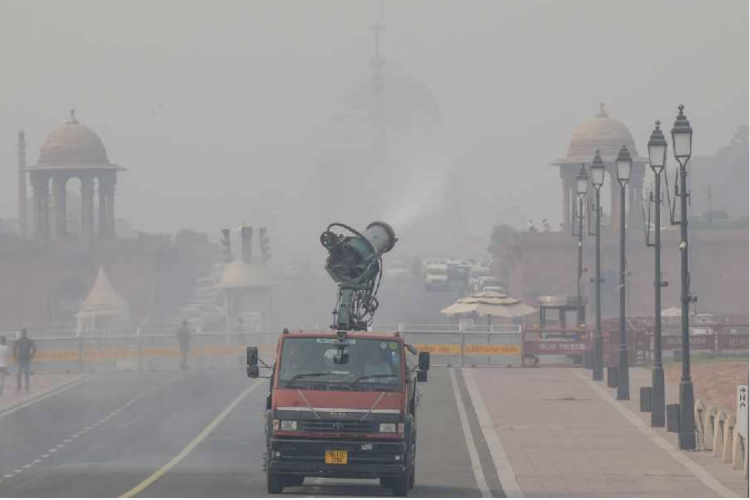
Understanding the crisis requires examining its structural causes, political complexities, health impact, and the systemic shifts needed to achieve clean air.
1. The Anatomy of a Perfect Environmental Storm
Delhi’s seasonal pollution spike is driven by a conjunction of geography, meteorology, and human activity.
- Stubble Burning: Post-monsoon, farmers in neighboring agricultural states (primarily Punjab and Haryana) clear millions of hectares of paddy fields using fire to make quick way for winter wheat planting. Depending on wind velocity, agricultural fire smoke can account for 20% to 45% of Delhi’s seasonal pollution loads.
- Vehicular and Industrial Emissions: Over 10 million registered vehicles line the capital’s roadways. Year-round vehicular exhaust, combined with emissions from brick kilns, manufacturing units, and thermal power plants across the NCR region, provides a constant baseline of high pollution.
- Dust and Waste Combustion: Fugitive dust from ongoing urban infrastructure and construction activity, combined with informal solid waste burning at landfills, supplies coarse particulate matter PM10 into the atmosphere year-round.
- Topographical Trap: As temperatures drop in late October, a meteorological phenomenon known as thermal inversion occurs. Cold, stagnant air acts as a lid, trapping toxic particles close to the ground rather than allowing them to dissipate higher up.
2. Burden of Disease Report & Health Impact
The health toll of chronic air pollution in India, and Delhi specifically, has been documented by leading public health institutions and global reports. The results reported are frightening, to say the least. Yet in seasonal GRAP measures we tend to think that we have done out duty.
- Mortality & Life Expectancy: According to assessments published in The Lancet and the Global Burden of Disease (GBD) study, air pollution is responsible for approximately 1.67 million to 1.7 million premature deaths annually in India, accounting for nearly 17.8% of all deaths in the country. Studies focusing specifically on urban centers reveal that short-term PM2.5 exposure accounts for roughly 11.5% of annual deaths in Delhi, marking the highest share among major Indian cities.
- Pathological Burden: Prolonged inhalation of PM2.5 fine particulate matter that penetrates deep into the lungs and blood stream, leads to chronic respiratory illnesses (COPD, Asthma), ischemic heart disease, stroke, lung cancer, and type 2 diabetes.
- Vulnerable Populations: Children in NCR suffer disproportionately, exhibiting reduced lung capacity, cognitive developmental delays, and higher rates of pediatric asthma, while the elderly face escalated acute cardiovascular risks.
3. Economic Cost of Air Pollution in India
Air pollution is not just a health crisis; it is a substantial drain on national and regional economic growth.
- Macroeconomic Loss (% of GDP): Data from The Lancet Countdown on Health and Climate Change estimates that PM2.5 pollution costs India up to 9.5% of its GDP annually (approx. $340 billion in lost output, healthcare expenditure, and reduced labor productivity). Alternative economic evaluations by the World Bank place the overall systemic cost at approximately 6% of GDP, not a small amount for an economy that claims to grow at 7%.
- Regional Impact on Delhi: Delhi incurs the highest per-capita economic loss due to air pollution among all Indian states and Union Territories, losing around 1.08% of its State Gross Domestic Product (SGDP) directly to lost output from premature deaths and pollution-induced illness.
- Business & Workplace Losses: Industry estimates (including studies by Dalberg and FICCI-EY) show that air pollution costs Indian businesses around $95 billion per year through employee absenteeism, reduced cognitive function, lower worker productivity, and diminished consumer footfall during peak smog months.
4. Regulatory Interventions and Limitations
Governance of Delhi’s air quality relies primarily on reactive policies managed by the Commission for Air Quality Management (CAQM):
|
Regulatory Framework |
Focus & Mechanism |
Key Limitations |
|
Graded Response Action Plan (GRAP) |
Staged emergency response triggered by rising AQI thresholds. Restricts non-essential construction, bans older diesel vehicles, ramps up road sweeping, and increases parking fees to lower traffic. |
Primarily reactive rather than preventative; relies on short-term emergency curbs rather than long-term infrastructure changes. |
|
Odd-Even Vehicle Rationing |
Restricts personal private vehicles based on license plate end-digits during peak smog phases. |
Exemptions (two-wheelers, electric vehicles, solo drivers) limit its overall reduction of net PM2.5 levels. |
|
Agricultural Subsidies |
Subsidizing In-Situ crop residue management machines (e.g., Happy Seeders, Super Seeders) for farmers. |
High operating costs for smallholders and supply-chain friction delay widespread adoption before planting deadlines. |
5. The Path Forward: From Firefighting to Air Quality Management
First and foremost, Delhi cannot treat its air crisis as an isolated local problem; it must be tackled via a holistic Air Quality Management Approach. Air pollution follows wind currents across political and municipal boundaries, necessitating unified governance spanning multiple states. It also requires that the CPCB should not remain as Central Pollution Monitoring Board, it should act with robust policies and year round action plan to justify its name as Central Pollution Control Board.
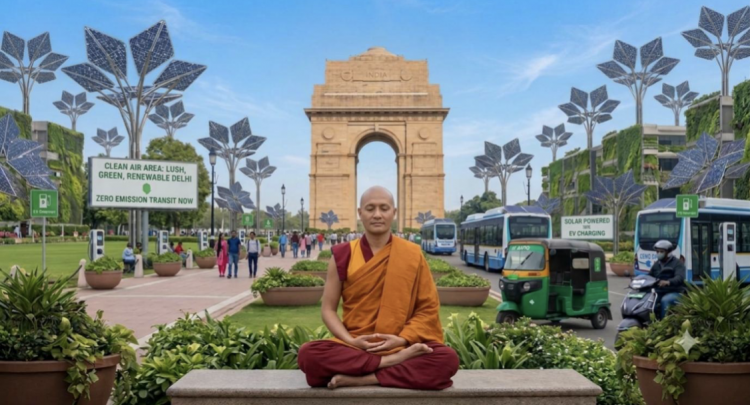
AI generated representative image of clean and green Delhi of tomorrow
Key structural reforms needed are:
- Agricultural Supply Chain Interventions: Establishing scalable commercial markets for crop stubble (converting paddy straw to Bio-Pellets, Compressed Biogas, or paper pulp and high quality Compressed plyboards and a wide variety of bio based products) to make stubble an economic asset for farmers rather than waste to be burned. Innovative startups based on Agri waste should be heavily subsidized and promoted as a national and state policy.
- Transitioning Public & Private Transport: Rapid expansion of the EV ecosystem, scaling up public bus networks, promoting green taxies and green luxury coaches for office commuters be promoted to reduce dependency on internal combustion vehicles. Solar power based EV charging stations in great numbers along the highways and within the city would do great good.
- Strict Industrial Enforcements: Ensuring 100% transition of small- and medium-scale industrial units in the NCR to clean fuels (such as PNG, CBG and CNG) alongside automated monitoring of industrial emissions. A massive public campaign to create awareness and intense urge to adopt clean fuels be also mounted.
- Year-Round Dust & Waste Management: Mandating enclosed construction technology, mechanizing road cleaning, and capping and mining legacy landfill sites to eliminate landfill fires.
- Massive Public Campaign for Pollution Control at Source: It is absolutely necessary to take both the public and industry and business houses on board to mount a decisive campaign for pollution control at source. The TVs and Social Media platforms be mandated to show small 10 second slits on air and water pollution control all the year round. After all these channels and platforms have a public responsibility as much as the government and the corporate. This could then be an SSR, Sustainability Social Responsibility of press and media.
Conclusion
Delhi’s clean air crisis is not insurmountable, but it requires shifting away from seasonal emergency fixes toward continuous, year-round enforcement, regional coordination and public awakening. Recognizing the true burden of disease and economic toll is the first step toward treating clean air not as a luxury, but as an essential prerequisite for India’s long-term health and economic development. Our pathways Viksit Bharat@2047 need a strategic realignment to ensure that we have a prosperous, happy and a healthy nation of immense pride when we celebrate the centenary of India’s independence. The tryst with destiny that we made long ago will then be redeemed wholly. Do not forget that India was a green Nation, with Air Quality as good as ‘Pran Vayu’ and the water of our holy rivers and water bodies around the country as good as the Nectar, Amrut before independence in 1947.
_____________________________________________________________________
*The author Prof PB Sharma is an eminent academician, tech innovator and institutional builder of great writ and vision, a former Professor of IIT Delhi, Founder Vice Chancellor of DTU and Past President of AIU, Currently, Vice Chancellor of Amity University Gurugram. The views expressed are personal views of the author.

Comments are closed.