

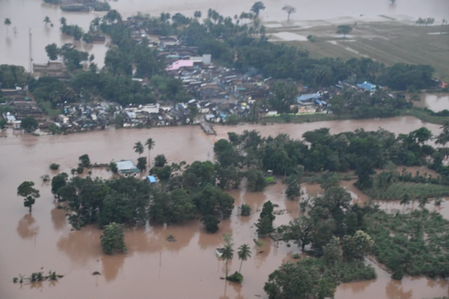
Unprecedented rainfall triggered Ganjam floods: Odisha govt
Bhubaneswar, Nov 11 (IANS) Amid opposition criticism over the devastating floods in Ganjam being described as a man-made crisis, Odisha Chief Secretary Anu Garg explained the role of unprecedented rainfall and reservoir operations in the recent flooding, stating that the rainfall was 65 per cent higher than that recorded during the 2013 Cyclone Phailin.
Responding to queries from media persons, Garg said a Central team led by a Joint Secretary, with members from the Ministry of Jal Shakti, had visited the affected areas soon after the floods.
Following its assessment, the team told state government officials at a meeting that the situation was caused by unprecedented rainfall.
She noted that while Phailin brought heavy rainfall in a single day, the recent event involved three consecutive days of rainfall. Patrapur recorded 546 mm in one day, following 89 mm on the first day and followed by 173 mm on the third day, taking the three-day total to 808 mm.
Several other rainfall stations also recorded more than 300 mm, exceeding their previous records. Addressing questions about reservoir operations, the Chief Secretary said the combined catchment area of the Rushikulya and Bahuda rivers was around 9,800 sq km, of which approximately 880 sq km, or about 10 per cent, contributed water to dams.
The remaining 90 per cent flowed directly into the rivers and could not be controlled through the dams. She said engineers followed established protocols and assessed the situation before releasing water from the reservoirs.
Releases during the event were made according to these assessments, with the release levels described as 60 to 65 per cent. Water was also being released through canals for irrigation. She said similar measures had been adopted during Cyclone Phailin.
“We have to understand that there was unprecedented rainfall. Even so, the required amount of water was released from the dams, and everything that needed to be done was done. Despite these measures, the crisis happened,” Garg said.
Emphasising dam safety, Garg said the gates were opened in phases following continuous assessments of incoming water. At Purushottampur, river discharge reached 6,907 cumecs, which she described as double the river’s carrying capacity.
She said the dam-related discharge was 746 cumecs. Garg said the administration’s primary objective was to prevent loss of life and that no casualties had occurred.
The Chief Secretary added that efforts were underway to restore essential services as quickly as possible, with power restoration targeted within three days and water supply within two days. The administration was also working to expedite relief for affected residents.
–IANS
grm/dan

Comments are closed.