

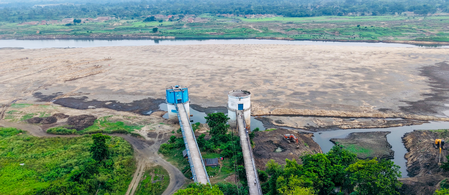
Maharashtra stares at severe water crisis as 19 Marathwada dams dry up
Mumbai, Nov 25 (IANS) The drought situation in Maharashtra is worsening by the day. With local water sources supplying villages and hamlets gradually drying up, the demand for water tankers has doubled over the past month, putting additional pressure on the already strained water supply system.
As many as 19 dams in the Marathwada region have completely dried up, triggering concerns that the water crisis could intensify further in the coming days.
Due to the impact of El Niño, a severe drought looms over the state, prompting the government to declare drought conditions in 310 talukas. With growing demands to include 13 additional talukas on the list, authorities have ordered surveys to assess the drought conditions in those areas.
Scarcity mitigation measures have already been initiated in the declared talukas as the administration takes various steps to overcome the mounting water shortage. The weekly state cabinet meeting slated for Wednesday will hold a comprehensive review of the situation and take decisions on intensifying the implementation of mitigation measures.
With local water supply schemes failing, reliance on tankers has spiked sharply. Currently, as many as 1,323 tankers are supplying water to 1,102 villages and 3,801 hamlets across 11 districts in the state, said the compilation made by the state government.
The Marathwada region accounts for the highest deployment, with 668 tankers in operation of which Beed district leads with 326 active tankers. In Nashik District, despite having a high concentration of dams, the administration has been forced to deploy 43 tankers to meet local water needs. Officials from the Water Supply Department have warned that the demand for tankers is likely to rise further in the near future.
While local water schemes are shutting down, overall water storage in the state’s dams has also dropped significantly. Total water storage across all dams in Maharashtra currently stands at 61.88 percent, a sharp decline as compared to 90.26 percent at the same time last year. As per the report by the water resources department, the water storage in the Konkan region is 79 percent, Pune Division 72.44 percent, Nashik Division 71.30 percent, Nagpur Division 54.93 percent, Amravati Division 50.53 percent and Marathwada 33.79 percent (down drastically from 90.16 percent last year).
The situation in Marathwada is particularly alarming, with major reservoirs running empty. In Dharashiv district, all dams have dried up except for the Lower Terna dam, which holds just 14 percent water. Beed faces a similar crisis; barring the Majalgaon and Dhanegaon dams—which hold a meager 14 percent to 16 percent storage — all other dams in the district are completely dry.
According to sources, the severe local deficit has forced the administration to bring in water-filled tankers from neighbouring districts to supply the affected areas.
Earlier, citing erratic rainfall, prolonged dry spells, declining groundwater levels, and depleting water storage across parts of the state, the Maharashtra Planning Department has issued a Government Resolution (GR) laying down guidelines for fund allocation, work prioritisation, and temporary suspension of non-essential water-intensive new construction works in scarcity-affected regions under the District Annual Plan (General) for the 2026–27 financial year.
The government has resorted to this move to conserve water amid worsening drought conditions across Maharashtra. The state’s Planning Department headed by Chief Minister Devendra Fadnavis has also asked local authorities to redirect all resources toward ensuring uninterrupted drinking water supply in drought-declared talukas.
District Planning Committees (DPCs), led by District Collectors as member secretaries, have been directed to prioritise works that deliver direct water access to citizens and livestock within the scarcity period.
Priority categories include completing incomplete pipelines, pumps, connections, tanks, and distribution systems; repairing post-defect-liability water supply assets to curb leakage; linking water sources to scarcity-hit works; finishing nearly complete works facing minor fund shortfalls; and executing ongoing water supply schemes in the 310 drought-hit talukas.
Works such as Water Treatment Plants (WTPs), Sewage Treatment Plants (STPs), solar projects, and solid waste management in municipal councils/nagar panchayats slated for completion before March 31, 2027, along with fodder and water measures for livestock, public health, and essential livelihood works, are also eligible under the prioritised framework.
— IANS
sj/srk/mr

Comments are closed.