
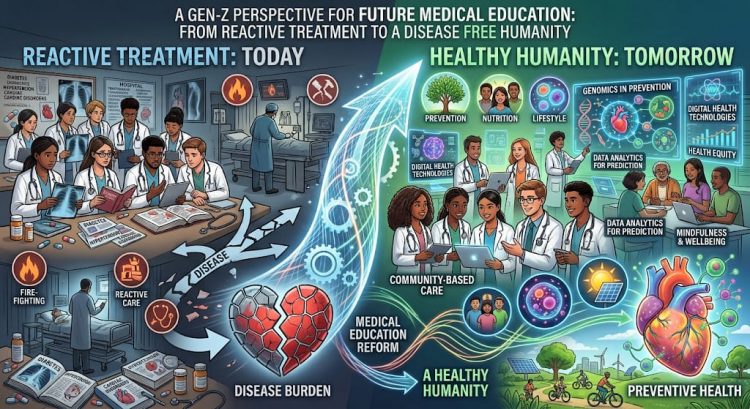
A Gen-Z Perspective for Future Medical Education: From Reactive Treatment to a Disease-Free Healthy Humanity
Authored by: Sanskrit Sharma
Modern medical education stands at a crucial turning point today. While the twentieth century achieved extraordinary victories over many acute infectious diseases through sanitation, vaccines, and antibiotics, the twenty-first century presents a fundamentally different challenge. Today, healthcare systems worldwide are overwhelmed by chronic non-communicable diseases, the infamous ones being diabetes, cardiovascular disorders, hypertension, and autoimmune conditions. This in turn is compounded by environmental stressors and widening health disparities, together creating enormous burden of disease for the global humanity.
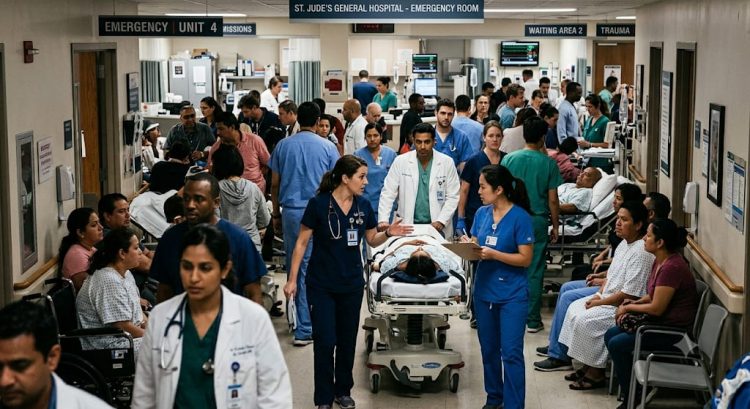
For decades, medical training and clinical practice have operated largely on a reactive model. Clinicians are trained to intervene downstream, once the disease has manifested and incubated, diagnosing and managing chronic illness through lifelong pharmacotherapy or tertiary interventions. Yet, when treatment begins only after irreversible tissue damage has occurred, medicine functions primarily as damage control. If we hope to reduce the global burden of disease rather than merely manage its consequences, reform must begin at the root: within the lecture halls, laboratories, and clinical rotations of medical education. This calls for a thorough reimagining of medical education for tomorrow to combat the burden of disease and to create a healthy humanity.
In the opinion of the author to build a healthcare system capable of addressing modern realities, medical education must undergo a deliberate reorientation towards one that broadens its focus from pure pathogenesis to empowering people to make necessary amends to their lifestyles and food habits on one hand and investment by the government and the civic societies in moping out enormous air and water pollution, implement robust framework of laws for prevention of food adulteration. Such initiatives require both the public as well as the government and corporate to work together for wellbeing and the larger collective good of humanity. The medical education for tomorrow need to accordingly align its curriculum design and delivery systems, clinical practices in a manner that assimilate advances in biomedical engineering, life sciences and the integration of AI in both education as well as clinical practices.
Gen-Z Perspective of Medical Education in AI Age
For students entering the medical sciences today, this shift feels natural. Having grown up through a pandemic, visible climate concerns, and wider discussions around mental well-being, our generation tends to view healthcare more holistically.
Instead of seeing healthcare solely as hospital-based crisis management, more and more students belonging to Gen-Z are paying attention to public health, environmental factors, and long-term prevention. Being highly conscious about their responsibility towards maintaining high commitment to sustainability and net zero emission technologies and green and healthy environment, the Gen-Z is knowingly highly conscious of their personal health and hygiene of their surroundings. As such their general outlook for healthcare is shifting away from simply treating sickness after it develops to taking guards through preventive measures and amends to lifestyle and food habits.
The traditional medical curriculum, inherited from early twentieth-century reforms that codified the laboratory sciences, places overwhelming emphasis on advanced pathology and pharmacology. While a deep mastery of disease mechanisms is of course non-negotiable, preventive medicine comparatively has historically been treated as a secondary approach, merely an elective subject rather than an intellectual cornerstone. This has resulted in making healthcare heavily loaded towards treatment of diseases. The result is obvious, healthcare is more towards hospitals rather than proactively preventing the occurrence of diseases by working with the people as partners in creating a healthy humanity.
The renowned medical sociologist Aaron Antonovsky coined the term salutogenesis to describe an approach focused on the factors that actively create and sustain human health, rather than merely those that cause disease (pathogenesis). Preparing tomorrow’s physicians requires elevating preventive disciplines to the same level of scientific rigor traditionally reserved for acute therapeutics. Lifestyle interventions should be evaluated, taught, and prescribed with the same diagnostic discipline and precision as pharmaceuticals.
Human Health and Environmental Health Interface
We must also understand that human health cannot be separated from the surrounding environment. Rising ambient temperatures through global warming, air pollution, microplastics, and similar factors directly influence our health, causing diseases ranging from asthma, even pediatric asthma to renal afflictions. Clinicians must understand these environmental determinants as direct physiological risk factors and advise patients accordingly. Rather than waiting for patients to cross arbitrary diagnostic thresholds, future doctors should be trained in early phenotypic screening and biomarker identification, learning to intervene during the subclinical stages of chronic illness. The physicians and their medical academies should do a whole lot of advocacy and engage with the government and the society to create a more profound understanding of the interface between human health and environmental health.
Cultivating Technological Literacy and Clinical Acumen
The arrival of artificial intelligence, high-throughput multi-omics, and continuous physiological telemetry offers unprecedented diagnostic capabilities. However, integrating technology into clinical medicine carries a distinct risk: intellectual overreliance and the erosion of foundational diagnostic reasoning that forms the core of medicine. Medical education must ensure that technological tools sharpen, rather than replace, clinical acumen.Even as machine learning and clinical decision-support systems become standard practice, medical students must understand their statistical foundations, limitations, and potential biases. Future physicians must serve as discerning critics, not blind followers, of computational outputs, recognizing that predictive models do not replace biological plausibility or individual clinical evaluation.
Remote wearable sensors now track glycemic trends, cardiac rhythms, and blood pressure in real time. Training students to interpret these continuous data streams will help chronic disease management transition from brief, sporadic clinic appointments to ongoing, preemptive care. In coming years these wearable medical devices shall be your doctor on your wrist able to mentor you for keeping fit and healthy both mentally as well as physically with sound immunity to viruses and diseases.
Reaffirming the Social Context of Medicine
In the mid-nineteenth century, the physician Rudolf Virchow remarked that “medicine is a social science, and politics is nothing else but medicine on a large scale.” Decades of epidemiological data continue to reinforce this observation: the majority of health outcomes are governed not by clinical interventions alone, but by key social determinants such as nutritional and food security, socioeconomic stability, housing, and education.
Confining clinical training almost exclusively to specialized referral centers can leave students with a detached view of why patients fall ill and why they struggle to follow medical advice. Students may be introduced to primary health centers, rural clinics, and community dispensaries for some designated periods early in their training, as understanding the physical and economic conditions of a patient’s everyday life provides vital context that cannot be acquired in an intensive care unit.
Clinical practice should not operate in a vacuum. Grounding students in epidemiology, health policy, and the economics of healthcare prepares them to advocate for systemic reforms that prevent illness on a broader scale.Effective care requires understanding how personal beliefs, educational backgrounds, and language barriers shape health literacy. Clinicians must know how to communicate complex medical concepts clearly and build genuine trust across diverse patient populations.
Also, as biomedical science expands into new, exciting areas like gene therapies, artificial intelligence, and sophisticated life-prolonging technologies, the ethical responsibilities resting upon physicians become greater than ever. Technical competence without humanistic grounding leaves clinical practice hollow. Ethics training must move beyond rote legal compliance. Students should engage in rigorous discussions on patient autonomy, equitable resource distribution, technological paternalism, and the compassionate management of end-of-life care.
No diagnostic test or algorithmic recommendation can substitute for a careful patient history and a thorough physical examination. The Oslerian tradition of attentive, empathetic listening remains one of the most powerful diagnostic and therapeutic instruments a clinician possesses, and the same should be integrated into the physicians.
Genuine competence in medicine is defined not by rigid certainty, as that is often unrealistic, but by a commitment to critical inquiry and self-correction. Medical training must cultivate the habit of continuous learning, adaptability to new technology and assimilation of new and advanced knowledge of life sciences and drug discovery ensuring that graduates remain active, thoughtful scholars throughout their careers.
Conclusion
The health of a society ultimately mirrors the priorities instilled in its healers. If medical training continues to focus almost exclusively on downstream rescue, and pathogenic responses, our healthcare systems will remain overburdened by preventable illness and unsustainable costs for treating them.
By balancing advanced medical technology with primary prevention, anchoring clinical science in community realities, and preserving the human connection at the base level of ethics, morality and learning, we can prepare a generation of physicians that are well-equipped for the demands of the 21st century. In doing so, medicine can fulfill its most meaningful purpose: not merely treating disease after it appears but safeguarding the vitality and well-being of the society it serves to heal.
As a student preparing to enter medical education, my hope is to join a system that looks upstream. I hope to be trained not just in bedside diagnosis and new computational tools, but also in measures for preventive care and community health. By balancing clinical science with early prevention and genuine human connection, medical training can do what it was meant to do: not just manage disease after it appears but help build a healthier society.
The days ahead for medical education are bright, but our success will defend upon how seriously the regulatory bodies like National Medical Commission in India mobilise their reformist instinct to cause a major reform in curriculum and its forward looking approach to mitigate threats of diseases and viruses and protect humanity from the agonies of pendomics and deadly diseases.
_________________________________
The Author Sanskrit Sharma is medical education aspirant, currently 12th grade student with Amity International School.

Comments are closed.