
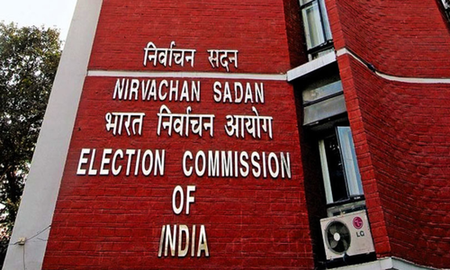
Bengal Assembly elections: Electoral officers to be under ECI surveillance on polling days

Kolkata, March 17 (IANS) The roles of electoral officers at all levels will be under layer-wise surveillance on the polling days this time for the two-phase West Bengal Assembly elections scheduled next month.
“The Chief Election Commissioner, Gyanesh Kumar, in his press conference on Sunday, had assured that elections in West Bengal would be violence-free and peaceful. In pursuance of this objective, ECI this time had decided to keep the roles of electoral officers at all levels under constant and layer-wise surveillance, especially on the two polling days of April 23 and April 29,” said an insider from the office of the Chief Electoral Officer (CEO), West Bengal.
The CEO’s office explained that surveillance will start with control-room-based surveillance and have two levels.
A district-level control room will be there at the office of the District Magistrate (DM), who is also the District Electoral Officer(DEO), in each district, from where surveillance will be maintained at the booth-level and polling-station levels, to check whether the returning and polling officers are performing their duties as per the guidelines of the ECI or not.
In the second level, there will be an integrated control room at the CEO’s office in Kolkata, from where it will be monitored whether those electoral officers from the DEOs are being prompt in addressing complaints received both from common people and political parties about poll practices at the booth, polling station, and area levels.
At the same time, a parallel system of surveillance will continue on two polling days. “While Assembly constituency- specific observers to be appointed for each of the 294 Assembly constituencies will constantly supervise the polling process at the polling booths and the polling station level, the two district-specific central observers will keep an overall surveillance in the district concerned from the control room at the DEO’s office concerned,” the CEO’s office insiders.
On this second line of surveillance, the highest level of monitoring will be done by the ECI-appointed central observer and his team.
“As regards movement of the security personnel, both Central Armed Police Forces (CAPF) as well as the state forces, the process will be monitored and operated at the district levels by district-specific composite teams, to evaluate the pocket-specific requirement for CAPF deployment, and the decisions of the police observers in the matter will be final,” the CEO’s office insider said.
To ensure the best possible utilisation of the central security forces for the forthcoming Assembly polls, the Election Commission of India (ECI) has decided to strip the district administration of the authority to determine the CAPF movement, starting from the enforcement of the model code of conduct till the time it ends.
Until the last elections, District Magistrates, including District Electoral Officers, were authorised to determine the movement of the CAPF before, during, or after the polls while the model code of conduct was in force.
However, this time, the top poll body decided that the ECI-nominated police observers for the polls will determine the CAPF movements for the respective districts. The decision on this count had been conveyed to the office of the Chief Electoral Officer (CEO), West Bengal, during the two-day review tour of ECI’s full bench last week, said an insider from the CEO’s office.
In the first phase of polls on April 23, there will be polling for 152 Assembly constituencies, while in the second phase on April 29, there will be polling for 142 Assembly constituencies. As per calculations made by the ECI as of now, not less than 2,300 companies of CAPF will be deployed in each phase”.
–IANS
src/dpb

Comments are closed.