

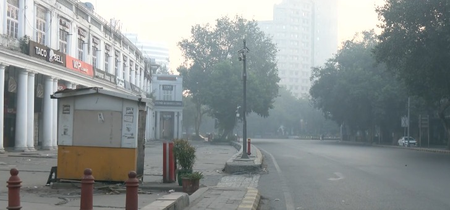
Delhi’s air quality drops to poor category with AQI at 289
New Delhi, Nov 19 (IANS) The air quality in Delhi deteriorated further on Thursday morning, with the Air Quality Index (AQI) rising from 212 to 289 at 8:30 a.m., placing it in the ‘poor’ category, according to the Central Pollution Control Board (CPCB).
A thick layer of smog engulfed several parts of the national capital, significantly reducing visibility during the early morning hours. Along with smog and fog, residents also experienced chilly weather conditions.
Several monitoring stations across Delhi recorded AQI levels in the ‘poor’ and ‘very poor’ categories. These included Burari (298), Karala (286), Ghoga (270), Nangloi (280), Jharoda Kalan (280), Chhawla (320), NIH Narela (297), Talkatora Garden (344), NSUT Jaffarpur (358), Aya Nagar (325), CRRI Mathura Road (347), Sirifort (363), Commonwealth Sports Complex (350), JNU (367), Burari Crossing (320), ITO (356), Anand Vihar (256), DTU (344), Mundka (325), Rohini (295), Jahangirpuri (319) and Nehru Nagar (311).
Meanwhile, neighbouring areas of the national capital also recorded AQI levels in the ‘poor’ category. According to CPCB data, Gurugram recorded an AQI of 271, Faridabad 207 and Noida 237.
On Wednesday, Delhi recorded an average AQI of 232, also in the ‘poor’ category. The national capital had witnessed its cleanest air of the month on Tuesday, when the AQI stood at 204, the lowest since October 31, when it was recorded at 117 in the ‘moderate’ category.
Of the 58 air quality monitoring stations that recorded data on Wednesday, 33 reported ‘poor’ air quality, 20 had ‘moderate’ levels, and five fell in the ‘very poor’ category. Uttam Nagar recorded the worst air quality, with an AQI of 385, according to official data.
As per CPCB classifications, an AQI between zero and 50 is considered ‘good’, 51 and 100 ‘satisfactory’, 101 and 200 ‘moderate’, 201 and 300 ‘poor’, 301 and 400 ‘very poor’, and 401 and 500 ‘severe’.
On Wednesday, the Air Quality Early Warning System cautioned that unfavourable meteorological conditions over the next two days could hamper the dispersion of pollutants, potentially worsening the situation.
On Tuesday, the Commission for Air Quality Management (CAQM) lifted Stage III restrictions under the Graded Response Action Plan (GRAP) in the national capital following a decline in pollution levels.
Delhi’s air quality had deteriorated significantly with the onset of winter, which worsened further after Diwali celebrations and increasing stubble burning cases in the neighbouring states, particularly in Punjab. However, pollution levels had shown a gradual improvement over the preceding week.
Authorities had imposed GRAP Stage III restrictions across the National Capital Region on November 6 after the AQI entered the ‘severe’ category. Stage I restrictions had come into effect on October 21, followed by Stage II on November 2.
–IANS
jk/dpb

Comments are closed.