
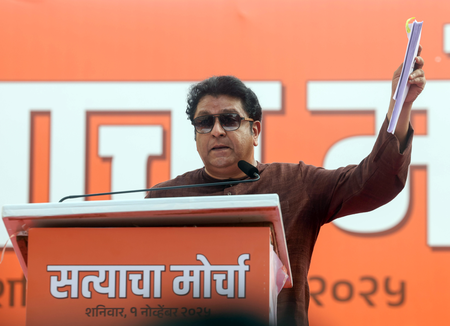
Development sans environment protection is hollow, throwing lives into chaos: Raj Thackeray targets Maha govt, Centre

Mumbai, June 5 (IANS) Marking World Environment Day, Maharashtra Navnirman Sena (MNS) chief, Raj Thackeray, on Friday delivered a blistering critique of the state and central governments, labelling the current trajectory of urban expansion and tree-plantation drives as superficial and a “race to claim political credit.”
Recalling the vision document he launched over a decade ago, Thackeray remarked, “Back in 2014, when I presented the ‘Blueprint of Maharashtra’s Development’, I included a short film emphasising that if development is not coupled with an appreciation for aesthetics and a consideration for the environment, it remains merely superficial and hollow. Today, we are witnessing the tangible proof of this reality.”
Thackeray in his post on X heavily criticised the political obsession with mega-infrastructure projects that crumble under initial seasonal stress.
He highlighted that despite competitive chest-thumping over newly-built roads and bridges, a single spell of rain—even before the heavy monsoons establish—regularly throws major cities into absolute chaos.
The MNS chief pointed out an unliveable seasonal reality that now traps citizens for eight months of the year.
“Urban areas see cars floating on waterlogged streets while rural districts watch their entire agricultural yield get washed away. Scorching temperatures have made life unbearable,” he said.
Thackeray referenced recent reports noting that agricultural labourers no longer dare to work in the fields past 10:00 A.M.
Mocking the administration’s fascination with “big numbers” and economic rankings, Thackeray claimed that the environmental degradation is actively cannibalizing India’s economic growth.
Shifting focus to policy decisions at the federal level, Thackeray claimed that the Centre has systematically dismantled environmental safeguards over its 11-year tenure. He pointed out that approximately 1,730 square kilometres of pristine forest land have been diverted for mining and infrastructure projects.
To illustrate the sheer scale of the 1,730 square kilometer loss, Thackeray used a localised comparison to Mumbai’s primary ecological lung.
“Mumbai’s own Sanjay Gandhi National Park (SGNP) covers an area of 104 square kilometres—an ecosystem upon which the very future of Mumbai depends. The loss of 1,730 square kilometres of forest land is equivalent to the destruction of approximately 16 Sanjay Gandhi National Parks,” he remarked.
Addressing the younger generation, Thackeray acknowledged the growing epidemic of loneliness and depression that drives youth to spend entire days scrolling through social media. However, he refused to blame them, citing that local urban environments have been completely stripped of beauty.
“We lack parks; urban trees have been felled on a massive scale; our hillsides have been hollowed out; and we ourselves have polluted our rivers,” he noted.
He issued an earnest appeal to the youth of Maharashtra, calling on them to stop being swayed by deceptive imagery and false data. Instead, he urged them to actively demand that the beautiful cities and preserved natural landscapes they admire on social media be replicated right here at home.
“Hold the system accountable for this,” he warned. “If you fail to do this, it is certain that your lives will be reduced to a mere existence no different from that of bugs.”
Thackeray concluded by questioning how a historically nature-worshipping society transformed into one that destroys it. He pointed out that the sacred groves in the Konkan region have survived purely because they were fiercely guarded by local traditions of nature reverence.
He emphasised that discussing the environment must no longer be viewed as the exclusive domain of a handful of hobbyists or nature enthusiasts. It has now evolved into an immediate, overarching threat to public health, regional agriculture, and the survival of our cities.
“What kind of Maharashtra are we preparing to hand down?” Thackeray asked. “A state of tree-devoid concrete jungles, rivers reduced to open sewers, or lush, beautiful, liveable habitations? We must begin to ponder this today if we want to truly say this day was celebrated,” he said.
–IANS
sj/rad

Comments are closed.