

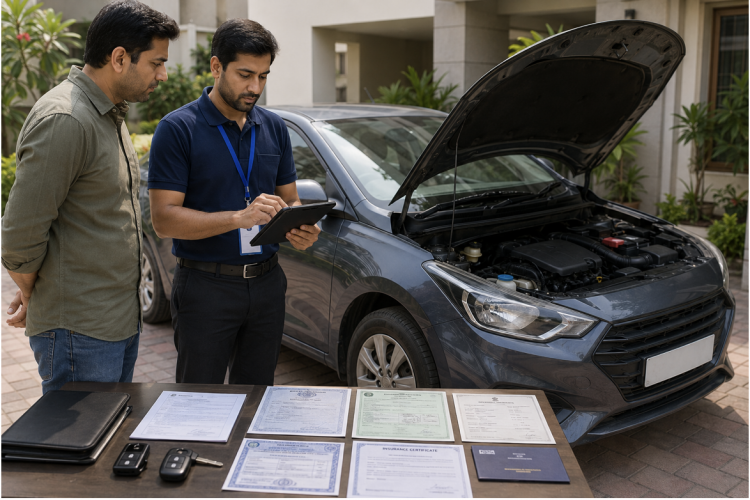
Doorstep Car Inspection: What Sellers Should Prepare Before the Evaluator Arrives
The doorstep inspection model in used car selling is often understood purely as a convenience. Instead of driving to a dealer’s location or a branch, someone comes to you. This is a genuine benefit, particularly for sellers who are busy professionals, families without a second car to use during the inspection, or apartment residents who cannot easily move a car to a distant location.
But the doorstep inspection is more than a convenience feature. It is a data collection exercise that determines the final offer price. A trained evaluator arrives at your home, assesses the car’s condition across its physical and mechanical parameters, verifies the documentation, and uploads the findings into the system. This assessment directly informs the Cars24 AI valuation and the subsequent dealer auction price.
Sellers who understand what gets checked, and who prepare accordingly, position themselves to receive the most accurate offer for their car. Sellers who are unprepared discover post-inspection that conditions they could have resolved before the evaluation affected their final price. Preparation does not mean hiding problems. It means presenting the car’s genuine best condition and having all documentation ready so the evaluator can work efficiently.
Documents to Have Ready Before the Evaluator Arrives
Document verification is a core part of the inspection process, and document issues create holdbacks that affect the net payment the seller receives. Having every required document ready before the evaluator arrives prevents delays and ensures the transaction can proceed on the day of inspection without outstanding items.
The original Registration Certificate is the foundational document. It must be the original, not a photocopy. If the original RC has been lost and a duplicate obtained from the RTO, have the duplicate RC ready. Note that a duplicate RC creates an additional verification step in the transfer process.
If the car was purchased on finance and the loan has been repaid, the bank’s No Objection Certificate must accompany the RC. Equally important is the hypothecation removal annotation on the RC itself. Many sellers have received the NOC from the bank but have not yet submitted Form 35 to the RTO for the hypothecation removal. If the RC still shows the bank’s hypothecation even though the loan is paid, this will trigger a holdback until the removal is processed. It is significantly better to resolve this before the inspection rather than after.
The insurance certificate should be current and valid at the time of inspection. If the policy is expiring within the next few weeks, consider whether renewing it before the inspection is practical, as lapsed insurance at the time of handover creates a holdback. The Pollution Under Control certificate must also be current.
Service history records are not mandatory documentation but they are valuable at the inspection stage. A complete set of service records showing regular maintenance at authorised workshops demonstrates the car’s maintenance quality and can result in a higher final offer because it reduces the dealer’s uncertainty about the car’s history.
How the Evaluator Assesses the Car and What Affects the Offer
The evaluator follows a structured assessment methodology. Understanding what they are checking helps sellers present the car accurately and avoid misunderstandings about why specific findings affect the offer.
Body panel condition is assessed using a paint depth gauge, which measures the thickness of the paint coat on each panel. Panels that have been repainted register differently from original factory paint, and the evaluator will document any panel that shows evidence of repainting. This is not about cosmetic appearance alone. Repainting often indicates a previous repair, which is relevant information for the dealer network bidding on the car.
The evaluator checks the exterior for visible dents, scratches, and glass condition. They look at panel gaps for consistency. They check door, bonnet, and boot alignment. Significant findings in any of these areas are documented in the inspection report, which is then visible to bidders in the auction. The offer from the auction reflects what dealers are willing to pay knowing about these conditions.
The mechanical assessment covers engine start quality, idle behaviour, transmission engagement, steering play, brake feel, and AC cooling efficiency. The evaluator checks under the bonnet for fluid levels and quality indicators. Tyre tread depth is measured at multiple points on each tyre. Battery health may be checked using a load test tool.
The interior assessment covers seat condition, dashboard, infotainment functionality, all switches and windows, and central locking. Any non-functional electrical item is noted.
The final offer from the auction reflects the car’s actual condition as documented in the inspection. A car that presents well on all these dimensions will attract confident bidding. A car with documented deficiencies will still be bid on, but the bids will incorporate the cost of bringing the car to the standard required for resale.
Whether Washing and Cleaning the Car Affects the Valuation
A clean car makes a better first impression on any evaluator, but the question of whether cleaning affects the final valuation deserves a direct answer.
Cleaning the exterior removes surface dirt that might obscure minor scratches or paint imperfections, which means a thorough clean can actually make the car’s actual condition more visible to the evaluator rather than less. A paint depth gauge reading is not affected by whether the car is clean. Neither is a tyre tread depth measurement or a mechanical diagnosis.
What a clean car does is allow the evaluator to conduct their assessment efficiently and without ambiguity. An extremely dirty car may have conditions that are difficult to assess accurately because of surface contamination. A clean car presents its actual condition clearly, which allows the evaluation to be completed without re-checks.
For the interior, cleaning is somewhat more relevant. An interior that has been thoroughly cleaned presents more accurately for condition assessment. Old food debris, surface stains, and strong odours affect the perceived condition of the interior and can affect dealer interest. A clean interior is not a misrepresentation of condition. It is simply presenting the car’s actual interior in its best accurate state.
What does not change the evaluation is concealing mechanical problems through cleaning. Engine bays that have been pressure-washed to remove oil evidence, for example, do not fool an experienced evaluator who checks for fresh oil accumulation after the engine is run. The inspection is structured precisely to identify conditions that cannot be hidden by surface cleaning.
Why Transparency During Inspection Prevents Post-Inspection Offer Changes
The most disruptive outcome of any inspection is discovering information after the initial offer that significantly changes the final price. For sellers, this creates the uncomfortable experience of having planned for one amount and receiving a different one at the point of transaction.
This outcome can often be prevented by transparency at the inspection stage. If the seller knows about a specific condition, disclose it proactively. An evaluator who is told about a previously repaired panel before they start the assessment will document it and factor it into the initial inspection report, which then informs the auction price. An evaluator who discovers it without prior disclosure creates the same documentation, but the seller may feel the finding came as a negative surprise rather than a known condition that was always in the price.
The AI estimate that the platform provides before the physical inspection is based on declared information. If the declared information does not match the physical condition of the car, the difference between the initial estimate and the final auction price reflects that gap. Sellers who declare their car’s condition accurately before the inspection receive an initial estimate that more closely tracks the final offer.
What Happens After the Inspection Is Completed
Once the evaluator completes the assessment and uploads the findings, the car is listed on Cars24’s live dealer auction platform. The entire inspection data becomes visible to the network of over 20,000 verified dealers across India who then bid competitively for the vehicle.
The auction typically happens on the same day as the inspection. The seller receives the highest bid from the auction and is presented with the final offer. At this point, the seller’s Relationship Associate walks through any applicable charges or holdbacks, explains the net payment amount, and confirms the transaction details.
If the seller accepts the offer, payment is processed and transferred directly to the seller’s bank account. The entire process from inspection to payment can be completed within 24 hours. Once the payment is confirmed, the car is scheduled for pickup from the seller’s location.
After the car is picked up, Seller Kavach activates and remains in effect until the RC transfer is officially completed. The seller retains no ongoing responsibility for the vehicle from the point of handover. This clean closure, where the seller can confirm both that payment has been received and that post-sale liability has been covered, is what distinguishes a structured platform transaction from the open-ended exposure of an informal sale.

Comments are closed.