

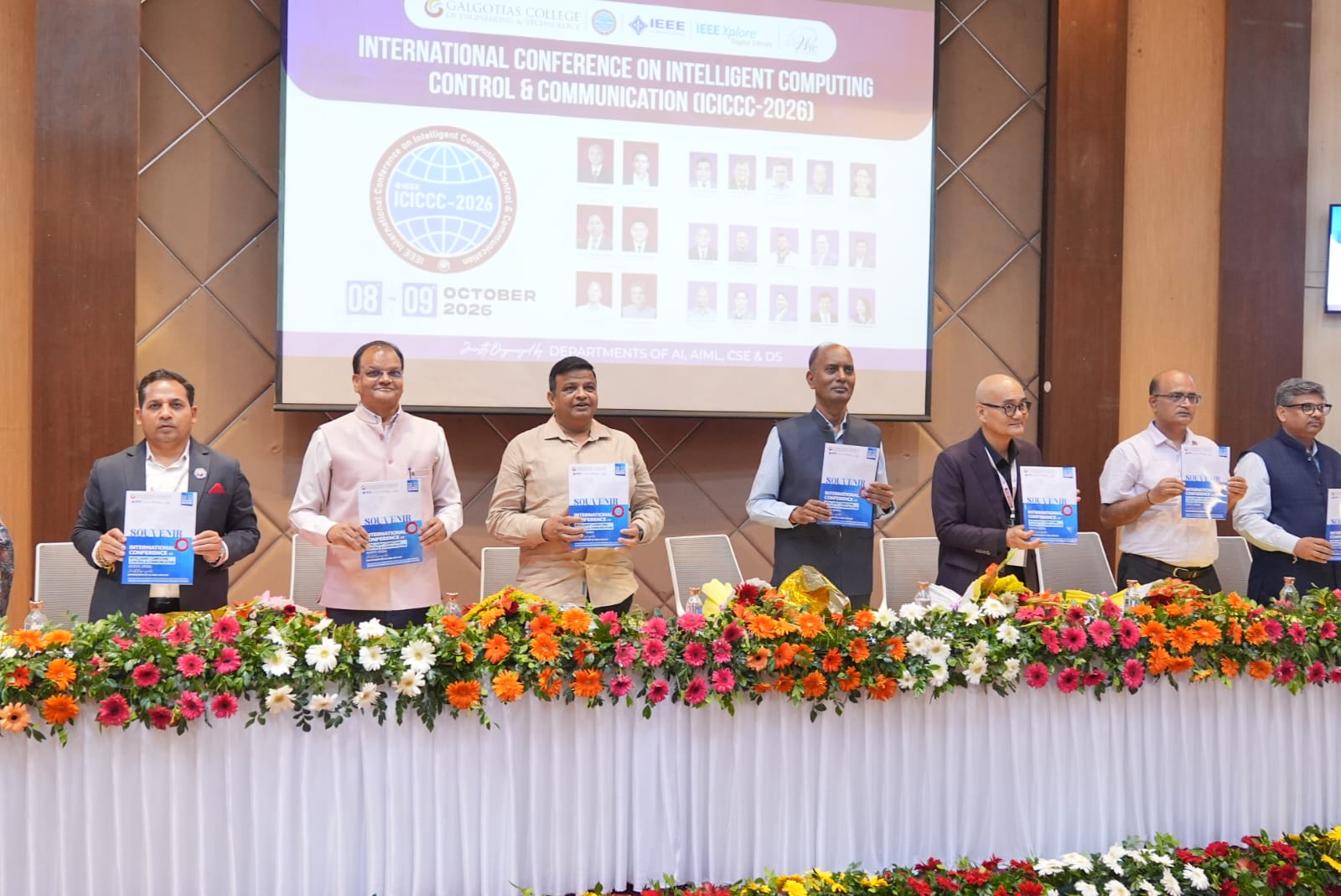
GCET Emerges as Global Research Hub, Attracts 1,433 Submissions for IEEE ICICCC Conference
Greater Noida, 27 October 2026: Researchers from six countries submitted 1,433 papers to the IEEE International Conference on Intelligent Computing, Control and Communication (ICICCC-2026), hosted by Galgotias College of Engineering and Technology (GCET), Greater Noida, on 8 and 9 October 2026. Peer reviewers accepted 332 of them, fewer than one in four.
Beyond the strong response from across India, 25 papers came from researchers in the United States (15), Nigeria (4), Malaysia (3), the United Kingdom (2) and Ethiopia (1), with the United States the largest source of international submissions. The spread across North America, Europe, Africa and Southeast Asia places GCET on the map of institutions that researchers outside India now consider a credible venue for their work.
The accepted papers focused on the meeting point of artificial intelligence with control systems and communication technologies, an area that underpins applications from smart grids and autonomous systems to next-generation wireless networks. Machine learning and intelligent computing featured across the technical sessions, keynote addresses and expert talks.
The conference was organised jointly by four GCET departments, Artificial Intelligence, AI and Machine Learning, Computer Science and Engineering, and Data Science. Running it as a single cross-departmental effort allowed the programme to connect core computing research with its engineering applications, rather than treating them as separate fields.
Senior academics and scientists from the Atal Bihari Vajpayee Indian Institute of Information Technology and Management (ABV-IIITM), Gwalior, the Motilal Nehru National Institute of Technology (MNNIT) Allahabad, Prayagraj, the Indira Gandhi Delhi Technical University for Women (IGDTUW), Delhi, the Defence Research and Development Organisation (DRDO) and American University, Vietnam, took part, giving GCET faculty and student researchers direct engagement with leading national institutions and India’s principal defence research body.
Dr Dhruv Galgotia, Chief Executive Officer, Galgotias Educational Institutions, said, “The most useful work in AI today sits where computing meets physical systems, in power grids, autonomous vehicles, wireless networks and industrial control. That is exactly the space this conference covered, and it is where we want GCET’s research to concentrate. The next step for our departments is to turn the contacts made here into co-authored papers and joint projects with the institutions that took part.”
For GCET’s own faculty and student researchers, the conference offered a direct benchmark against submissions from established institutions in India and abroad, and a route to building the research partnerships that the institution’s AI and computing departments are now pursuing.

Comments are closed.