

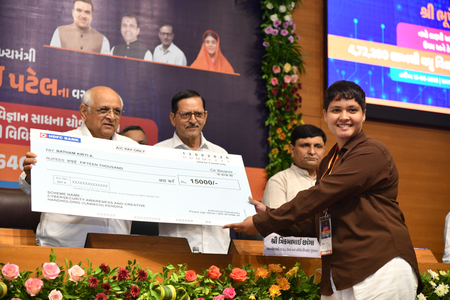
Gujarat CM disburses Rs 646 crore in scholarships to over 4.72 lakh students
Gandhinagar, Aug 12 (IANS) Gujarat Chief Minister Bhupendra Patel on Wednesday distributed more than Rs 646 crore in scholarships and other educational assistance to over 4.72 lakh students, with the bulk of the amount going to girls who cleared their Class 10 and Class 12 board examinations under the ‘Namo Lakshmi’ scheme.
At a programme held at Swarnim Sankul in Gandhinagar, financial assistance was transferred directly to beneficiaries through Direct Benefit Transfer (DBT). The government said more than 4,72,260 students received the assistance.
Under Namo Lakshmi, more than 4 lakh girls who passed the Class 10 and Class 12 board examinations received over Rs 513 crore.
A further Rs 28 crore was distributed to more than 57,000 students who passed the Class 12 science-stream examination under the ‘Namo Saraswati Vigyan Sadhana’ scheme.
The state Education Department’s scholarship information also records Namo Lakshmi as a major financial-support scheme for girls’ education.
Another Rs 105 crore was distributed under various scholarship and higher-education support schemes.
Of this, Rs 96 crore went to 7,260 students under schemes including the Mukhyamantri Yuva Swavalamban Yojana, Scheme of Developing High Quality Research (SHODH), Mukhyamantri Shri Scholarship Yojana and Mukhyamantri Kanya Kelavani Nidhi Yojana.
A further Rs 9 crore was provided as grants to 48 institutions. Patel said Prime Minister Narendra Modi had laid a strong foundation for education and thereby established the basis for Gujarat’s development.
“The state government’s focus on education, health and security had helped advance the Prime Minister’s vision of promoting girls’ education,” he said.
Highlighting the Namo Lakshmi and Namo Saraswati schemes, Patel said they had produced good results, particularly in encouraging girls to pursue science. He also called for greater cooperation between teachers and society to improve educational outcomes.
“The changes that have taken place among children with the times, and the increase in their spirit of curiosity, make it equally necessary for the teaching community to develop greater preparedness,” Patel said.
The government would continue to stand with teachers, he said, but society too needed to “stand shoulder-to-shoulder” with them to achieve better results.
The Chief Minister noted that the government had also launched a campaign to identify children who had discontinued their schooling and facilitate their re-enrolment.
He urged greater coordination between students and the education system to achieve further progress in the sector.
Education Minister Pradyuman Vaja, recalling Swami Vivekananda, said, “Education is the manifestation of the perfection already in man.”
He said the government was working to give wings to the aspirations of thousands of students.
Since International Youth Day was also being observed, Vaja said the state government, under Patel’s leadership, was committed to education and the rights of young people.
“Education not only strengthens the foundation of the overall development of the nation, but is also the foundation of a developed India,” Vaja said.
He said Gujarat had made education a powerful instrument for achieving the Prime Minister’s vision of ‘Viksit Bharat 2047’.
Referring to the slogan “Beti Bachao, Beti Padhao”, Vaja said: “The government wanted to ensure that no girl was deprived of education because of financial difficulties and that no meritorious student was held back by economic limitations.”
Minister of State for Education, Rivaba Jadeja, said the Shala Praveshotsav and Kanya Kelavani campaigns, launched in Gujarat in 2003 when Modi was Chief Minister, had brought fundamental changes to education.
“The enrolment rate had risen from around 75 per cent to 99.99 per cent, while the dropout rate had fallen from 37 per cent to around one per cent. The Namo Lakshmi and Namo Saraswati schemes were helping students, particularly girls, continue into higher secondary education and science,” she said.
According to the figures presented at the programme, girls’ enrolment in higher secondary education increased by 16 per cent in the first year, while the number of girls in Classes 9 to 12 with attendance above 80 per cent rose by around 73 per cent.
The number of science-stream students with attendance between 80 and 100 per cent increased by 125 per cent.
Jadeja said direct financial transfers were supporting girls’ aspirations for self-reliance and a better future, adding that the initiatives formed part of the broader objective of “Viksit Gujarat to Viksit Bharat”.
Minister of State for Higher and Technical Education, Trikam Chhanga; Minister of State for Finance, Kamlesh Patel; Additional Chief Secretary of Higher and Technical Education, Mukesh Kumar; Principal Secretary of Primary and Secondary Education, Milind Torawane; Higher Education Commissioner Dilip Rana; Commissioner of Schools Anand Patel; and officials from the Education and Health departments attended the event.
Teachers, parents and students from across Gujarat joined virtually.
–IANS
mys/uk

Comments are closed.