
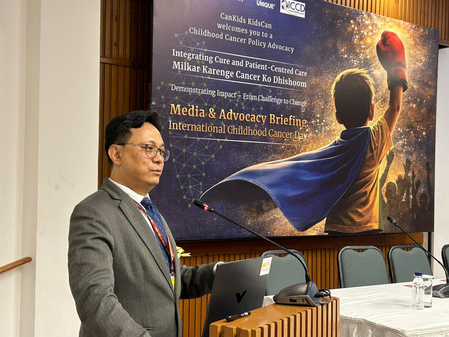
Health Ministry official outlines target of 60 pc survival rate for childhood cancer by 2030

New Delhi, Feb 15 (IANS) Assuring innovative funding models to support childhood cancer, Deputy Director General of Health Services L. Swasticharan said on Sunday that the Union government is aiming to achieve a survival rate of 60 per cent for childhood cancer by 2030.
Speaking at an event to mark the International Childhood Cancer Day observed globally on February 15, Swasticharan highlighted the government’s focus on saving precious human capital and said, “We should not leave anybody behind. They should all survive and contribute to the Viksit Bharat 2047 that we are dreaming of.”
Assuring the central government’s support for the fight against childhood cancer, including innovative funding models, he said, though there is no separate National Policy on childhood cancer, the existing framework has enough scope to accommodate the programmes for access and financial support for Universal Health Coverage for children with cancer and their families.
Appreciating the MoUs signed by 9 States to prioritise childhood cancer, Swasticharan called upon governments to work with all stakeholders closely to ensure that no child is left behind.
He said stakeholders advocating for better funding should come up with focused solutions and data to enable policymakers to support diagnostics, treatment and training targeted at childhood cancers.
The event, organised by CanKids KidsCan, demonstrated the impact of challenges to change. Significant progress has been achieved — access to care has doubled from 27 per cent in 2019–20 to over 54 per cent in 2025, with 9 state governments making childhood cancer a child health priority.
Building on these achievements, the way forward is clear: Towards 100 per cent access, 100 pr cent financial protection, and 60 per cent survival by 2030, in alignment with national health priorities and the WHO Global Initiative for Childhood Cancer, said an expert during a panel discussion.
Professor Sameer Bakshi, Medical Oncology, AIIMS, stressed on strengthening systems that save lives and improving access and survival among childhood cancer patients.
He said, “Capturing more and more number of children with childhood cancer is the easiest fruit to be captured when we look at raising the national survival rate from 50 per cent to 60 per cent by 2030.”
Professor Bakshi appreciated that there has been some change in the government system over the years, and even PM Ayushman Bharat is onboard to address cancer, but there is still a need to work as one family to amplify outcomes.
“Now, there is a crying need to address the fragmentation of the system through better coordination between stakeholders working in the field of childhood cancer and sharing data,” he said.
Poonam Bagai, Member, ICMR Central Ethics Committee on Human Research, and Childhood Cancer International’s WHO South East Asia Region Representative, highlighted the need for dialogue, solutions and policy integration, which the newly formed Technical Expert Group for childhood cancer will help to secure.
Bagai, Founder Chairman, CanKids KidsCan and Vice Chairman, Pallium India, said, “We want the society to believe that cancer can be treated. Even if we are a low-income country, we have made a lot of achievements.”
The event also saw strong voices of support for systems and capital from former IAS officer from Punjab, Karan Avtar Singh, CSR legislation advocate Nikhil Pant and banker Piyush Gupta.
Childhood Cancer Survivors Excellence Awards were given to Dr Tanveer Ahmed and Asian Youth medallist in sports climbing, Shivani Charak.
–IANS
rch/uk

Comments are closed.