

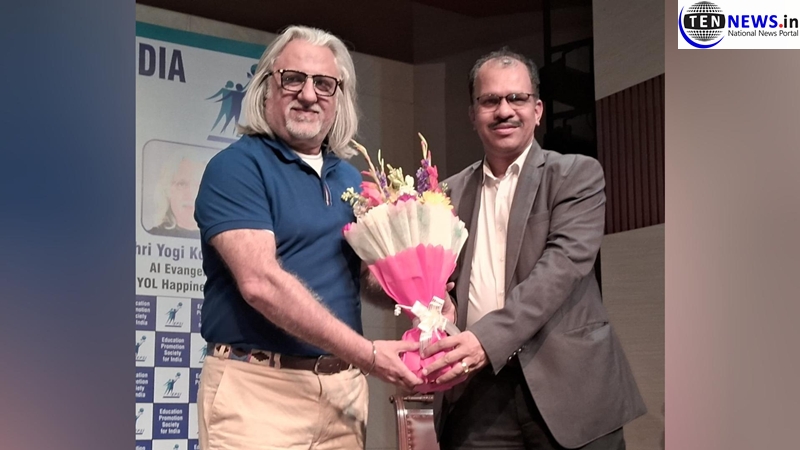
India is a grave yard for research: Yogi Kochhar | Artificial Intelligence | The Road Ahead 2.0 Book
TEN NEWS NETWORK
New Delhi (30 March 2025): In an event organized by the Education Promotion Society for India (EPSI), the highly anticipated book, The Road Ahead 2.0: A Seminal Work on AI, was launched, shedding light on the transformative potential of Artificial Intelligence (AI) in reshaping industries and society. The book, penned by the eminent Dr. TG Sitharam and co-authored by Yogi Kochhar, delves into the burgeoning role of AI and its future implications for education, business, and technology. The launch event was graced by several distinguished dignitaries, industry experts, and academic leaders, marking a significant step in the ongoing dialogue about AI’s potential in India.

During a thought-provoking firechat session, Yogi Kochhar made bold assertions about the state of research in India, particularly in the context of innovation and operationalization. He highlighted a glaring issue within the Indian research ecosystem, emphasizing the vast gap between theoretical research and its real-world applications.
85,000 patents were awarded in India in 2022 alone, but only 500 of those were operationalized, Kochhar stated, calling India a “graveyard for research.” He stressed that the country’s research landscape is marred by a lack of focus on practical implementation, urging academic leaders and educationists to reconsider their approach to hiring and nurturing talent.
Kochhar advised, If you are an eminent educationist or a chancellor, next time you hire someone with a PhD, ask them what they have operationalized. If the person has not operationalized their work, they are not of much value to you. They are merely a theoretician. This is an era of applied learning, and in this era, we need people who can actually create applications, who know how to apply learning, and who can take immediate steps toward for its implementation.
Kochhar’s comments were aimed at encouraging a paradigm shift in the Indian education research system—one that focuses on the practical application of knowledge rather than just theoretical research. He further explained how a small app created at Mayo College, Ajmer, exemplifies the type of operational mindset needed for innovation.
We set up a small AI lab at Mayo College, Ajmer, a prestigious institution. A Grade 6 student developed a portable detection system and went to his teacher to ask what he should do with it. The teacher initially had no idea, but the next day, the teacher returned and suggested selling the system to the Deputy Commissioner (DC), Kochhar recounted, highlighting how a young student had managed to create an AI-driven portable pots detection system with the potential for real-world application. This example, Kochhar suggested, exemplified the mindset of “operationalizing” knowledge—a mindset crucial for the future of innovation in India.

Continuing the conversation, Kochhar shared another example from the same school, where a Grade 7 student took the initiative to create his own curriculum after dissatisfaction with the current history teacher’s methods. The student’s action led to a conversation with the school principal, who intervened to address the issue and acknowledged the student’s innovative approach. The principal took the professor aside and questioned his teaching methods, resulting in the student’s curriculum being adopted. The children were very happy with the change, Kochhar remarked.
The impact of AI on the Indian education system was another key theme discussed during the event. Kochhar emphasized the importance of innovation and scaling up AI-driven projects in schools. He referred to Action Texan School, a school in the United States that had adopted AI and ranked among the top 2% of schools nationwide. According to Kochhar, AI holds the potential to revolutionize education globally, not by replacing teachers, but by enhancing their ability to guide and mentor students more effectively.
Kochar said that I am not suggesting that we eliminate teachers, but we need to refocus on innovation. The purpose of innovation should be clear—what is its objective, and how can it be scaled? Kochhar asked, stressing the importance of building an ecosystem where AI and education can work hand-in-hand to fuel progress.

The launch event of The Road Ahead 2.0 also brainstormed the critical role of AI in India’s future, urging policymakers, educators, and industry leaders to actively engage with applied AI technologies. The book serves as both a reflection on the current state of AI in India and a call to action for embracing innovation with a practical, real-world focus.
As India stands at the crossroads of technological advancement, The Road Ahead 2.0 aims to catalyze a movement that could reshape the country’s approach to education, business research, and technological growth. The event served as a powerful reminder of the need for collaboration, innovation, and strategic integration to steer India toward a future driven by AI. With a focus on operationalizing research, fostering practical learning, and scaling innovations, the release of this book marks an important moment in India’s ongoing journey toward AI-powered progress.
Dear Readers and Viewers, Ten News Team daily publishing / curating latest and top ten news, from ten news categories. So please keep visiting tennews.in : National News Portal thrice a day and subscribe it by submitting e mail at home page.
Also keep watching TEN NEWS NATIONAL YouTube Channel and subscribe it to watch Delhi / National News Videos.

Comments are closed.