
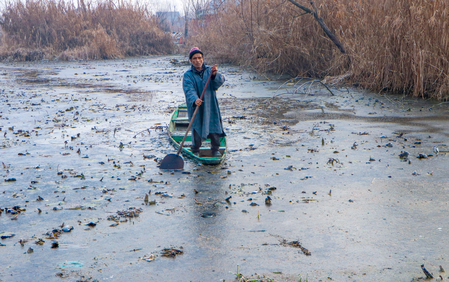
Jammu reels under unprecedented cold, Kashmir in deep freeze

Srinagar, Jan 15 (IANS) Unabated cold accompanied by chilly winds blowing into the plains from mountains continued in Kashmir on Thursday and Jammu city also reeled under unprecedented chilly weather.
The maximum temperature was 7.4 degrees Celsius in Jammu on Wednesday, while the minimum was 4.4 degrees Celsius on Thursday.
With just a gap of 3 degrees between the maximum and minimum temperatures, Jammu city is witnessing unprecedented cold weather, made worse by fog that continued throughout the day with varying intensity.
Jammu city on Wednesday recorded the 4th lowest maximum temperature ever at 7.4 degrees Celsius.
The maximum temperature was 5 degrees in January 1986, 6.7 degrees in 2013 and 7.1 degrees in 2016.
Srinagar had a minimum temperature of minus 3.9 degrees Celsius, Gulmarg minus 3.2, and Pahalgam 5 degrees.
Jammu city had 4.4 degrees, Katra town 6.8, Batote 4.9, Banihal 1.9 and Bhaderwah minus 0.1 as the minimum temperature.
The Meteorological (MeT Department has forecast that a weak Western Disturbance is expected to bring rain/snow in J&K on January 16, to be followed by two back-to-back Western Disturbances.
“Under the influence of these Western Disturbances, the plains of the Valley are likely to get their first snowfall of this season,” the MeT department officials said.
So far, there has been no major snowfall in the Valley as the plains are yet to receive this season’s first snowfall.
The continued dry spell has raised alarm across J&K as all the water bodies, on which agriculture, horticulture and drinking water needs are based, in turn depend for replenishment on heavy snowfall during the ongoing 40-day period of harsh winter cold locally called the ‘Chillai Kalan’.
This crucial 40-day period is already more than halfway through, and the plains of the Valley are yet to witness this season’s first snowfall. Chillai Kalan ends on January 30. Snowfall in February and March is of little consequence as it melts quickly and does not help replenish the perennial water reservoirs in the mountains.
–IANS
sq/dpb

Comments are closed.