
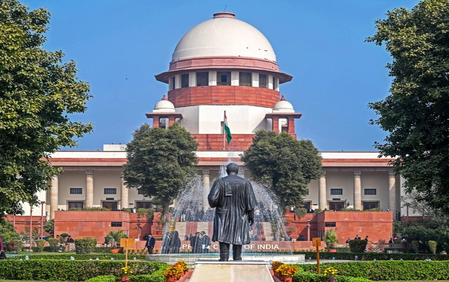
Magistrate must apply Section 225 if accused lives outside jurisdiction: SC

New Delhi, April 22 (IANS) In a significant ruling on criminal procedure under the Bharatiya Nagarik Suraksha Sanhita, 2023, the Supreme Court has held that a magistrate must mandatorily follow the procedure prescribed under Section 225 before proceeding against an accused residing outside its territorial jurisdiction.
A bench comprising Justices M.M. Sundresh and Prasanna B. Varale made these observations while allowing an appeal by Rajeev Mehta @ Rajiv Kishor Kirtilal Mehta, who had challenged a Punjab and Haryana High Court order in a criminal matter arising out of proceedings before a trial court.
Dealing with the applicability of Section 225 of the BNSS, the apex court found “considerable force” in the appellant’s contention that the provision must be invoked where the accused resides outside the territorial jurisdiction of the magistrate.
“Section 225 of the BNSS in specific terms provides that the said power has to be exercised upon receipt of a complaint… Therefore, upon such receipt, it is mandatory on the part of the Magistrate to press into service Section 225, upon satisfying himself that the accused person is residing at a place beyond the area in which he exercises jurisdiction,” the Justice Sundresh-led Bench said.
Noting that the appellant was admittedly residing in Mumbai, outside the jurisdiction of the magistrate concerned, the top court held that failure to apply Section 225 would render the provision “otiose and redundant”.
On the question of territorial jurisdiction, the apex court expressed concern that, despite the issue having been specifically raised, the P&H High Court had failed to adjudicate it.
“Section 223 would be amenable to a Magistrate who has jurisdiction. Therefore, the Magistrate will have to satisfy himself that he does, in fact, have jurisdiction before proceeding further,” the Justice Sundresh-led Bench observed.
“When the issue of jurisdiction has been raised specifically before the High Court, the same ought to have been answered… in one way or the other,” it added.
In view of this, the Supreme Court remitted the matter to the Punjab & Haryana High Court for a fresh decision on the issue of jurisdiction, requesting that it pass appropriate orders within three months.
The Justice Sundresh-led Bench clarified that it had not expressed any opinion on the merits of the jurisdictional issue and left all contentions open for consideration.
In the interim, the Supreme Court stayed the proceedings pending before the trial court.
–IANS
pds/dan

Comments are closed.