

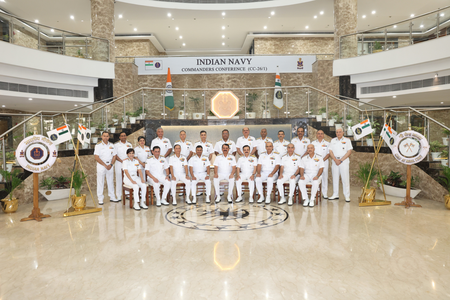
Navy Chief Admiral Tripathi commends force’s role in safeguarding energy security amid West Asia conflict
New Delhi, April 15 (IANS) India Navy chief Admiral Dinesh K. Tripathi has commended the force for its role in safeguarding India’s maritime interests, particularly in ensuring energy security amid the ongoing tensions in West Asia.
In his inaugural address at the Navy Commanders’ Conference 2026 on Tuesday, he noted the increased operational tempo and emphasised the importance of inter-services coordination, while underlining the need to maintain high combat readiness and adopt emerging technologies to build a future-ready force.
The Commanders’ Conference 2026 commenced at Nausena Bhawan, with the senior naval leadership, including operational and area commanders, command headquarters representatives, and naval headquarters staff, attending the event.
Highlighting the evolving global security landscape, the Navy chief pointed to continuing instability in West Asia and its impact on maritime traffic. He described the situation as “a reminder that security is interconnected, persistent, and unforgiving — where distance from conflict does not equate to distance from its consequences”.
This Conference takes place amidst the Indian Navy’s deployment in the Indian Ocean, where it is tasked with protecting oil tankers that are travelling towards India after passing through the Strait of Hormuz, in light of the ongoing conflict in West Asia.
Admiral Tripathi also reflected on the broader geopolitical shift, stating that “in a span of five years, we have moved from a competition continuum to a conflict continuum”.
He noted that ongoing conflicts are shaping both economic and military outcomes, while also influencing perceptions through narrative warfare, not just battlefield developments.
The Navy chief observed that the maritime security environment has reached a critical juncture, driven by simultaneous conflicts, growing adversary capabilities, weakening institutional frameworks, and reduced costs enabling non-state actors to acquire advanced systems. These factors, he said, are creating an increasingly contested operational space for the Navy on a daily basis.
He highlighted the progress made by the Indian Navy in its transformation into a combat-ready, credible, cohesive and future-ready force. Alongside readiness for both offensive and defensive kinetic operations, he noted a marked rise in the deployment of naval platforms over the past decade.
Efforts to strengthen warfighting capabilities across surface, sub-surface and aerial domains were also emphasised, supported by infrastructure development, strong maintenance systems and indigenous technological advancements.
Admiral Tripathi also pointed to significant achievements in capability enhancement, including full utilisation of the allocated budget, the signing of over 90 capital contracts, continued induction of indigenously designed and built platforms, and the scheduled delivery of more than 15 platforms this year.
He also highlighted the Navy’s role as a dependable maritime partner, noting its contribution in ensuring the safe passage of merchant vessels from the Persian Gulf and providing reassurance to Indian seafarers through the deployment of naval warships in the region.
Among other milestones, he referred to the maiden voyage of INSV Kaundinya and the successful conduct of major multilateral engagements such as Maritime Mahakumbh, IFR, MILAN, and the IONS Conclave of Chiefs.
The deployment of IOS Sagar-2 with participation from 16 friendly foreign countries was also cited as a reflection of India’s growing maritime outreach and the Navy’s role in advancing it.
The Navy vhief further highlighted initiatives aimed at strengthening personnel welfare, including improvements in recruitment, training, medical support, and sports, which he said have reinforced cohesion, trust and resilience within the force.
He also pointed to advancements in technology-driven capabilities, including the integration of artificial intelligence and machine learning into operational frameworks, as part of efforts to enhance future readiness.
Outlining priorities for the force, he stressed the need to maintain peak combat efficiency, strengthen force levels and capacity, improve maintenance and logistics, drive innovation and technological integration, focus on human resource development, enhance organisational agility, and deepen jointness and integration across services.
–IANS
sd/vd

Comments are closed.