
NCP balances ‘Young Turks’, veterans in RS nomination; opts for stability over spectacle

Mumbai, June 8 (IANS) The Rajya Sabha nomination exercise within the Nationalist Congress Party (NCP) underscored the leadership’s tightrope walk as it sought to balance generational aspirations and organisational stability.
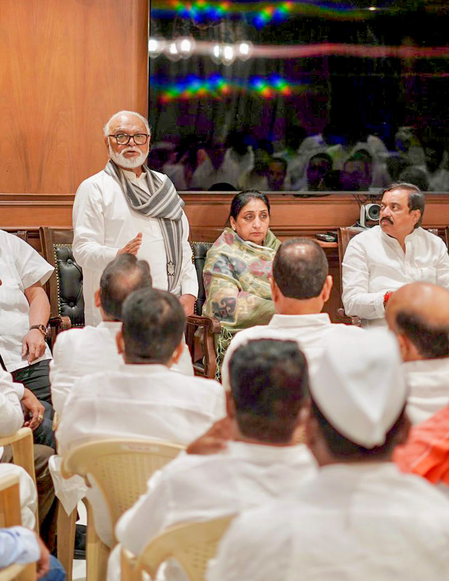
Following the withdrawal of OBC stalwart and Maharashtra Minister Chhagan Bhujbal and handing the ticket to Rajendra Jain — a staunch loyalist of party Working President Praful Patel — the NCP leadership managed to avert a messy, public showdown.
This move represents a highly calculated effort by the party’s core committee, headed by national president and state Deputy Chief Minister Sunetra Pawar, to project an image of internal stability, balancing the restive ambitions of its “Young Turks” against the entrenched weight of its organisational veterans. Today is the last date for filing nominations, while the polling is slated for June 18.
Chhagan Bhujbal’s decision to opt out of the Rajya Sabha race was framed as an amicable party consensus, but beneath the surface lay a complex web of political leverage, familial ambitions, and hard resistance from alliance partners. Bhujbal did not merely want a seat in the Upper House for himself, but he attached a strict condition to his nomination. He demanded that his nephew, Sameer Bhujbal, be inducted into the state cabinet before he files his nomination papers.
Bhujbal argued that since both the Pawar and Tatkare families enjoyed dual representation in governance, equity demanded the same for his family. However, the BJP, which heads the MahaYuti alliance, did not accept Bhujbal’s demand after Chief Minister Devendra Fadnavis took it up with the party’s high command in New Delhi following his meeting with the NCP delegation.
Facing a deadlock where he would gain a Delhi berth but lose his family’s active ministerial foothold in Maharashtra, Bhujbal ultimately retreated, leaving his home turf of Yeola and the Nashik region politically insulated for the time being. Bhujbal, however, urged the party leadership to give ministerial berth to his nephew, Sameer Bhujbal, as and when the CM expands the cabinet, while offering to step down as the minister and also as the legislator.
The core committee assured him that it will consider his request and also hinted that he can be considered for the Rajya Sabha in 2028 for a six years term while Sameer Bhujbal can represent the Yoela assembly seat.
With Bhujbal out, the nomination of Rajendra Jain was an explicit tactical victory for Praful Patel and a reward for quiet, unyielding organisational loyalty. Jain’s political identity is inextricably linked to Praful Patel. Having served as Patel’s former personal assistant and his key lieutenant in Eastern Vidarbha (specifically the Gondia-Bhandara belt), Jain has long been the operational backbone of the party’s regional machinery. Jain has been a former member of the state council, and he has been quite active in the party’s organisational work in the Gondia-Bhandara belt.
Unlike a heavyweight champion like Bhujbal — who brings massive OBC leverage but also highly public, independent bargaining power — Jain represents a frictionless insider. His elevation satisfies the party’s need to keep its organisational apparatus incentivised without triggering internal envy among frontline ministerial aspirants.
Patel made a strong case for Jain’s nomination, arguing that he can work to further strengthen the organisational base ahead of the 2029 Lok Sabha elections. Patel told the core committee that this will be essential as he is keen to contest the next general election from the Gondia Bhandara seat. Nominating a leader from Vidarbha ensures that the NCP maintains a structural presence in a region heavily dominated by the BJP and Congress, especially crucial as the state ticks closer to local bodies and legislative assembly elections.
Interestingly, the entire selection process was managed to mask a deeper generational and factional anxiety brewing within the NCP.
The party’s younger brigade, centred around Parth Pawar, has been eager to step out of the shadow of the senior leadership and claim institutional rewards. This generational friction has frequently threatened to spill into public view. By choosing Jain — an organisational hand rather than another high-profile senior minister — the party leadership effectively signalled that cabinet berths and parliamentary seats are not exclusive monopolies of the front-row veterans.
Had Bhujbal been openly denied the ticket without a face-saving exit, it would have validated the opposition’s narrative that senior leaders and OBC icons are being systematically sidelined within the new NCP structure. By keeping the negotiation behind closed doors, the party allowed Bhujbal to step back gracefully while framing the final choice as a collective decision.
By placing Rajendra Jain in the Rajya Sabha, the NCP leadership chose stability over spectacle. It successfully defused a potential rebellion from Bhujbal, neutralised the immediate demands of the party’s ambitious youth wing, and demonstrated to its coalition partner, the BJP, that it can manage its internal contradictions without disrupting the delicate equilibrium of the Mahayuti alliance.
–IANS
sj/skp

Comments are closed.