
Advocacy for Conscience, Compassion, and Co-existence: A Blueprint for Global Peace and Sustainable Harmony in the Age of Intelligent Automation and Attention Economic Era
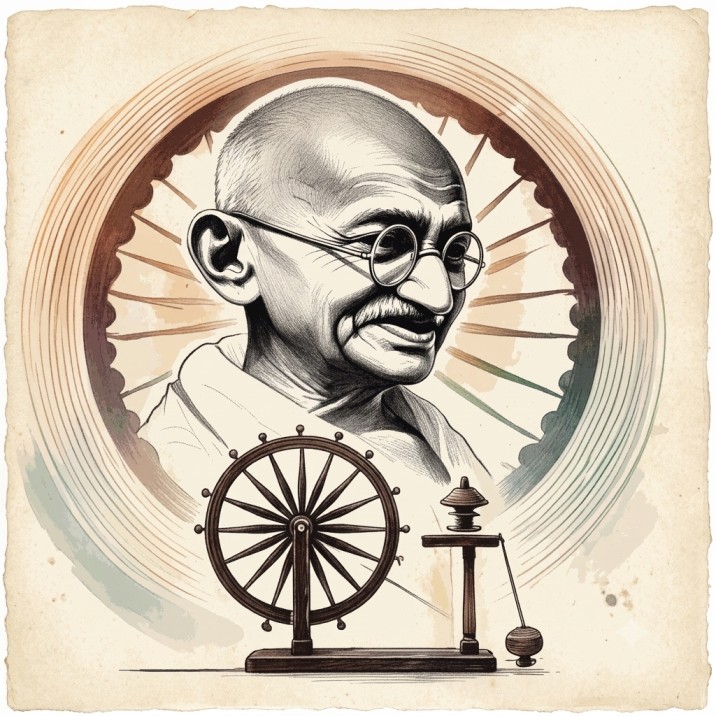
As the global humanity prepares to celebrate the International Day of Nonviolence and to pay its respectful tribute to the Apostle of Peace, Mahatma Gandhi Ji, who lived a life of Truth, Nonviolence, Ahmisha, Aparigraha and Social Harmony and showed the path of Satyagraha and Global Peace to the nations of the world. He proved that the might of the Satyagraha, peaceful disobedience, and Nonviolence, Ahmisha, are more powerful than the swords and guns of the mighty rulers. He in fact, paved the path of liberation from foreign domination not only of India but the nations around the globe. On this day we pay our respectful homage to Mahatma Gandhiji and pledge to engage seriously to rediscover the relevance of Mahatma Gandhi’s principles of Truth, Satya, Nonviolence, Ahimsha and Sustainability, Aparigriha to create a just and peaceful global humanity.
Today, when the global humanity is faced with the formidable challenges of climate change, rising aggression, lust and greed to possess more and consume more and more, and the fear of war looming large, we need to reemphasise the power of Truth, Harmony and Sustainability to co-create a bright and blissful future for the global humanity and reinstate global peace and peaceful coexistence as the noble objectives for the human society.
We are at a defining crossroads of human history, an era where human ingenuity has unlocked the immense powers of artificial intelligence, automated systems and unprecedented technological connectivity and even ushered a new era of “attention economy” yet simultaneously finds ourselves haunted by specters of division, environmental distress, ethical fragmentation and even the fear of world war, looming large on humanity at large.
We are also at the same time in the exciting times in which on one hand, never has humanity possessed such vast capabilities to construct, nor such potent capacities to destabilize. Therefore, as we navigate the complex currents of the 21st century, it becomes starkly evident that technological advancement, unaccompanied by an equal or greater evolution in human consciousness, is not progress; it is peril, rather devastation of a scale never witnessed ever before. In this context it is important to realise that true peace is not merely the absence of war; it is the presence of justice, the cultivation of ecological harmony and the flowering of human dignity across all borders.
The Crisis of Conscience in an Age of Acceleration
The contemporary world is dazzled by the brilliance of algorithms, machine learning and rapid automation. We speak of smart cities, autonomous machines and digital transformation. Yet, beneath this veneer of modernization lies a deep malaise a crisis of conscience. The fear of distortion and distrust coupled with insecurity of information and reliability of data when added to the capability of AI and ML to create false and fabricated documents and videos are no ordinary challenges. On top of all this the ever rising ability of AI for research and creativity are throwing human engagements not only out of gear but also creating the fear of unknown, even existential threat to humanity at large.
When science divorces itself from moral accountability and when economic dominance supersedes human welfare, the natural outcome is inequality, injustice, alienation, and conflict. The challenges we face today whether geopolitical tensions, the existential threat of climate change, or the ethical dilemmas posed by autonomous weapons and unbridled artificial intelligence cannot be resolved by the same mindset that created them.
It is here that we need a renaissance of the human spirit. We must recalibrate our civilizational compass, moving away from a culture of domination, exploitation and hyper-competition toward a culture of care, collaboration and co-existence. We need to clearly define implementable goals and pathways to achieve global peace, justice and a compassionate human society that practices Nonkilling, Nonviolence and Aparigraha, to achieve the compliances of sustainable development goals. This we need to achieve with a sense of urgency and conscious priority of our acts and actions.
Ancient Wisdom for Modern Realities
To chart a sustainable pathway toward global peace, we do not need to invent a new philosophy; rather, we must rediscover the profound eternal truths embedded in our ancient heritage. Civilizations across millennia have taught us that humanity is an indivisible family Vasudhaiva Kutumbakam.
In the timeless traditions of the Orient and in the shared moral intuitions of great thinkers across global history, peace begins within the individual consciousness. Kautilya’s Arthashastra reminds us that the ultimate welfare and security of a state rest upon the happiness and moral well-being of its people. Similarly, our classical insights into etymology and ethics teach us that duty (Dharma) and moral integrity (Mānavattava) are the twin pillars of a civilized society.
When we view the others not as our enemies to be destroyed but to be conquered by our conviction to win over there misguide and misconduct to inspire them to lead a life of dignity and honour like ours and have pride in being a human, then we move away from distraction and warfare to a dialogue and a peaceful settlement of dispute and disagreements. It demands the institutionalization of a global code of peaceful coexistence and a universal conflict resolution framework, akin to an ISO 10000 standard for human morality and scientific responsibility, ensuring that our intellectual pursuits remain dedicated to global peace and the upliftment of all sentient life.
Technology as an Instrument of Peace and Sustainability
Science and technology have all along, especially after the second world war have become the instruments of warfare more than the solace to the humanity for peace and wellbeing. Though it was not intended to be like that. Now that the power of science and the might of Technology is poised to attain new alters of eminence and global impact, we must ensure that the Science & Technology once again become instruments of grace rather than instruments of dominance and distraction. As educators, scientists, and leaders, our mandate should be to direct scientific advancement and technology innovations toward healing our planet and empowering the global humanity a new opportunity to innovate and excel and live a life of dignity and honour in harmony and peace. For this major shift is needed in our approach to ushering scientific advancement and technology innovations so that our collective efforts are targeted to peace, harmony and progress.
- Green Mobility and Ecological Stewardship: True peace is impossible on a dying planet. Our transition to net-zero carbon economies, green infrastructure, and circular wastewater management is not merely an environmental obligation; it is a profound peace-building initiative. Ecological degradation breeds scarcity, and scarcity breeds conflict. By securing our natural inheritance, we secure human peace.
- Responsible AI and Human-Centric Governance: As we integrate artificial intelligence into higher education, governance, and daily life, we must enforce rigorous frameworks of cybersecurity, transparency, and human-centric design. Machines must serve human flourishing; they must never usurp human conscience or erode human dignity.
- Education for Values and Excellence: Education must transcend the narrow confines of producing economic units. It must be refocused on nurturing character, compassion, and critical wisdom. Quality, relevance, and excellence must be harmonized with simplicity, integrity, and social responsibility. Sustainability should become a universal human value to be adorn with pride by one and all and in the interest of humanity and mother nature.
A Call to Action: The Global Conscience Consortium
Peace is not a passive dream; it is an active, relentless architectural project. It requires the collective resolve of global academia, civil society, industry, and youth.
AS we traverse through our discussions today at this international seminar, let us commit today to establishing a robust Global Conscience Consortium—a unified intellectual movement dedicated to:
- Fostering cross-cultural dialogue rooted in mutual respect and shared human values.
- Advocating for ethical guardrails in emerging technologies.
- Promoting sustainable development models that honour both human needs and ecological limits.
- Inspiring the younger generation to become Ambassadors of Nonkilling, Nonviolence and Global Peace, armed with both scientific competence and moral clarity.
On this momentous day of great International significance, the International Day of Nonviolence, the 157th birth anniversary of Mahatma Gandhiji, we must pour our hearts to humanity at large and commit ourselves to rediscovering a profound meaning and purpose of the teachings of Mahatma Gandhiji, his trust on power of truth, nonviolence and peaceful coexistence and social harmony.
Let us therefore walk forward with the firm conviction that despair is not our destiny. Through selfless service, unwavering environmental stewardship, and a shared dedication to global harmony, we can, and we will, build a new world order defined by equity, compassion, and enduring peace.
Let us pledge today to transform our vision of a peaceful world into a living reality for our children and for all generations to come.
*The author Prof PB Sharma is a renowned thought leader, Founder Vice Chancellor of DTU and Past President of Associations of Indian Universities and currently Vice Chancellor of Amity University Gurugram. The views expressed are the personal views of the author.

Comments are closed.