
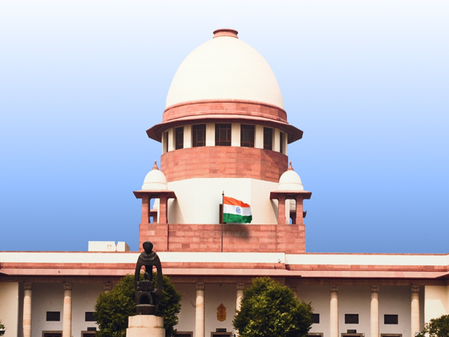
SC issues notice on PIL to implement creamy layer in SC/ST reservations

New Delhi, Jan 12 (IANS) The Supreme Court on Monday issued notice to the Centre and all state governments on a public interest litigation (PIL) seeking the implementation of the “creamy layer” principle in reservation for Scheduled Castes (SCs) and Scheduled Tribes (STs).
A Bench of Chief Justice of India (CJI) Surya Kant and Joymalya Bagchi sought responses from the Union government as well as all state governments on the writ petition filed under Article 32 of the Constitution by advocate Ashwini Kumar Upadhyay.
Appearing before the apex court, Upadhyay contended that in cases where a member of an SC/ST family has already attained a constitutional or senior government position, the children of such a person should not be allowed to avail of reservation benefits.
He argued that the continued grant of reservation to socially and economically advanced families within SC/ST categories defeats the very object of affirmative action.
The petition stated that reservation was introduced as a remedial and temporary measure to uplift those suffering from entrenched social, educational and economic backwardness, but over time, an elite class has emerged within the SC/ST communities, which has already achieved social mobility and economic stability.
Despite this advancement, such sections continue to corner reservation benefits generation after generation, excluding the weakest members of the community, it said.
Referring to the Constituent Assembly Debates, the plea submitted that reservation was never intended to become a hereditary or undifferentiated entitlement. It referred to the views of Dr B.R. Ambedkar and other framers to assert that affirmative action was meant to operate dynamically and remain subject to periodic review.
The petition further claimed that non-exclusion of the creamy layer has grave national, social and economic consequences, including elite capture of benefits, compromise of administrative efficiency, and violation of the constitutional principles of equality, justice and fraternity.
It also highlighted the Constitution Bench verdict in State of Punjab vs. Davinder Singh had recognised that Scheduled Castes are not a homogenous class and that benefits of reservation must reach the “weakest of the weak”.
In a landmark judgment delivered on August 1, 2024, a 7-judge Constitution Bench headed by then Chief Justice D.Y. Chandrachud had suggested the application of the “creamy layer” principle to SCs and STs for availing quota benefits, with the caveat that while providing for sub-classification, the government could not reserve 100 per cent of seats for a particular sub-class to the exclusion of others.
In his opinion, then Justice B.R. Gavai had asked, “When the 9-Judge Bench in Indra Sawhney held that applicability of such a test (creamy layer test) insofar as Other Backward Classes are concerned would advance equality as enshrined in the Constitution, then why such a test should not also be made applicable to the Scheduled Castes and Scheduled Tribes?”
“Can a child of IAS/IPS or Civil Service officers be equated with a child of a disadvantaged member belonging to Scheduled Castes, studying in a Gram Panchayat/Zilla Parishad school in a village?” Justice Gavai had observed.
His view was supported by Justices Vikram Nath, Pankaj Mithal and Satish Chandra Sharma, who had stressed that the government must evolve a policy for identifying the creamy layer within SCs and STs so as to exclude them from the benefit of affirmative action. However, days after that verdict, the Union Cabinet, chaired by Prime Minister Narendra Modi, had discussed the judgment and maintained that the Constitution does not provide for a creamy layer within SC and ST reservations.
Union Information and Broadcasting Minister Ashwini Vaishnaw had said the NDA government was committed to constitutional provisions and that “according to the Constitution given by B.R. Ambedkar, there is no provision for a creamy layer in the SC-ST reservation”.
–IANS
pds/dpb

Comments are closed.