

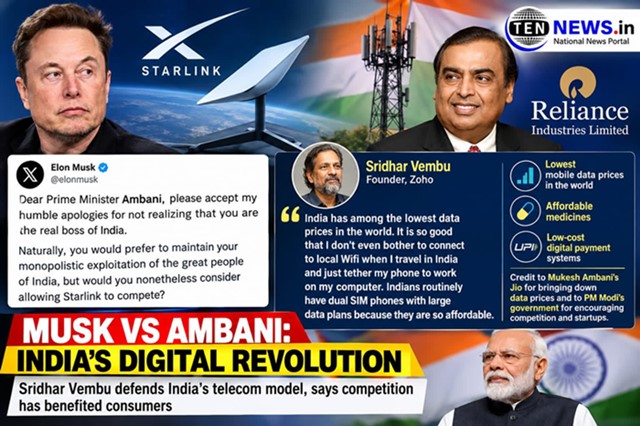
National News (10 October 2026): A debate over competition, affordability and regulatory hurdles in India’s telecommunications sector has gained fresh attention following an exchange between Tesla and SpaceX CEO Elon Musk and Zoho founder Sridhar Vembu. The discussion centres on Starlink’s proposed entry into the Indian market, the regulatory approvals required for satellite-based internet services and the role of established telecom operators in making internet access affordable for millions of consumers.
Musk recently raised concerns over the delays in obtaining final regulatory approvals for Starlink’s satellite internet services in India. In a post on X, he sarcastically referred to Reliance Industries Chairman Mukesh Ambani as “Prime Minister Ambani” and questioned whether Starlink would be allowed to compete fairly with established players in the country’s telecommunications market. His remarks brought renewed focus to the challenges faced by new entrants seeking to establish themselves in a market dominated by major telecom operators.
Sridhar Vembu Highlights Jio’s Contribution to Affordable Internet
Responding to Musk’s comments, Zoho founder Sridhar Vembu defended India’s telecommunications ecosystem and highlighted the benefits consumers have gained from affordable mobile data services. He credited Reliance Jio with playing a significant role in reducing mobile internet costs and expanding access to digital connectivity across the country.
Vembu explained that mobile data has become so affordable in India that he often relies on his phone’s internet connection while travelling rather than connecting to local Wi-Fi networks. He also highlighted the widespread use of dual-SIM smartphones and high-data-usage plans among Indian consumers, reflecting the accessibility of mobile internet services.
His remarks underscored how lower data prices have changed internet consumption patterns in India, making online communication, digital services and information access more accessible to a wider section of the population.
Affordable Medicines and UPI Also Cited as India’s Achievements
Beyond telecommunications, Vembu pointed to affordable medicines and the Unified Payments Interface (UPI) as examples of India’s ability to develop cost-effective services at scale. He argued that technological progress, competition and innovations in service delivery have helped create substantial benefits for consumers across different sectors.
India’s digital payments ecosystem, powered by UPI, has transformed everyday transactions by enabling individuals and businesses to transfer money quickly and conveniently. Similarly, the availability of relatively affordable medicines has helped improve access to essential healthcare products for a large section of the population.
By citing these examples, Vembu highlighted the broader benefits of India’s technology-driven development model and suggested that the country’s market should be viewed in the context of the value and affordability it delivers to consumers.
Musk Questions Regulatory Hurdles Facing Starlink
Musk’s remarks have also brought attention to the regulatory challenges associated with introducing satellite-based internet services in India. Starlink, operated by SpaceX, aims to provide broadband connectivity through a network of satellites, with the potential to serve areas where conventional internet infrastructure is limited or difficult to deploy.
However, satellite internet providers must meet India’s applicable licensing, security, spectrum and other regulatory requirements before offering services commercially. These requirements are intended to ensure compliance with national laws and the country’s telecommunications framework.
Musk has alleged that influential business interests are creating obstacles to Starlink’s entry into India. His comments have fuelled discussion about whether new service providers can compete on a level playing field with established telecom companies.
Union Communications Minister Jyotiraditya Scindia rejected Musk’s claims, maintaining that companies seeking to operate in India must comply with the country’s regulatory framework. The government’s position emphasises that regulatory requirements apply to companies seeking to provide telecommunications services in the country.
Starlink’s Entry Could Expand India’s Connectivity Options
India is one of the world’s largest telecommunications markets, with affordable mobile data and widespread smartphone adoption contributing to the rapid growth of digital services. Established operators, including Reliance Jio and other telecom companies, have played a major role in expanding connectivity and making mobile internet an everyday necessity for millions of people.
Starlink’s proposed entry could introduce another connectivity option, particularly for remote and underserved areas where traditional broadband infrastructure may be expensive or challenging to establish. However, satellite internet services will also need to address factors such as pricing, service availability, regulatory compliance and affordability for Indian consumers.
The exchange between Musk and Vembu highlights two important aspects of India’s digital future: the need to maintain an environment that encourages fair competition and the importance of preserving the affordability of essential services.
As discussions surrounding Starlink’s entry continue, the central question remains whether new satellite internet providers can enter the Indian market while meeting regulatory requirements and offering services that complement the country’s existing connectivity infrastructure. For consumers, the potential benefits will ultimately depend on greater choice, reliable service and competitive pricing.
Dear Readers and Viewers, Please note that tennews.in: National News Portal daily publishes latest and top ten news from government, politics, national, business, education, technology, lifestyle, entertainment, health etc ten categories. You may submit your e mail and subscribe it to get updates on your e mail. Please also subscribe TEN NEWS NATIONAL YouTube Channel.

Comments are closed.