

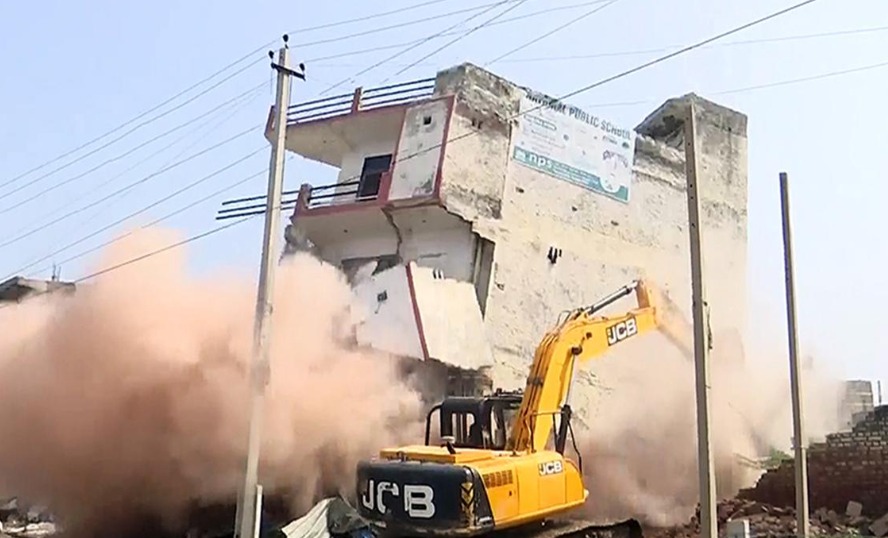
New Delhi, August 8, 2023: The Punjab and Haryana High Court delivered a resolute order on Monday, putting an immediate stop to bulldozer operations in the aftermath of communal violence in Nuh and Gurugram.
The court raised concerns over the potential misuse of law and order as a pretext to dismantle structures, and even ventured to question whether this could be indicative of an insidious attempt at “ethnic cleansing” by the State.
In a notable reference to Haryana Home Minister Anil Vij’s assertion that bulldozers were akin to a remedy for the state’s investigation into communal strife, the court invoked the timeless wisdom of English writer and historian Lord Acton: “Power tends to corrupt and absolute power corrupts absolutely.” This pointed quote underscored the court’s skepticism towards unchecked authority.
The court’s scrutiny extended to the methodology employed, as it observed, “Apparently, without any demolition orders and notices, the law and order problem is being used as a ruse to bring down buildings without following the procedure established by law.” Media accounts highlighted the apparent demolition of homes and shops tied to those engaged in “anti-social activity” and illegal construction, further intensifying the debate.
With precision, the court directed the Haryana government to provide a sworn affidavit detailing the tally of demolished structures over the past two weeks in both Nuh and Gurugram. The specific inquiry sought to ascertain whether prior notifications were dispatched prior to the demolitions.
Reacting promptly to the court’s decision, Deputy Commissioner Dhirendra Khadgata swiftly directed the cessation of bulldozer activities. The court, acting on its own accord, stepped in a week after communal clashes resulted in a tragic loss of six lives, significant property damage, and widespread unease in Nuh and Gurugram.
In a disconcerting span of four days, over 350 shanties and 50 cement structures were razed, further fueling the ongoing discourse around the situation. As the region grapples with these legal and ethical concerns, the high court’s intervention emerges as a pivotal moment in the trajectory of the communal violence fallout.
