
From Greater Noida to the Globe: Galgotias Students Crack World Innovation Platforms
TEN NEWS NETWORK
Greater Noida (27/05/2026): An increasingly confident India First mindset is beginning to shape how students approach technology, startups, and global innovation platforms, and that shift is becoming increasingly visible at Galgotias University.
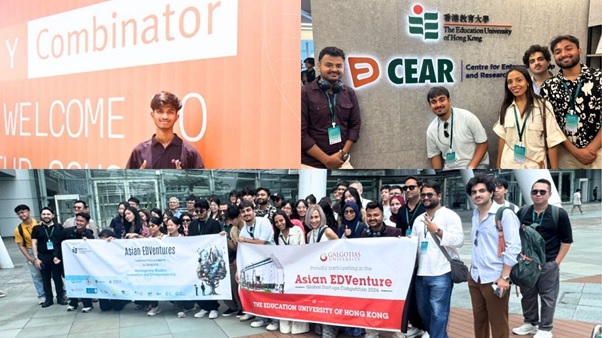
Students from the university are currently representing India at the Global EDVentures Startup Competition in Hong Kong, carrying ideas, products, and ventures that originated inside classrooms, labs, maker spaces, hostels, and collaborative student communities at Galgotias University. Their participation comes amid an incredible wave of student-led achievements emerging from the university ecosystem over the past year, including 18 winners at the global Apple Swift Student Challenge, the launch of 37 live applications on Apple’s iOS ecosystem, and growing engagement with international startup conversations connected to organisations such as Y Combinator.
India First Ambition and National Pride Drive Galgotias University Students onto Global Innovation Platforms
The university’s growing startup ecosystem has also begun translating into tangible market confidence. One of the student-led ventures emerging from the Galgotias ecosystem, Cybergenix, recently secured INR 3 crore in funding. A striking aspect of the story is that one of the co-founders of the startup is just 18 years old, reflecting how early exposure to innovation, mentorship, experimentation, and startup culture is beginning to shape a new generation of young Indian founders far earlier than traditionally expected.
Seen across a single year, these developments begin to reveal how quickly the innovation culture at Galgotias University is evolving, with students increasingly approaching university life as builders, founders, creators, and product thinkers operating with global ambition.
The scale and consistency of success at the Apple Swift Student Challenge offers one of the clearest indicators of the ecosystem now taking shape at Galgotias University. After producing 10 winners in 2025, the university saw that number rise to 18 winners in 2026, suggesting that mentorship, peer learning, experimentation, product thinking, collaborative problem-solving, and technical confidence are beginning to spread organically across the student community.
The momentum is also becoming increasingly visible across the wider campus ecosystem and is no longer confined to one department or one select batch, with students from engineering, artificial intelligence, design, management, and interdisciplinary programmes collaborating to build applications, AI-driven products, startup ventures, and technology solutions connected to healthcare, accessibility, productivity, education, immersive learning, and digital communities. Across Galgotias University, building products, experimenting with ideas, and attempting ambitious work is steadily becoming part of everyday student culture instead of being limited to a handful of prodigious individuals.
More than 135 startups have already emerged from the broader innovation ecosystem at Galgotias University, supported through incubation, mentorship, prototyping support, industry exposure, and the INR 10 crore Galgotias Innovation Fund. The university has simultaneously expanded its technology ecosystem through specialised labs and Centres of Excellence built with organisations including Apple, Intel, Cisco, NVIDIA, Salesforce, Tata Technologies, and Capgemini, alongside high performance computing infrastructure powered by NVIDIA DGX H200 systems.
Perhaps the most important transformation underway is psychological, with a visible shift beginning to emerge in the confidence, ambition, and self-belief with which students approach their university years. Increasingly, students at Galgotias University are treating the campus experience not simply as a pathway to a degree, but as an opportunity to build products, experiment with ideas, collaborate across disciplines, and attempt meaningful work much earlier in life while believing that globally relevant startups and technologies can emerge directly from Indian university campuses. Many now have role models within their own university ecosystem to look up to, including seniors who have built apps, secured international recognition, launched startups, raised funding, and represented India on global platforms, alongside mentors who continue to guide, challenge, support, and push them toward thinking beyond conventional academic pathways.
That confidence was visible during the recent visit of Ramana Ramanathan to Galgotias University, where he interacted with founders behind student-led ventures such as Project Tacto and Tekurious, both currently representing India at the Global EDVentures Startup Competition in Hong Kong. Mr. Ramanathan, widely regarded as one of the principal architects behind India’s modern innovation and entrepreneurship movement through the Atal Innovation Mission, appeared particularly struck by the seriousness, clarity, and execution-focused thinking demonstrated by the student teams. Discussions revolved around scalability, deployment challenges, user behaviour, product-market relevance, and real-world application instead of abstract ambition.
Speaking about the emerging ecosystem, Dr. Dhruv Galgotia, Chief Executive Officer of Galgotias University, said: “A new generation of young Indians is beginning to believe that they can build for the world directly from India. That confidence matters. At Galgotias University, we are witnessing students move beyond conventional academic boundaries and begin creating products, applications, startups, and technologies with global ambition while still inside the university ecosystem. What is encouraging is that these achievements are no longer isolated success stories. We are now seeing outcomes emerge repeatedly across domains and cohorts, which tells us that a larger culture of innovation, experimentation, ambition, and national confidence is steadily taking shape.”
At Galgotias University, momentum now appears to be compounding through visibility, peer influence, mentorship, experimentation, and repeated student success across platforms. One app launch encourages another student to experiment. One international competition changes how an entire cohort sees its own potential. One startup securing funding changes how young founders perceive risk and possibility.
That confidence is now becoming increasingly visible across the university ecosystem, where more students are beginning to believe that globally relevant products, companies, and technologies can emerge directly from Indian campuses.

Comments are closed.