

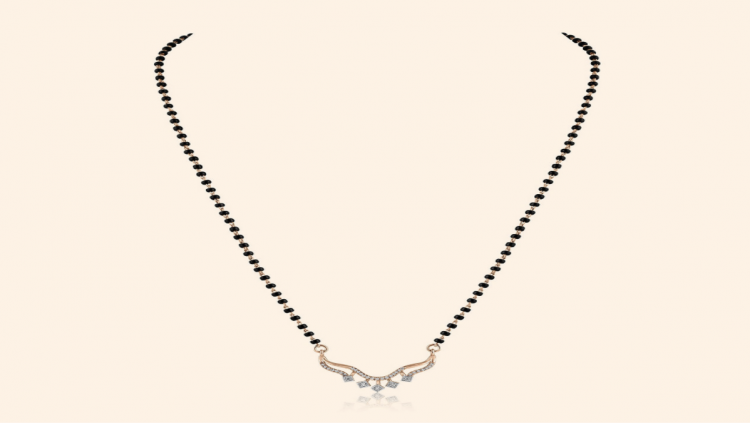
Two Lives, One Light: How a Diamond Mangalsutra Becomes a Symbol of a Lifetime
There is a moment in every wedding that belongs entirely to two people, not the guests, not the cameras, not the choreography of the ceremony. It is the moment the mangalsutra is fastened, and something invisible but irreversible passes between a couple.
For generations, this has been one of the most quietly powerful gestures in South Asian matrimony. Today, the diamond mangalsutra has become the form in which that gesture finds its most luminous expression.
It is at once a declaration and a protection, a thread of devotion made tangible. Traditionally strung with black beads to ward off misfortune, and centred on a pendant that varies by region and family, the mangalsutra has always been deeply personal. What has changed, beautifully so, is the language in which it speaks. The contemporary diamond mangalsutra speaks in light.
The Evolving Significance of the Mangalsutra
Across India’s many cultures, the mangalsutra takes different forms, such as the thali in the South, the mangalya in Tamil Nadu, and the tanmaniya in Maharashtra. Yet for all their regional variation, these pieces share a singular intention: to bind two lives together in a form that can be worn, seen, and remembered every day.
The black beads absorb negativity; the pendant’s gold or silver radiates auspiciousness. Every element is considered, and every element carries weight.
This is why the introduction of diamonds into the mangalsutra’s design was not merely an aesthetic evolution, it was a philosophical one. Diamonds, formed under extraordinary pressure over millions of years, are perhaps the most fitting material for something meant to endure. The diamond mangalsutra embodies the very qualities a marriage aspires to: resilience, brilliance, and a light that does not dim.
How Diamonds Bring a Contemporary Touch to Tradition
Diamonds do not take away from the sacredness of the mangalsutra. They refine it for the woman who wants tradition to move with her through modern life.
A diamond mangalsutra can feel ceremonial without being heavy, graceful without being ordinary, and modern without losing its roots. It can sit beautifully with a saree, a work blazer, a festive lehenga, or a simple kurta. That versatility is what makes it so meaningful today.
The brilliance of diamonds also changes the visual language of the mangalsutra. The design feels lighter, more luminous, and easier to wear every day. It becomes less of an occasion-only ornament and more of a constant companion.
How to Choose Diamond Mangalsutra Designs that Reflect Personal Style and Bond
Choosing a diamond mangalsutra is about finding the piece that feels closest to the woman who will wear it and the bond it represents.
Here are three design directions that show how a diamond mangalsutra can hold both personal style and emotional meaning.
- Grand Design Can Speak of Ceremony, Heritage, and Presence: The Double Disc Design
A grand diamond mangalsutra design usually features a larger motif, balanced symmetry, and a more noticeable centrepiece. Buyers who prefer a ceremonial or heritage-inspired look can consider circular motifs, twin-disc patterns, layered settings, or broader pendant forms.
These designs work well for women who like jewellery with presence and cultural depth. Rounded or paired motifs can suggest completeness, continuity, and togetherness, while diamonds add a refined festive glow. This style is ideal for special occasions, family gatherings, and moments where the mangalsutra becomes part of the overall statement
- Delicate Motif Can Feel Intimate, Graceful, and Suited to Daily Wear: The Floral Cross Design
A delicate motif usually has a softer shape, lighter pendant structure, and a more graceful diamond setting. Buyers who want something elegant yet easy to wear can consider floral patterns, petite geometric forms, four-petal motifs, or slim diamond arrangements.
This design direction suits women who move between work, home, celebrations, and everyday routines. It does not feel too heavy or prominent, but still carries emotional meaning. A delicate diamond mangalsutra can bring subtle sparkle while staying comfortable enough for regular wear.
- Minimalist Pendant Can Reflect Quiet Confidence and Modern Restraint: The Drop Solitaire Design
A minimalist pendant usually focuses on clean lines, fewer details, and one strong visual element. Buyers who prefer modern simplicity can consider solitaire drops, sleek bars, small diamond clusters, or refined linear pendants.
This design style works well for women who like understated jewellery with quiet impact. It pairs easily with Indian, western, and fusion outfits, making it versatile for daily styling. A minimal diamond mangalsutra feels personal, polished, and elegant without needing an elaborate form.
What unites all three is the understanding that a diamond mangalsutra is worn for oneself, as a daily reminder of a choice made, a vow taken, a life shared. The diamonds hold the light, the way memory holds the best moments of a marriage.
The Diamond Mangalsutra: A symbol for the years to come
Marriage, at its best, is not a single moment but an accumulation of thousands of cups of tea made in silence, hands held in waiting rooms, laughter that bubbles up from nowhere. A diamond mangalsutra is present for all of it. It goes to the office, to the temple, to the school gates, and to the dinner table.
This is the quiet power of the diamond mangalsutra. It is an argument that love, when it is real, is worth making permanent. That two lives brought together deserve to be marked in something enduring. That light, once found, should be kept close.
Jewellery brands like Indriya bring this sentiment to life through designs that honour both tradition and modern expression. In the end, every great piece of jewellery tells a story. A diamond mangalsutra tells the greatest one of all.

Comments are closed.