

Four Leaders, Five Countries: India’s Diplomatic Balancing Act Across the Globe
TEN NEWS NETWORK
National News (27/08/2026): India is simultaneously engaging with Russia, China, Japan, Canada and the United States, highlighting a foreign-policy approach built around flexibility rather than alignment with a single geopolitical bloc.
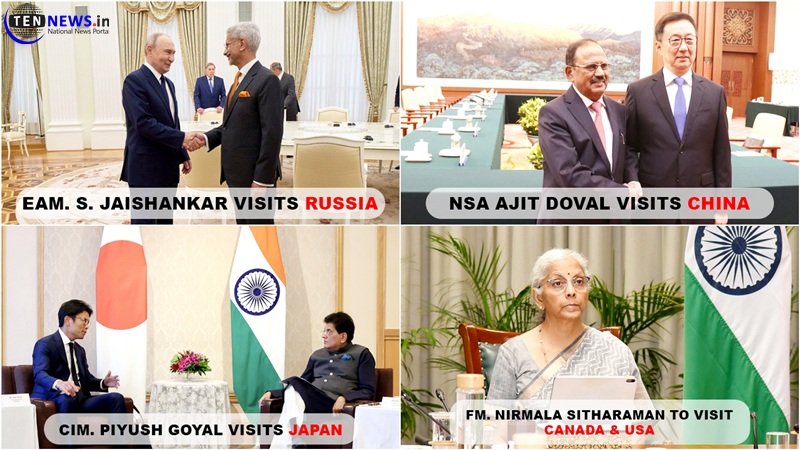
In the past few days, four senior Indian leaders have been pursuing separate but interconnected diplomatic priorities. External Affairs Minister S. Jaishankar travelled to Russia, National Security Adviser Ajit Doval held boundary talks with China, Commerce and Industry Minister Piyush Goyal led a large business delegation to Japan, while Finance Minister Nirmala Sitharaman began an economic outreach covering Canada and the United States.
While the issues on the table vary from energy and defence to border security, manufacturing, technology and investment, the larger objective remains the same — expand India’s global partnerships while preserving its freedom to make decisions based on national interest.
Russia: Keeping Strategic and Economic Ties on Track
S. Jaishankar’s August 23-24 visit to Russia highlighted the continuing importance of the bilateral relationship. During the visit, he co-chaired the 27th session of the India-Russia Inter-Governmental Commission, which covers trade, economic cooperation, science, technology and other areas.
Russia remains an important partner for India in several strategic sectors, including energy, fertilisers and defence.
However, India’s approach is also evolving. Along with maintaining established areas of cooperation, New Delhi is looking to expand economic engagement and create more opportunities for Indian businesses.
The objective is to keep the long-standing partnership relevant while widening its economic base in response to changing global circumstances.
China: Dialogue Amid Continuing Border Concerns
India’s engagement with China is driven by a different set of priorities, with the boundary dispute remaining a major concern.
On August 25, NSA Ajit Doval met Chinese Foreign Minister Wang Yi in Beijing for the 25th round of Special Representatives talks on the India-China boundary question. The discussions covered the boundary issue, peace and stability along the border and the broader direction of bilateral relations.
According to the Ministry of External Affairs, the meeting produced an eight-point set of outcomes and understandings aimed at advancing discussions on the boundary question and maintaining stability.
For India, the message is clear: border security remains a critical priority, but diplomatic communication must continue. Keeping high-level dialogue active provides a channel for managing differences and reducing the risk of tensions escalating.
Japan: Strengthening India’s Manufacturing Ambitions
Piyush Goyal’s Japan visit puts India’s industrial and technological ambitions in focus.
The Commerce and Industry Minister is visiting Japan from August 24 to 27 with a 200-member Indian business delegation. The programme includes engagements in Tokyo, Nagoya and other major industrial centres. Key areas of interest include semiconductors, automobiles, advanced manufacturing, technology, innovation and resilient supply chains.
For India, Japanese participation could bring not only investment but also manufacturing expertise, technological capabilities and stronger links with global production networks. As businesses around the world rethink their supply chains, India is seeking to strengthen its position as a major manufacturing destination.
The broader aim is to combine international investment and technology with the expansion of India’s own industrial capabilities.
Canada and the US: Expanding the Investment Outreach
Finance Minister Nirmala Sitharaman’s visit to Canada and the United States adds another dimension to India’s diplomatic activity — international investment and financial cooperation.
Her tour, scheduled from August 25 to September 2, includes meetings with policymakers, investors and business representatives. The programme includes the India-Canada Economic and Financial Dialogue as well as engagements linked to the G20 financial process in the United States.
The outreach comes as India seeks to attract greater international investment and strengthen cooperation in areas such as technology, critical minerals, energy and supply-chain resilience.
For New Delhi, foreign investment is not simply about capital inflows. It can also support technology transfer, industrial expansion, business growth and India’s integration with global markets. The North American outreach therefore forms part of a larger effort to connect India’s economic growth with international capital and technology.
Five Countries, Four Different Priorities
The current diplomatic activity shows how India is approaching each relationship according to its specific strategic and economic requirements.
With Russia, the focus includes energy, trade and strategic cooperation.
With China, India is prioritising border management, stability and continued communication.
With Japan, the emphasis is on manufacturing, technology, investment and advanced industries.
With Canada and the United States, financial cooperation, investment, technology and global economic connectivity are prominent areas of engagement.
Different countries, different priorities — but one common consideration: India’s national interest.
Why India Is Keeping Multiple Partnerships Open
The international environment is becoming increasingly complicated. US-China competition is reshaping global trade and technology, while the continuing Russia-West tensions have implications for energy markets and international commerce.
At the same time, semiconductors, artificial intelligence, critical minerals and secure supply chains are becoming increasingly important to both economic competitiveness and national security.
For India, excessive dependence on any one major power could reduce its ability to respond independently to changing circumstances.
Maintaining strong relationships with multiple countries provides greater room for manoeuvre.
India can cooperate with Russia on energy and strategic issues while expanding economic ties with the United States. It can work with Japan on technology and manufacturing while maintaining direct communication with China on border concerns.
This ability to engage with different power centres is at the heart of India’s policy of strategic autonomy.
Partnerships, Not Dependence
Diversification has become an important feature of India’s external engagement.
India needs reliable energy supplies, but does not want energy requirements to determine its entire foreign policy.
It wants access to advanced technology and international investment while simultaneously strengthening domestic manufacturing.
It seeks a more stable relationship with China but continues to place border security at the forefront.
At the same time, India is deepening economic relations with Western economies while retaining the freedom to take independent positions when its interests require it.
As global power equations continue to shift, maintaining this flexibility could become increasingly important.
The Bigger Picture
The significance of the latest developments lies not in any single visit but in the fact that several diplomatic tracks are moving forward simultaneously.
While Jaishankar is working on strategic and economic cooperation with Russia, Doval is engaged in sensitive boundary discussions with China. Goyal is pursuing investment and industrial opportunities in Japan, while Sitharaman is taking India’s economic and investment message to Canada and the United States. Together, these engagements reflect an effort to broaden India’s options rather than limit them.
The approach can be summed up in four broad priorities:
Engage globally. Build economic strength. Protect strategic interests. Avoid excessive dependence.
As geopolitical competition intensifies, maintaining this balance will remain challenging. But India’s latest diplomatic outreach indicates that New Delhi is not interested in being confined to one side of the global divide. Instead, India is seeking partnerships across the geopolitical spectrum — while ensuring that Indian interests remain at the centre of every major strategic, economic and diplomatic decision.
Dear Readers and Viewers, Please note that tennews.in: National News Portal daily publishes latest and top ten news from government, politics, national, business, education, technology, lifestyle, entertainment, health etc ten categories. You may submit your e mail and subscribe it to get updates on your e mail. Please also subscribe TEN NEWS NATIONAL YouTube Channel.

Comments are closed.