

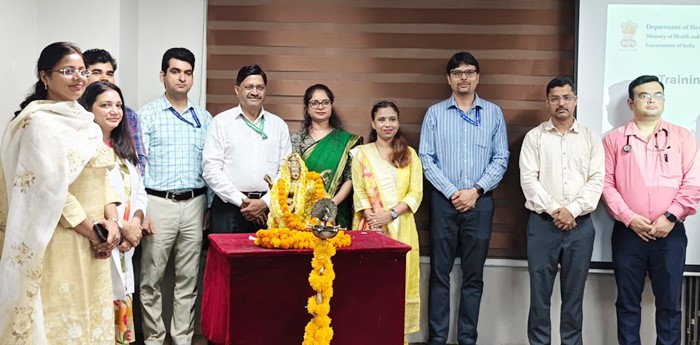
GIMS Greater Noida Conducts Two-Day PBHS 2.0 Training
TEN NEWS NETWORK
Greater Noida News (03 September 2026): The Government Institute of Medical Sciences (GIMS), Greater Noida, organised a two-day training programme under the Population Based Health Survey (PBHS) 2.0 initiative to enhance the skills and preparedness of field teams involved in population-level health data collection.
The training programme, held on September 2 and 3, 2026, brought together participating field teams from MRHRU Dadha and MRHRU Panipat. The initiative focused on improving the accuracy, consistency and quality of household and community-level health data, which can play an important role in evidence-based public health planning and policymaking.
ICMR-NICPR Director and GIMS Director attend inaugural session
The programme began on September 2 with a welcome address by Dr. Priyanka from the Department of Community Medicine, GIMS. The opening session included an overview of the MRHRU programme and PBHS 2.0, outlining the objectives and field-level requirements of the survey.
The inaugural session was attended by Dr. Shalini Singh, Director, ICMR-National Institute of Cancer Prevention and Research (ICMR-NICPR), Noida, and Brig. Dr. Rakesh Gupta, Director, GIMS, Greater Noida.
The presence of senior officials and experts highlighted the importance of strengthening the implementation capacity of field teams engaged in population-based health research.
Multidisciplinary training covered key health domains
The training followed a multidisciplinary and practical approach, combining classroom-based academic sessions with demonstrations, field-oriented discussions and interactive learning activities.
The expert faculty from GIMS included Dr. Abhishek Bharti, Dr. Sanju Yadav, Dr. Deepshikha Varun, Dr. Deepak Sharma and Dr. Vaishali. During the programme, participants were trained in several important areas of population health, including:
Reproductive Health
Non-Communicable Diseases (NCDs) and Cancer
Mental Health
Household-related survey modules
The sessions were designed to familiarise field personnel with the survey methodology while also helping them understand the practical challenges that may arise during household and community-level data collection.

Focus on uniformity and quality of field-level survey work
The participating teams were coordinated by Dr. Prashant Kumar Singh, Nodal Officer, MRHRU Dadha, and Dr. C. P. Yadav, Nodal Officer, MRHRU Panipat, along with their respective field teams.
Dedicated practice sessions were conducted to provide participants with hands-on understanding of survey procedures. Interactive discussions also enabled the teams to raise field-level concerns and seek solutions to potential challenges.
The organisers emphasised that the reliability of a population-based health survey depends significantly on the preparedness, technical understanding and field skills of the teams collecting the information.
Structured training, practical exposure and regular technical guidance were therefore highlighted as essential components for maintaining the accuracy, completeness, consistency and validity of survey data.
Day 2 focuses on NCDs, cancer, mental health and household module
The second day of the programme, held on September 3, included further sessions on the NCD and Cancer Module, Mental Health Module and Household Module.
An interactive question-and-answer session was also conducted, allowing participants to clarify methodological issues and discuss practical situations that they may encounter during the actual field implementation of PBHS 2.0.
The sessions aimed to ensure that participating teams follow a consistent approach while gathering and documenting health-related information from households and communities.
PBHS 2.0 expected to support evidence-based health planning
The training programme is expected to strengthen coordination among GIMS, ICMR-NICPR, MRHRUs and the field health system. Better coordination and trained field personnel can help translate technical expertise into effective community-level health assessment.
Data generated through PBHS 2.0 could provide valuable insights into the health needs and disease patterns of populations covered by the survey. Such evidence can contribute to informed health planning, policy formulation and the strengthening of public health services.
The organisers said that the two-day training marks an important step towards developing a skilled and coordinated field workforce capable of implementing PBHS 2.0 effectively and generating reliable population-level health evidence.
They also acknowledged the contribution of experts, faculty members, nodal officers and participating field teams whose active involvement supported the successful conduct of the training programme.
Dear Readers and Viewers, Please note that tennews.in: National News Portal daily publishes latest and top ten news from government, politics, national, business, education, technology, lifestyle, entertainment, health etc ten categories. You may submit your e mail and subscribe it to get updates on your e mail. Please also subscribe TEN NEWS NATIONAL YouTube Channel.

Comments are closed.