

Over/Under Corners Betting in Football: 7 Smart Basics
Table of Contents
- Introduction
- What does over/under corners mean?
- How the total corners market works
- Why corner counts change from match to match
- How to read odds and lines correctly
- Common mistakes in football corner betting
- A simple corner betting strategy for beginners
- Final thoughts
- FAQs
Introduction
Over/Under Corners Betting in Football is a market where you predict whether the total number of corners in a match will finish above or below the bookmaker’s line, such as 8.5, 9.5, or 10.5. It is simple in concept, but it rewards bettors who understand match tempo, team style, score effects, and how game state changes corner volume.
If you are still learning how sportsbooks present specialist football markets, looking at a sportsbook review such as khelostar can be useful for seeing how betting menus, bonus details, and football options are typically displayed before you place any wager. The Telecom Asia review describes Khelostar as a platform that includes sportsbook features alongside other betting products, which makes that reference relevant in a discussion about navigating football betting interfaces.
This guide explains the market clearly, answers the most common beginner questions, and shows how to think about football corner betting without overcomplicating it.
What Does Over/Under Corners Betting in Football Mean?
Over/under corners is part of the broader total corners market. Instead of betting on who wins the match, you bet on how many corners both teams will produce combined.
For example:
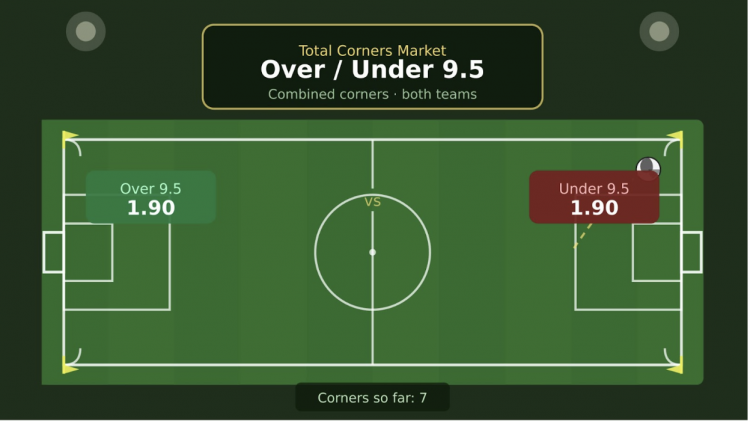
- Over 9.5 corners wins if the match has 10 or more corners
- Under 9.5 corners wins if the match has 9 or fewer corners
- The final score does not matter unless it affects the style of play
This is why many bettors like the market. You are not relying only on goals. You are reading pressure, territory, attacking patterns, and whether a team tends to force blocks, crosses, and saves.
Why do bookmakers use lines like 8.5 or 9.5?
Bookmakers usually use half lines to avoid a tie. If the line is 9.5, the bet cannot land exactly on 9.5. It must go over or under.
That makes settlement straightforward:
- 10 corners or more = over wins
- 9 corners or fewer = under wins
Some sportsbooks also offer whole-number lines like 9 or 10. In those cases, a push may be possible. If you bet over 9 and the match ends with exactly 9 corners, your stake is often returned, depending on the house rules.
What counts as a corner in football betting?
A corner is counted only when it is officially awarded and taken. A dangerous attack that almost wins a corner does not count. A deflected shot that goes behind for a goal kick does not count either.
That is why live bettors should be careful. Fast-paced moments can look like corner-heavy pressure, but only officially recorded corners settle the market.
How the Total Corners Market Works
The total corner market is built on probability. Bookmakers estimate how open the match should be and then set a line based on likely corner volume.
In a match between two wide, attack-minded teams, the line may be higher. In a slower match between possession-heavy teams that attack centrally, the line may be lower.
How do odds reflect the expected number of corners?
The line and the odds work together.
A bookmaker might offer:
- Over 9.5 corners at 1.90
- Under 9.5 corners at 1.90
That suggests the market sees both outcomes as roughly balanced before margin is considered.
But the market may move. If team news, weather, or betting activity changes expectations, the line might shift from 9.5 to 10.5. That move matters. A single corner can be the difference between a winning and losing ticket.
Which matches usually produce more corners?
There is no guaranteed profile, but some patterns appear often:
- Teams that attack through wingers tend to create more crossing situations
- Underdogs defending deep can concede repeated corners
- Matches where one team chases the game often become corner-heavy
- Cup ties and knockout matches can become tactical and slower early on
- Rivalry games may be intense but not always corner-rich
This is where football corner betting becomes more than guesswork. The best reads come from style, not just league averages.
Why Corner Counts Change From Match to Match
Many beginners ask: Why do some matches finish with 3 corners while others end with 14?
The answer is game state. Corners are shaped by what the match becomes, not only by what it looked like on paper before kickoff.
Team style and attacking shape
A team that attacks wide, overlaps often, and delivers crosses will usually create more corner opportunities than a team that builds patiently through the middle.
Look for teams that:
- Play with natural wingers
- Attempt frequent crosses
- Take lots of shots under pressure
- Spend long spells in the final third
These patterns matter more than reputation. A famous club is not automatically a good over corners pick. A less glamorous side with relentless wing play may be better for this market.
Scoreline, pressure, and late-match urgency
The score changes everything.
If a favorite goes 1-0 down early, it may spend the rest of the game piling pressure onto the box. That can lead to blocked shots, defensive clearances, and repeated corners.
On the other hand, if a strong team scores twice in the first half, the tempo may drop. The leading side may recycle possession instead of forcing attacks. The trailing team may struggle to create meaningful pressure. In that case, an over can die even in a match with strong pre-game stats.
This is why many bettors combine pre-match analysis with live observation. Over/Under Corners Betting in Football is often easiest to read when you understand how urgency changes behavior.
How to Read Odds and Lines Correctly
A common question is: How do you know whether the corner line is too high or too low?
You never know with certainty, but you can compare the line against realistic match scenarios.
Reading pre-match over under betting lines
Suppose the line is 11.5 corners. That is high. To back the over, you need a strong reason to expect sustained pressure from one side or an end-to-end game from both teams.
If the line is 7.5, that is much lower. The over may look attractive, but low lines often exist for a reason. The teams may be slow, compact, or unlikely to attack wide.
When reading over under betting markets for corners, ask:
- Is one team likely to dominate territory?
- Does the underdog concede pressure in wide areas?
- Will the match stay competitive long enough to keep the pace high?
- Are both teams comfortable attacking from the flanks?
Why live corner lines can offer better value
Live betting can reveal the real shape of the match.
You may notice:
- One team is pinning the other back
- Full-backs are constantly overlapping
- Shots are being blocked repeatedly
- The tempo is much higher than expected
In those situations, the live corner line may still lag behind what the eye test suggests.
But caution matters. Early corners can also distort the live number. A match may start with three quick corners and then slow down completely. Chasing an inflated line just because the opening 10 minutes were frantic is a common mistake.
Common Mistakes in Football Corner Betting
Many bettors treat corners as random. They are not fully random, but they are noisy. That is why discipline matters.
Betting overs in every high-profile match
Big matches attract attention, but that does not mean they suit overs.
Elite teams may control space so well that attacks never turn into corner sequences. Some high-level games become tactical chess matches with long spells of safe possession.
A glamorous fixture is not enough. You still need a reason grounded in the actual matchup.
Ignoring how one-sided games can hurt totals
Beginners often assume domination means lots of corners. Sometimes it does. Sometimes it does not.
A dominant team may score early and then stop forcing the issue. If the weaker side barely crosses halfway, the overall total can remain modest.
That is why a good corner betting strategy looks beyond “strong team versus weak team” and asks how the match is likely to unfold after the first goal.
Over/Under Corners Betting in Football for Beginners
This section answers another common question: What is the safest way to approach over/under corners as a beginner?
There is no risk-free method, but there is a smarter way to build your process.
Start with simple filters
Before betting, check:
- Recent corner trends for both teams
- Whether they attack wide or centrally
- Whether one side usually dominates territory
- Whether the match is likely to stay competitive
- Whether weather or pitch conditions may slow the game
Do not treat these as rigid rules. Use them as filters to remove weak bets.
Build a practical corner betting strategy
A beginner-friendly process could look like this:
- Avoid betting only on team names
- Focus on style and game flow
- Compare the line with realistic match scripts
- Watch for live pressure before entering late
- Keep stakes consistent
- Track results to see which setups actually work
This approach helps you turn football corner betting into a repeatable process rather than a series of guesses.
Final Thoughts
Over/Under Corners Betting in Football looks simple because the market asks only one question: will the total finish above or below the line? But the best decisions come from reading team style, match state, and pressure patterns rather than relying on instinct alone.
If you understand how the total corners market is priced, why lines move, and how game flow affects corner counts, you give yourself a much better foundation. Whether you prefer pre-match picks or live entries, the goal is the same: make disciplined decisions, avoid forcing bets, and treat Over/Under Corners Betting in Football as a market that rewards observation more than hype.
FAQs
What is over/under corners betting in football?
It is a bet on whether the combined number of corners in a football match will finish above or below a set line, such as 9.5 corners.
How do bookmakers set the total corners market?
They estimate likely corner volume based on team style, match expectations, and market activity, then adjust the line and odds as new information comes in.
Which is better: pre-match or live corner betting?
Neither is always better. Pre-match betting helps when you trust your research, while live betting helps when you want to confirm the pace and attacking patterns before entering.

Comments are closed.