

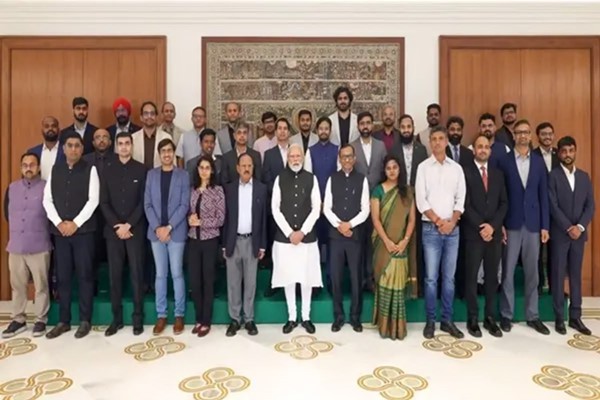
PM Modi Meets India’s Space Startups on National Space Day, Hails Their Vision for India’s Space Future
TEN NEWS NETWORK
National News (23 August 2026): Prime Minister Narendra Modi on Sunday interacted with representatives of India’s emerging space-startup ecosystem as the country marked National Space Day, highlighting the growing role of private enterprises in shaping India’s ambitions in space exploration and technology. Sharing a video of the interaction on social media, Prime Minister Modi said he was impressed by the enthusiasm, innovative thinking and ambition displayed by the young space entrepreneurs. He also invited citizens to share what excites them most about India’s rapidly evolving space journey.
The interaction comes at a time when India’s space sector is witnessing a significant expansion beyond traditional government-led programmes, with startups increasingly contributing to satellite technology, launch systems, space applications, earth observation and other emerging areas.
PM Modi Highlights Startup Energy and Innovation
Following his meeting with representatives of India’s space startups, Modi described the participants as some of the country’s brightest talent in the space sector. He praised their confidence and forward-looking approach and encouraged the public to engage with the broader conversation surrounding India’s space ambitions.
The Prime Minister’s interaction underlined the increasing importance of entrepreneurship and private-sector innovation in taking India’s space programme into its next phase. India has been steadily building a wider space ecosystem in which government institutions, established industries, startups, research organisations and young innovators can work together to develop new technologies and commercial applications.
National Space Day Marks Chandrayaan-3’s Historic Achievement
National Space Day is observed every year on August 23 to commemorate India’s historic Chandrayaan-3 achievement in 2023. On August 23, 2023, the Vikram lander successfully completed a controlled soft landing on the Moon, making India the first country to land a spacecraft in the lunar south polar region. The achievement placed India among the leading nations in lunar exploration and became a landmark moment for the country’s scientific and technological capabilities.
Following the landing, the Pragyan rover was deployed on the lunar surface to carry out experiments and gather scientific information. Prime Minister Modi had earlier extended his greetings on National Space Day, calling on the nation to continue pursuing ambitious goals, innovation and new frontiers in space exploration.
Amit Shah Pays Tribute to ISRO Scientists
Union Home Minister Amit Shah also greeted citizens on the occasion and recalled Chandrayaan-3’s historic landing.
Shah highlighted the significance of the mission and praised scientists of the Indian Space Research Organisation for establishing India’s technological capabilities on the global stage. The occasion has once again brought attention to the contribution of Indian scientists, engineers and researchers whose work has helped the country develop an increasingly sophisticated space programme.
ISRO Recalls India’s Journey From Humble Beginnings
The third National Space Day celebrations were held in Ahmedabad on Sunday, bringing together senior officials, scientists and representatives of India’s expanding space ecosystem. ISRO Chairman V Narayanan reflected on the organisation’s early years and the extraordinary transformation of India’s space programme over the decades. Recalling the challenges faced during the initial phase of the programme, Narayanan said rocket components were once transported using bicycles because the country lacked adequate transportation facilities for such work.
He contrasted those modest beginnings with India’s present-day position as a major global player across several areas of space technology and exploration.
Chandrayaan-3 Continues to Deliver Scientific Value
Narayanan also stressed that Chandrayaan-3’s success was not limited to achieving a soft landing. According to him, the mission has generated valuable scientific information that has been made available to researchers around the world. The data collected from the lunar surface has added to scientific understanding of the Moon and created opportunities for further research.
He further described the mission’s ability to inspire millions of Indians as one of its most significant accomplishments, saying Chandrayaan-3 generated a powerful sense of scientific curiosity and national confidence among people across the country and abroad.
Private Sector Emerges as a Key Force in India’s Space Ambitions
The Prime Minister’s meeting with space startups also reflects the changing structure of India’s space sector. With greater participation from private companies and startups, India is seeking to build a competitive space economy capable of supporting innovation, commercial launches, satellite-based services and advanced space technologies. The growing startup ecosystem is expected to complement the work of ISRO while creating new opportunities for investment, research, skilled employment and international collaboration.
National Space Day therefore serves not only as a celebration of Chandrayaan-3 but also as a platform to recognise India’s broader scientific progress and encourage the next generation to pursue careers in space science, engineering, research and technology. As India looks towards increasingly ambitious missions and a larger role in the global space economy, the combination of public-sector expertise, private innovation and young entrepreneurial talent is expected to remain central to the country’s space ambitions.
Dear Readers and Viewers, Please note that tennews.in: National News Portal daily publishes latest and top ten news from government, politics, national, business, education, technology, lifestyle, entertainment, health etc ten categories. You may submit your e mail and subscribe it to get updates on your e mail. Please also subscribe TEN NEWS NATIONAL YouTube Channel.

Comments are closed.