

Teachers Are the Indispensable Force Behind Innovation & Viksit Bharat 2047: Dr. K. Mallikharjuna Babu, VC, Galgotias University
TEN NEWS NETWORK
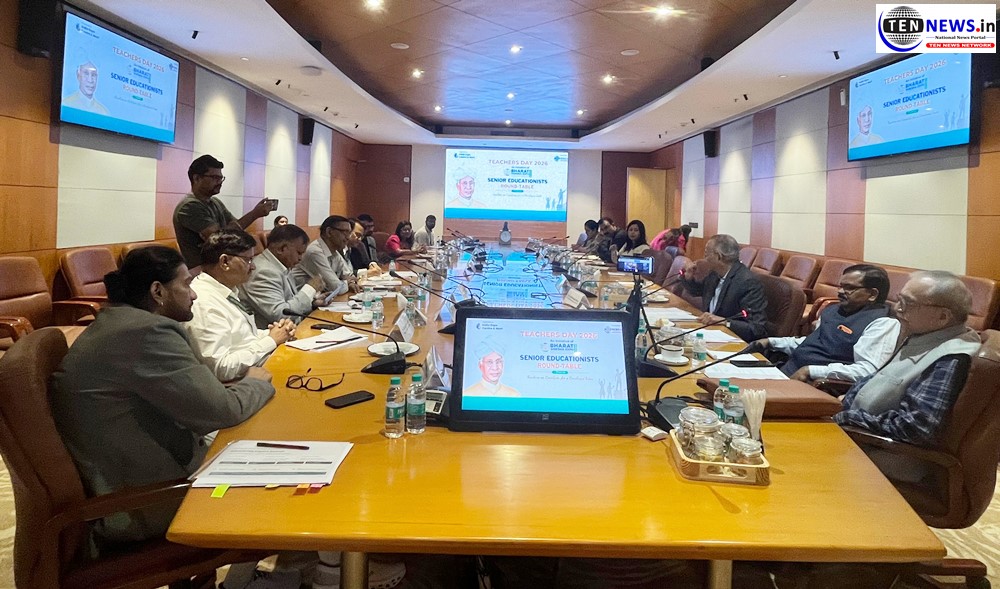
Greater Noida (September 6, 2026): The evolving role of teachers, the impact of artificial intelligence on education, the growing contribution of private universities, public-private partnerships in research and the long-term development of Greater Noida’s Knowledge Park emerged as key issues at the Bharat Shiksha Expo Initiative – Senior Educationists’ Round-Table, held on the occasion of Teachers’ Day 2026.
Organised by India Expo Mart & Centre in association with TEN NEWS NETWORK, the high-level dialogue was held on the theme “Teachers as Catalysts for a Developed India” and brought together senior educationists and institutional leaders to deliberate on the future of India’s education and knowledge ecosystem.
Speaking at the round-table, Dr. K. Mallikharjuna Babu, Vice Chancellor, Galgotias University, said India’s vision of Viksit Bharat 2047 should not be viewed merely as an economic target, but as a commitment to achieving global leadership in knowledge, technology and human development.
When we talk about Viksit Bharat 2047, we are not merely discussing an economic target. We are committing ourselves to a global leadership position — a Vishwaguru — in knowledge, technology and human development.

Dr. Babu said this vision has been embedded in Galgotias University’s institutional approach and is reflected in its academic, research and industry initiatives. He noted that the university began aligning itself with the national development mission well before Viksit Bharat became a widely discussed national theme.
According to Dr. Babu, Galgotias University launched its strategic Viksit Bharat series on September 14, 2023, with a session featuring Prashant Tandon, founder of Tata 1mg. Since then, he said, classroom initiatives, research activities and industry partnerships at the university have increasingly been aligned with the objective of building an ecosystem capable of contributing to India’s development by 2047.
Quality Education Must Go Beyond Marks
Addressing the question of what constitutes quality education in the 21st century, Dr. Babu said educational success can no longer be measured simply by textbook completion or examination scores. Quality education in the 21st century can no longer be measured by textbook completion or examination marks. It must be defined by future-ready skills.
He said education must focus on three fundamental dimensions — knowledge, skills and attitude — while preparing students to continuously learn, unlearn and relearn in response to a rapidly changing world. Dr. Babu emphasised that students enter universities with knowledge, curiosity and intellectual potential, but teachers play a critical role in providing purpose-oriented mentorship and helping young people channel their abilities towards meaningful goals.
He described the relationship between intellect, education and enterprise as an important part of the development journey, arguing that education should bridge intellectual potential with entrepreneurship, business and broader societal contribution.
Teachers Remain Central in the Age of AI
Dr. Babu placed the role of teachers at the centre of the discussion, arguing that technology may transform how knowledge is delivered but cannot replace the human influence of an educator. Behind every disruptive innovation, every successful start-up and every future-ready curriculum stands one indispensable force: the teacher.
He said infrastructure may attract students and technology may deliver content, but teachers remain uniquely positioned to ignite ambition, develop critical thinking and instil values. With students now having access to lectures, online courses, AI tools and vast digital resources, he said the teacher’s role is evolving from being primarily a transmitter of information to becoming a mentor, facilitator and guide.
“Technology can deliver content, but only a teacher can ignite ambition, critical thinking and instil values.”
Faculty Empowerment Essential for Future-Ready Education
Dr. Babu also underlined the importance of continuously empowering faculty members. He said online education and digital training have created greater opportunities for teachers to upgrade their knowledge, but institutions must ensure that faculty development is relevant to their disciplines and, more importantly, to the needs of their students.
He called for greater emphasis on global competencies, digital tools, emerging technologies and research capabilities, including areas such as artificial intelligence and quantum technologies. According to Dr. Babu, teachers themselves must remain lifelong learners if they are expected to prepare students for a rapidly changing global environment.
He also highlighted the importance of strengthening research standards among faculty and PhD scholars. Citing Galgotias University’s research policy, he said the institution has introduced higher publication expectations for its PhD scholars, requiring them to produce quality research publications.
Dr. Babu said the university has mandated its PhD scholars to publish two quality research papers in journals ranked from Q1 to Q4, despite such requirements going beyond the minimum regulatory expectations. He argued that stronger research standards not only improve institutional research outcomes but also enhance the capabilities of teachers, who frequently serve as supervisors and mentors to research scholars.
Building Global Citizens Rooted in Indian Values
Dr. Babu said the ultimate objective of education should be to create world-class global citizens who remain rooted in Indian ethos and values. Looking ahead to 2047, he said educators and institutions must collectively take responsibility for shaping the India they envision for the centenary of Independence. “If we all decide that Viksit Bharat should happen, it will happen. But if we remain in two minds, we cannot achieve that vision.”
He called for collective commitment, purposeful action and stronger collaboration among educational institutions, teachers, researchers, industry and policymakers to translate the vision of Viksit Bharat into reality.
The Round-Table was presided over by Dr. H. Chaturvedi, Pro-Chancellor, IILM University, Greater Noida, Sudeep Sarcar, CEO, India Expo Mart and attended by distinguished senior educationists and institutional leaders from leading universities, colleges and schools.
Those participating included Dr. K. Mallikharjuna Babu, Galgotias University; Prof. Sibaram Khara, Sharda University, Greater Noida; Brig. Dr. Rakesh Gupta, GIMS, Greater Noida; Ms. Kanchan Kumari, Delhi World Public School, Knowledge Park; Dr. R. S. Rai, Bennett University; Dr. Pankaj Gupta, O.P. Jindal Global University, Hisar; Dr. Abhilasha Gautam, Army Institute of Education, Ujjawal Pratap, Galgotias University among others.
The participation of senior academic leaders provided a diverse perspective on the role of teachers, higher education, research, innovation and public-private collaboration in advancing India’s development agenda.
The discussions reinforced a central message of the Bharat Shiksha initiative: India’s journey towards becoming a developed nation will depend not only on expanding access to education, but also on improving quality, strengthening research, empowering teachers and ensuring that technology-driven transformation reaches every layer of the education system.
Dear Readers and Viewers, Please note that tennews.in: National News Portal daily publishes latest and top ten news from government, politics, national, business, education, technology, lifestyle, entertainment, health etc ten categories. You may submit your e mail and subscribe it to get updates on your e mail. Please also subscribe TEN NEWS NATIONAL YouTube Channel.

Comments are closed.