
The Economics of Education: Investing in Human Capital in the Age of AI
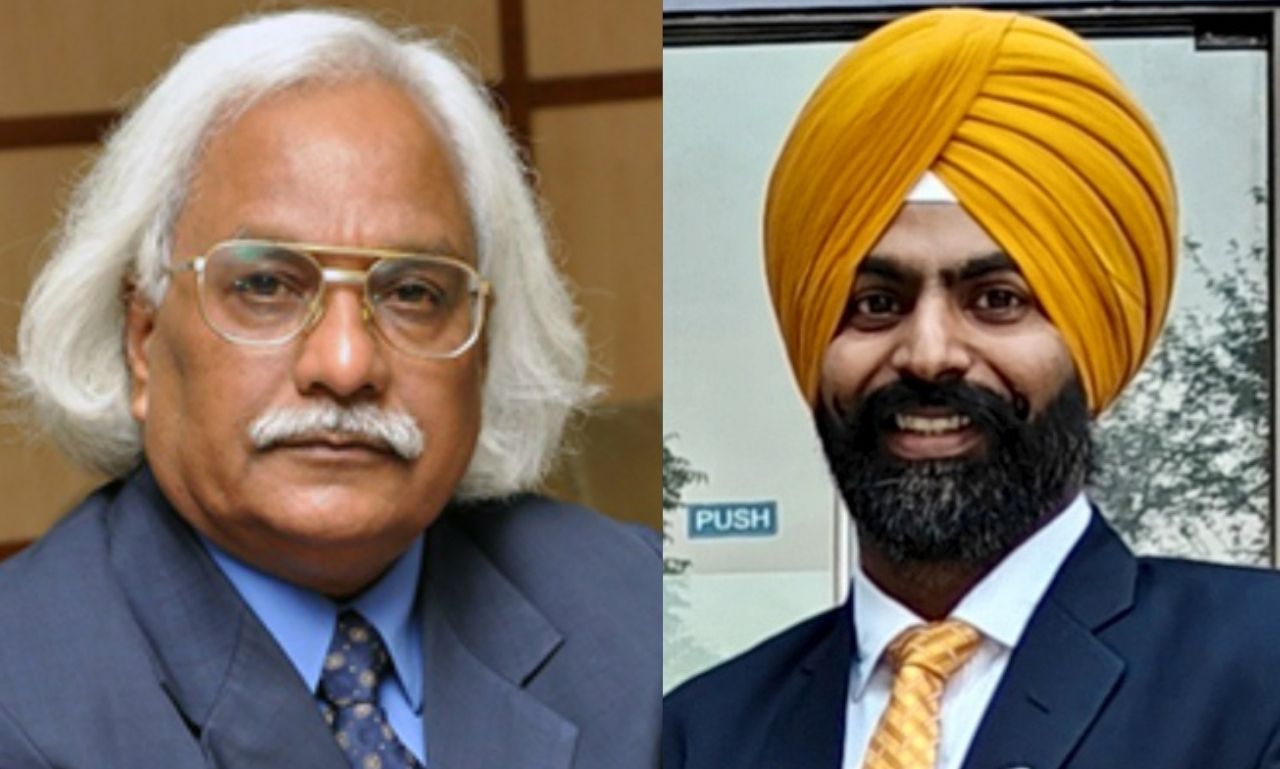
Prof PB Sharma and Sandeep Singh
Imagine a resource that can cause accelerated economic resurgence, reduce inequality and poverty, cause path breaking scientific discoveries, create game changing technologies, connect the whole world with hyper connectivity, create a profound vision and impactful strategies for nation building, provide leadership to the nation and also to global humanity, enable transactions at the speed of thought, boost innovation, cause New Age enterprise development, create capabilities to take the monumental challenges head on, redefine meaning and purpose of life, boost quality of life on land, scale the unscalable and stabilize economies, and that too all at once. It is not a rare mineral nor a breakthrough tech algorithm, it is the education that we provide to the inspired minds and empower them with the power of knowledge and the wings of innovation as also to mentor them as persons of integrity and conscience to trade and transact their personal and work life as noble citizens of the world.
In the realm of economics, education is rarely viewed as just a social good or a personal milestone. Instead, it is analysed as one of the most vital economic engines a society can fuel. The Economics of Education so far has been exploring how individuals, employers, and governments allocate resources for schooling, colleges and universities and the returns those investments yield. In our opinion, It has yet to rediscover the hitherto unexplored horizons of economics of education, a resource whose potential is often hidden in the engagement of individuals and teams that deliver the promise of unimagined returns on the strength of their ingenuity coupled with the translational power of knowledge and innovation that education in the age of AI is aiming to unfold.
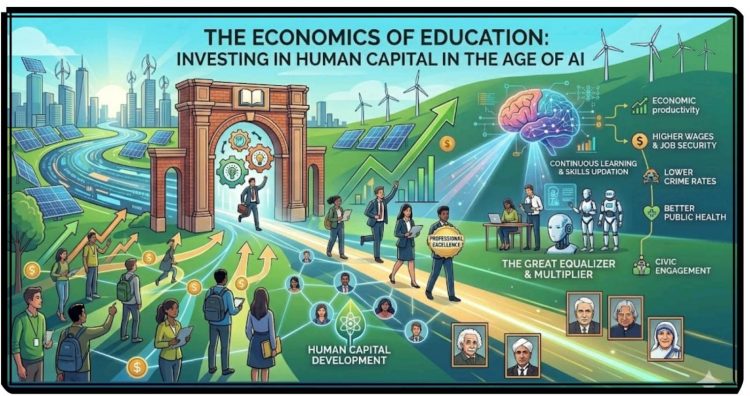
In the hypothesis below we reexamine the economics of education from the point of view of recognising the great power of education as also the responsibility of the society and the government to invest and support this noble act of the human society that creates, Sir Albert Einstein, Graham Bell, Thomas Edision, Madam Curie, Dr Hargobind Khurana, Bharat Ratnas Sir CV Raman, Dr S Radhakrishnan, Sir M Visvesvaraya, Dr APJ Abdul Kalam, Dr MS Swaminathan and illustrious Sons of Mother India like the master visionary Dr Homi Jehangir Bhabha, Dr Vikram Sarabhai, Prof Satish Dhawan, Dr Ram Mashelkar, Er E Sreedharan, the Father of White Revolution Dr Verghese Kurien, Nobel Laureate Sri Rabindranath Tagore, Nobel Peace Laureates HH Dalai Lama and Shri Kailash Satyarthi.
1. Education as “Human Capital”
For decades, classical economics focused heavily on money and physical capital (machines, factories, land). However, in the mid-20th century, economists like Gary Becker and Theodore Schultz pioneered the Human Capital Theory that propounded the idea that individuals possess a set of skills, knowledge, capabilities, and acumen that can be augmented through investments in education and training, ultimately increasing their economic productivity.Under this hypothesis, going to schools, colleges and universities is not just about learning to know or learning to do, it is an investment for the future, a readiness for launching oneself in the vast arena of professional endeavours and promising careers.
For this, individuals incur immediate costs (tuition, books, and the “opportunity cost” for those already in employment) in exchange for future rewards such as higher wages, better job security and a greater career mobility.
2. Symbolizing vs. Human Capital
There is a fascinating debate within economics regarding why education increases earnings:
- The Human Capital View: Education actually teaches you both the hard and the soft skills, making you fundamentally more productive.
- The Signaling (or Screening) View: Popularized by Michael Spence, suggests that education does not necessarily make you more productive; rather, obtaining a degree acts as a “signal” to employers that you are above board, have both the knowledge and exposer and capable of working in large teams handling complex tasks. It is like an IIT or IIM graduate being taken as being adorned with knowledge and skills beyond normal graduates rolling out from universities and colleges.
In reality, the truth is that a well-earned degree is much more, given the potential of innovation and creativity providing opportunities of leap frogging and also pole vaulting as one move from one level of excellence to another with integrity and maturity during his professional work life.
But here also the education environment and the ecosystem of value addition and exposure that matters often much more. A computer science degree teaches you how to code (human capital), but the Ivy League stamp on the diploma also acts as a powerful filter for recruiters (signalling) as it gives a much greater confidence in individuals capability to learn and adopt in teams and in a diversified multidisciplinary work environment.
3. Microeconomics: The Return on Investment (ROI)
For an individual, the economics of education boil down to a personal cost-benefit analysis. Economists measure this using the Mincer Equation, which calculates the rate of return on each additional year of schooling.
Beyond GDP numbers, public investment in education yields massive positive externalities that are the benefits enjoyed by society that the individual student did not necessarily plan for. These include:
- Lower Crime Rates: Higher education levels correlate with reduced structural crime, saving public funds on law enforcement and incarceration.
- Better Public Health: Educated individuals generally make healthier lifestyle choices, reducing the burden on public healthcare systems.
- Civic Engagement: Higher education levels are linked to increased voter turnout, volunteerism, and political stability.
Because the societal benefits of education outweigh the personal benefits, economists argue that governments must heavily subsidize education. If left purely to the free market, people would under-invest in education because they would only view the return of investment from education in terms of their jobs, salaries and carriers.
4. Current Trends and Challenges for Assessment of RoI
i. The Student Debt Crisis
In many nations, particularly in rapidly developing economies like India and China and in developed nations like the United States, the cost of higher education has vastly outpaced inflation. This has created a trillion-dollar student debt bubble in US and also causing a great concern in India. When young graduates carry heavy debt burdens, they often exhibit their dismay and dissatisfaction for the system of education as the heavy debt burden erodes their quality of life and wellbeing.
ii. The Equity Gap and Inter-generational Mobility
Education is often called “the great equalizer,” but it can also perpetuate inequality. Wealthier families can afford better neighbourhoods with well-funded public schools, private tutoring and elite university tuition. When access to quality education is heavily tied to socio-economic status, education becomes a mechanism for hoarding wealth across generations rather than offering equal opportunities to the talented individuals, no matter what prosperity levels they come from. The economic disparities and social inequalities that are associated with the modern economic systems are also a result of this uneven playfield in the arena of educational opportunities.
iii. The AI and Smart Automation Disruption
The rapid rise of Artificial Intelligence is shifting what the market values. Rote memorization and basic cognitive tasks are being automated and are being taken over by smart and intelligent machines powered by AI and ML Applications. In this scenario, the economics of education must now pivot toward teaching “durable skills” critical thinking, emotional intelligence, and continuous adaptability of new technologies, forcing colleges and universities to rethink their traditional curricula that earlier heavily relied on cultivating the knowledge base and analytical skills.
Concluding Remarks
The economics of education proves that investment in education and learning is in fact the ultimate multiplier. Computing RoI on the basis of investment per student and the return in entry level jobs is only the first estimate of RoI that gets enormously multiplied as individuals grow and advance to higher levels of responsibilities. Further, no one knows for sure that an individual, student of a class shall become an Einstein or CV Raman nor it is possible as at present to assess the carrier paths given the level of uncertainty and fuzziness of role of graduates in the age of AI. One thing however is clear that the investment in education, when made in an environment that nurtures creativity, innovation and collaboration empowering individuals with both the high tech skills and life skills to navigate their professional carriers along their interest areas and that too with integrity and agility, the return of investment in education becomes the investment for a bright and blissful future of the humanity and a great good to the people and the planet Mother Earth.
As such, there is no safer, high-yield investment than investing in human resource development and in regular update of their skills and knowhow. Thus, to thrive in a knowledge-driven global economy powered by AI and hyper-connectivity, education can no longer be treated as a mere investment to be managed. Instead, governments and individuals must view it as strategic capital to be deployed for nation-building and for the cultivation of a responsible global citizenship, a prerequisite for fostering true empathy, nobility, and fulfilment in human life.
The authors: Prof PB Sharma is a renowned thought leader, former President of AIU, founder Vice Chancellor DTU and currently the Vice Chancellor of Amity University Gurugram, Sandeep Singh is a research scholar pursuing his PhD in Cyber Security and AI at Amity University Gurugram.

Comments are closed.