
AI for Jobs for the Millions: A Perspective for Accelerating Economic Growth in the Age of AI
Authored by: Prof PB Sharma and Sanskrit Sharma
With the advent of AI and its applications being accessible to one and all, the digital revolution has entered into a new era where the man-machine interface has become one of the most powerful instruments to accelerate economic progress as well as social transformation at a scale unprecedented. However, The power of AI, and its integration on one hand is offering great opportunities for engagement of the young inspired minds in innovations and start-ups to make a Big of AI, on the other hand, AI and Machine Learning together are empowering industries and corporate with tools of ultra automation in their quest to significantly increase both the speed, precision as well as productivity of systems and efficacy of their services. The impact is so phenomenal that no sector of human activity remains untouched from assimilating AI and reeling under its impact.
This is giving rise to a new era in which AI is causing near-havoc at the workplace in leading MNCs and corporations. The recent announcement of massive layoffs including 12,000 workforces in India by a leading MNC which is also at the heart of ushering the AI revolution is one such example. Similar sentiments for job losses in India and in all nations of the world have begun to make headlines sending shockwaves for the future of job and the future of the workplace.
As per the The State of the Global Workplace report 2025, by Gallup, the world’s largest ongoing study of employee experience, the global employee engagement fell to 20% in 2025, its lowest level since 2020, costing the world economy an estimated $10 trillion in lost productivity. Similarly, the 2026 outlook for jobs, as per the World Economic Forum Report, 2025 is characterized by AI-driven transformation, with 39% of worker skills expected to change or become obsolete by 2030. While AI drives productivity and creates new roles, a “jobs gap” of 408 million people is projected worldwide. This gap requires massive education and upskilling in AI and AI driven workplaces in key growth areas that include AI integration, cybersecurity, green energy technologies, hightech agro-tech, healthcare, Industry 5.0, business and market intelligence, management of smart offices, smart mobility, smart cities and smart infrastructure.
India’s Economic Growth- The Time is Right for Leapfrogging
India with its fastest growing economy powered by phenomenal growth and development of its world class infrastructure and the rise of higher end manufacturing and export is poised for rapid advancement towards its goals of economic resurgence that promises its economy to grow from around 4 trillion economy to 40 trillion by 2047, a quantum jump indeed that necessitates pole vaulting in many sectors of its vibrant economy. Being a populous nation, currently home of 1.45 billion people, some 18% of the world population, it can not remain satisfied with only a 3.5 % share of the world economy as per the current size GDP. Its trajectories of economic growth now onwards must move along pathways of rapidtrack development. The time is right for leapfrogging in various sectors of economy as the opportunity is big for growth at a scale.
The question that however, haunts the minds of both the policy makers as well as 425 million youth of India in the age group of 15-29 years in 2025-26, is whether this impressive growth of nations economy will be able to meet the aspirations of young India in respect of massive job creation for its young inspired minds rolling out of its 1000 plus universities and 70000 plus colleges? India needs to take this challenge head on to encash its demographic dividend that make India a country of youth power comprising of 29% of the total population, of which roughly 64% are residing in rural areas and 36% in urban India.
Making AI a powerful Engine for Job Creation for Young India- Both Rural and Urban
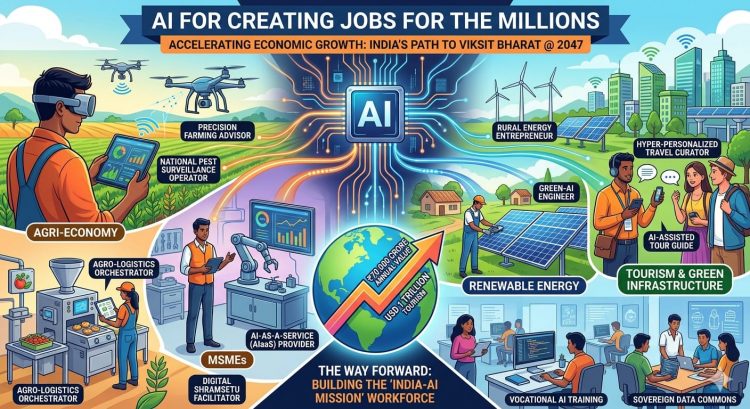
To achieve the ambitious goal of Viksit Bharat @ 2047, India must pivot its strategy toward high-impact sectors where AI can act as a catalyst for large-scale job creation. The following roadmap outlines how we can transform the “jobs gap” into a “jobs surplus” across critical pillars of the agro-economy, green infrastructure, rural entrepreneurship and urban services.
1. AI-Driven Agricultural Revolution & Agro-Economy
- The AI4Agri 2026 Summit: The AI4Agri 2026 Summit has highlighted that AI can unlock nearly ₹70,000 crore in annual value for Indian farmers. This shift is creating a new category of “Agri-Tech” professionals, opening new avenues for massification of AI Empowered workforce for India’s rural economy.
- Precision Farming Advisors: There is a massive demand for youth who can interpret AI-driven satellite and soil data to provide real-time, site-specific advisories.
- National Pest Surveillance Operators: Using AI models like those in the National Pest Surveillance System, thousands of rural youth can be trained as “Digital Crop Doctors” to identify and mitigate risks before they escalate.
- High Tech Agrotech Farmers: Using most modern agri processes for minimising water requirements, improving yield and adopting natural farming practices and creating smart and climate resilient farming using AI tools and higher end agriculture research.
- Multitasker Farming Professions: Using AI models supporting high productivity and quality of farm produce and promoting multisectorial growth of integrated systems of Agri-Horti-Fruits and Herbal Farming further supported by food processing industries in smart rural villages of tomorrow.
- Agro-Logistics Orchestrators: AI-enabled networks are optimizing market access for 1.8 million farmers. This requires a workforce skilled in managing AI-driven supply chains to reduce post-harvest losses and provide value addition to crop produce.
In 2025–26, India’s rural economy is estimated to contribute approximately US$1.8 trillion to the national GDP which is nearly 50% of its total GDP estimated at 3.916 US Dollars. Rural India continues to hold the majority of the population, accounting for 63.13% of the total 1.463 billion in 2025. AI integration in rural economic growth is poised to make Rural India a strong growth engine of Indian economy.
2. MSMEs: The Backbone of “Value for Many”
India’s 74.7 million MSMEs in India are the primary engines of employment currently employing 328.2 million of workers in their 74,7 million units, according to the Economic Survey 2025-26. AI integration into MSMEs by AI empowered workforce shall make the MSME sector to grow leaps and bound in the current decade of destiny, 2026-35.
- AI-as-Service Providers: Local youth can establish startups that provide affordable AI tools to small manufacturers for predictive maintenance and quality control, ensuring “Make in India” meets global standards.
- Digital Shram Tech Facilitators: Under the Digital ShramSetu Mission, AI is being used to match informal sector workers with high-demand manufacturing roles, creating a bridge between rural talent and urban MSME clusters.
- AI powered Marketing Professionals: AI powered Marketing Professionals shall connect MSME to the national and the global markets for their quality products and subassemblies making MSME as a vibrant growth engine of India’s economic resurgence for Viksit Bharat@2047.
3. Renewable Energy & Rural Entrepreneurship
The transition to a net-zero economy is perhaps the largest frontier for job creation:
- Rural Energy Entrepreneurs: AI-managed micro-grids and smart solar pumps allow rural youth to become energy providers for their own villages. This “Rural Energy Entrepreneurship” model creates decentralized jobs in grid maintenance and data-driven load balancing.
- Green-AI Engineers: As renewable energy processes become more complex, the demand for AI Experts in Energy is surging, with roles focused on optimizing solar and wind output through predictive weather modeling.
With India registering a phenomenal growth of its renewable energy sector, accounting already in 2026 to almost 50% of its installed energy capacity, there is huge scope for AI empowered workforce to support India’s transition to smart green energy future to support smart green mobility and green manufacturing and green development all around. Massive workforce requirement is envisaged to support the rise of this sector in coming years.
4. Tourism, Travel, and Green Infrastructure
The Vision India 2047 for tourism aims for a USD 1 trillion industry, projecting over 137 million jobs by 2030:
- Hyper-Personalized Travel Curators: AI tools like BHASHINI allow the tourism sector to cater to international and domestic travelers in their native tongues. This creates roles for “AI-Assisted Tour Guides” who can bridge cultural and linguistic gaps.
- Smart Infrastructure Managers: Green infrastructure—such as AI-driven waste management and smart water systems—requires a workforce skilled in “Digital Twin” technology to manage the physical assets of our developing cities and “Rurban” clusters.
- Massive job creation in urban India: Here lies another big opportunity as India is moving fast on urbanization at a scale to achieve its target of 50% urban population by 2035. The urban strategic planning for massive job creation is equally necessary to sustain Urbanization as a powerful vehicle of economic growth and societal transformation. The current focus of strategic planning for urban India hinges around strengthening city governance, large-scale skilling, and the digitalization of the MSME ecosystem powering job growth that aligns with India’s 2047 vision for Viksit Bharat as per NITI Aayog Report, 2026.
The Way Forward: Building the “India-AI Mission” Workforce
To realize this vision of AI empowered workforce the India-AI Mission, that is currently focussed on building the sovereign computing capacity and data centers, need to promote AI education and upskilling to meet the phenomenal demand for future ready AI workforce for ushering a New Era of growth and development supported by massive job creation for the AI empowered workforce. The focus must therefore remain on:
- Vocational AI Training: Integrating AI literacy into the Skill India and FutureSkills Prime frameworks to ensure every graduate is “AI-Ready.”
- Sovereign Data Commons: Developing localized AI models that understand the unique soil, climate, and socio-economic nuances of India.
- Inclusive Innovation: Ensuring that technology is powered not just by “Silicon” but “Silicon with a Soul”—designed for growth and development in harmony with nature and with highest levels of integrity, responsibility and sustainability in the new age of AI.
By 2047, the definition of a “developed nation” will not just be about high-rise buildings, but about a high-skilled, technologically empowered citizenry where every youth shall have ample opportunities for engagement in productive employment, including self employment and thus living a life with dignity and honour as the champions of sustainable development goals, SDGs and an active partners in progress of the nation.
We are thus at a critical juncture to make a Big of AI to unleash an era of massification of AI and AI empowered job creation in a nation like India, a country of youth, a powerhouse of talent and a home of STEM lovers in millions.
About the Authors:
Prof PB Sharma is a visionary thought leader, founder Vice Chancellor of DTU and Past President of AIU currently Vice Chancellor of Amity University Gurugram and Sanskrit Sharma is a tech savvy 12th Standards STEM student at Amity International School.

Comments are closed.