
GIMS Greater Noida Highlights Urgent Need for Adult Immunization in India Amid Ageing Population
TEN NEWS NETWORK

Greater Noida News (26/03/2026): With India witnessing a steady rise in life expectancy since the 1950s, healthcare experts are now emphasizing the growing importance of adult immunization as a critical public health priority. Medical professionals at the GIMS, Greater Noida highlight that as the country’s demographic profile shifts towards a larger adult and elderly population, preventive healthcare measures — especially vaccination — must receive renewed focus.
India’s healthcare advancements over the decades have significantly increased longevity, nearly doubling life expectancy compared to 1950. However, this progress has also brought new challenges. A rapidly expanding ageing population is more vulnerable to infectious diseases, making it essential for adults to adopt preventive health strategies to remain active and healthy.
The launch of the Universal Immunization Program (UIP) in 1985 marked a major milestone in India’s vaccination efforts. Since then, the country has strengthened vaccine manufacturing, cold chain systems, and delivery networks, along with training healthcare personnel nationwide. While childhood immunization has achieved considerable success in reducing disease burden and community transmission, experts warn that immunity from early-life vaccines may decline over time.
As a result, several infections once associated primarily with children — such as diphtheria, measles, mumps, rubella, influenza, pertussis (whooping cough), and hepatitis B — are increasingly being reported among adults and older individuals. This trend is not limited to developing nations but is also observed in high-income countries. In a fast-growing economy like India, such outbreaks pose risks not only to public health but also to economic productivity.

Despite these concerns, adult vaccination coverage in India remains low. Specialists attribute this gap to limited awareness among the general public and even healthcare providers, inadequate community engagement, and challenges related to the availability and affordability of vaccines.
Health experts outline three primary reasons for adult immunization: reinforcing immunity gained during childhood, protecting individuals against infections they may not have previously encountered, and offering additional safeguards in specific situations such as international travel or compromised immunity.
Recognizing the need for structured guidance, several professional bodies — including the Geriatric Society of India, Research Society for the Study of Diabetes in India, Indian Society of Nephrology, and the Federation of Obstetric and Gynaecological Societies of India — have issued vaccination recommendations over time. A significant development came in 2024 when the Association of Physicians of India (API), in collaboration with multiple medical organizations, released a comprehensive consensus guideline on adult immunization.
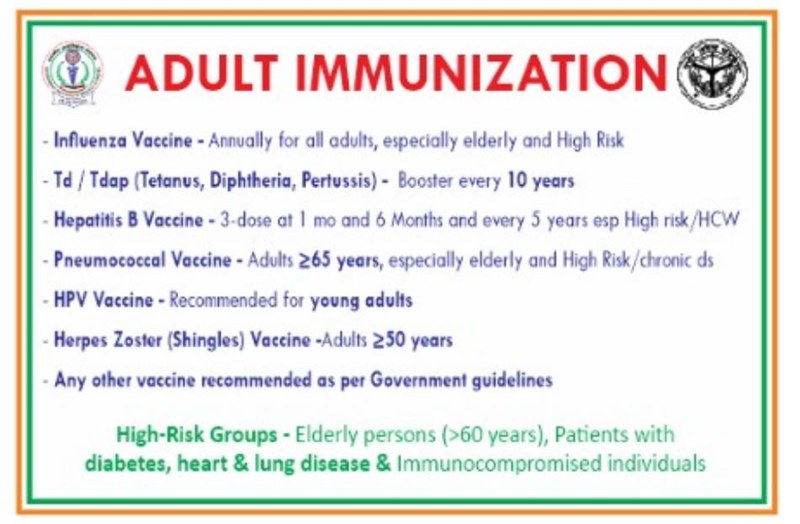
The guideline recommends a broad schedule covering 25 vaccines for different categories of adults. Commonly advised vaccines include those for chickenpox, cholera, Tdap (tetanus, diphtheria, and pertussis), hepatitis A and B, human papillomavirus (HPV), and influenza — particularly for individuals who were not previously immunized.
With projections indicating that one in five Indians will be above 50 years of age by 2050, healthcare professionals stress that informed decisions about preventive care, including timely vaccination, will play a crucial role in ensuring a healthier population and sustaining the country’s workforce in the years ahead.
Dear Readers and Viewers, Please note that tennews.in: National News Portal daily publishes latest and top ten news from government, politics, national, business, education, technology, lifestyle, entertainment, health etc ten categories. You may submit your e mail and subscribe it to get updates on your e mail. Please also subscribe TEN NEWS NATIONAL YouTube Channel.

Comments are closed.