

Harness Green Tech and Promote Ethical Governance for Net-Zero Emissions
Authored by: Prof PB Sharma
The global humanity is passing through the toughest times of the 21st century, where on one hand scientific advancement and technological innovations of the highest order are enabling inspired minds to achieve great gains from hi-tech powered AI and large data analytics applications enhancing both the speed as well as the impact of the digital revolution. At the same time there is growing fear of job losses due to intelligent machines and algorithms based decision systems overtaking skilled manpower that hitherto enjoyed great times during the last two and half decades of IT revolution and automation. While this fear is still being debated, the global humanity is increasingly being confronted with the ‘Triple Planetary Crisis’, namely the Climate Change, Environmental Pollution and a great loss of Biodiversity and the green cover.
The terrestrial happenings are creating conditions often unbearable due to intense heat waves in some parts of the globe while biting cold in some others. The recent hot days in NCR of Delhi and in most parts of the Indian subcontinent are merely just a reminder of the discomfort the humanity should be prepared to face if no brakes are applied to our mindless exploitation of nature and unless all nations invest their conscious efforts to mitigate the climate crisis on a war footing.
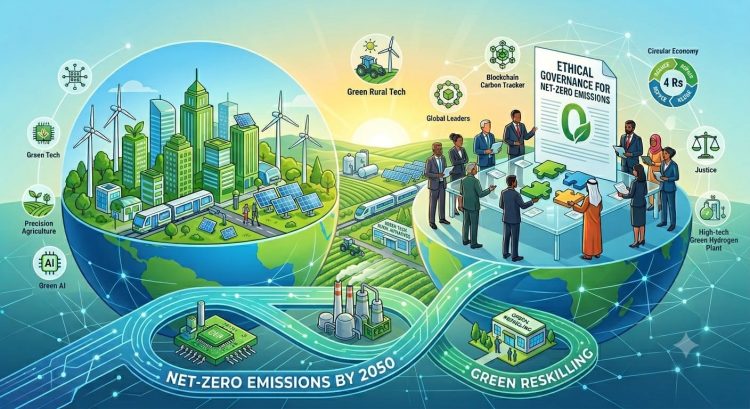
COP-2026 Mandate for Net Zero Emissions:
It needs no reminding that at the COP-2026, the nations of the world agreed to implement effective Green Technology measures to achieve the goal of net zero emissions by 2050. To turn this collective global mandate into a reality, our approach to development and technology innovation must undergo a fundamental paradigm shift. Advanced engineering, digital transformation, and artificial intelligence, AI must be explicitly engineered with environmental accountability by taking on board the nurturing of sustainability in all aspects of human endeavour.
This requires moving beyond new markets and boosting commercial profit to ensure that technological innovation directly addresses carbon neutrality and climate resilience. Knowingly that the primary purpose of advancement of engineering and technology has all along been to boost productivity and enhance production and profitability. The concern for people and the planet has remained by and large on the backburners during our quest for scientific advancement and technology development. But this shall not work any further, as the interest of human health and the health of the environment can no longer be given a go by in designing and developing innovative products and services to retain profitability and competitiveness. This is even more important now that we are to harness enormous power of AI and smartness of intelligent machines and systems to fuel the growth of economies and accelerate development.
Re-Engineering AI: From Carbon Consumer to Climate Catalyst:
For too long, the tech industry has treated the computational footprint of AI as an afterthought. Training massive neural networks for new and advanced applications of AI demands staggering amounts of electricity for operation and enormous amounts of water for cooling, threatening to exacerbate the very energy crisis we are trying to solve by implementing AI enabled smart solutions to augment energy capacity. Already the eyebrows are up as the large data systems and algorithms for their ultrafast analytics are becoming a great energy consumer. Ethical governance demands that we re-engineer AI to prioritize energy efficiency and water conservation. This means transitioning to “Green-AI” where algorithms are optimized not just for accuracy, but for computational efficiency, and where data centers are legally mandated to run entirely on co-located renewable energy sources, also optimizing water resource requirements for their operation. Green AI should inspire the AI developers both about taking sustainability on board in the development of the algorithms and also in the design innovations for tomorrow’s silicon chips for AI Data Centers. This would necessitate a major shift in the design of development of future AI on Chip and the new Chips for AI deployments in smart and intelligent machines and systems of tomorrow. We may begin right now to echo the demand for new generation ‘Green-Chips’. This is all the more important as when aligned with environmental accountability, AI could become our most potent weapon against climate change. It can be deployed to solve highly complex, multi-variable climate challenges that human processing cannot manage alone. Some emergent areas for deployment of AI are:
Intelligent Grid Management:
AI algorithms can predict energy demand fluctuations in real-time, seamlessly integrating volatile renewable sources like solar and wind into the national grid to minimize reliance on fossil-fuel backups. Tomorrow’s renewable energy transition for a rapidly developing nation like India shall require local areas to be powered by decentralized power grids that will require efficient smart grid management using AI enabled Grid Management systems.
Precision Agriculture:
By analyzing satellite imagery and IoT sensor data, machine learning models can optimize water use, minimize chemical fertilizer deployment, and monitor soil health, thereby protecting biodiversity and reducing agricultural emissions, so important to achieve net-zero emission goals.
Climate Modeling and Simulation:
Advanced AI models can simulate localized climate impacts, helping urban planners design resilient, climate-adapted cities capable of withstanding extreme weather anomalies like the heat waves striking the Indian subcontinent.
Urban Planning and Management of Civic Services:
By creating exact digital replicas of factories, supply chains, and entire urban ecosystems, utilizing the power of AI, engineers can simulate carbon footprints before a single brick is laid or a product is manufactured. This allows industries to proactively eliminate waste and optimize energy consumption. Smart monitoring and management of civic services is another area in which AI powered systems of urban service management can do a great good to minimize chaos and significantly enhance both efficacy and trust in civic services.
Blockchain for Carbon Tracking:
Green auditing remains a massive hurdle in global climate action. Utilizing decentralized, tamper-proof ledgers ensure that carbon credits, corporate emissions data, and supply chain sustainability metrics are completely verifiable. True accountability means a company’s environmental impact is visible to regulators and consumers alike.
Advanced Green Engineering and the Circular Economy:
The hardware of our future cannot be built with the linear “take-make-waste” mindset of the past. Advanced engineering must embrace a circular design philosophy, ensuring that every product is built for longevity, repairability, and ultimate recycling. This would require:
- National Circularity Mandates (NCMs): Implementing ambitious, National Circularity Mandates (NCMs) requiring a firm resolve and commitment to national and global mandates for 4 Rs, namely Reduce, Repair, Recycle and Reuse and mandating material recovery targets (e.g., 100% Waste Water Treatment, Recycle and Reuse; 100% Clean Energy Generation from renewable and clean energy resources and a minimum of 50% material recapture and reuse for key resources) by 2035.
- Extended Producer Responsibility (EPR): Strengthening and enforcing truly binding EPR laws globally, ensuring that industries bear the full financial and logistical cost of managing and recycling the entire lifecycle of their products. Further mandating that the Government, Industry and Corporate CSR to collectively fund path breaking research and technology innovations that strengthen natural resource recovery, including precious metals from used products and devices.
- Promotion of Responsible Consumption: Launching national and global campaigns to foster a culture of Responsible Consumption, Aparigriha, i.e. possessing as much as necessary and consuming as much as needed, encouraging conscious consumer choices, extending product life, and recognizing that citizen action is critical to aggressively reducing waste across all across of the supply chain.
Mandate for Green Technology Solutions and Relevance-Driven Innovation
All future technological investment should prioritize the rapid and scalable deployment of Green Technology Solutions, local applicability, cost-effectiveness and ethical governance, defining the new standard as Relevance-Driven Engineering and Technologies of Conscience. Governments and Corporate should prioritize R&D funding for and remove regulatory barriers against high-impact, scalable Green Technology Solutions, including advanced Bio-Energy systems, Future Biofuels, Green Hydrogen, High Energy High Storage and Long Life Batteries for EVs, localized smart micro-grids, carbon capture technologies, and sustainable water purification systems and ground water recharging systems.
It must be clearly understood that technology alone is a neutral tool, it is governance that dictates its trajectory. To ensure that innovations directly address carbon neutrality rather than corporate greed, governments and international bodies must institute strict regulatory frameworks for deployment of Green Technology solutions and promote green manufacturing, green supply chain management, green mobility and green initiatives to safeguard the interest of man and Mother Nature.
Mandate for Green Governance:
Green Governance requires that policies must evolve from passive incentives to active enforcement. Compliance with net-zero benchmarks should be legally tied to corporate operating charters. Furthermore, as automation shifts the labor landscape, a portion of the economic gains generated by AI-driven efficiencies must be aggressively reinvested into “Green Reskilling” programs ensuring that the workforce powered by the AI revolution is equipped to lead the ecological revolution.
The crisis unfolding across the globe is an explicit warning. We no longer have the luxury of treating economic growth, technological advancement and environmental preservation as competing interests. By embedding ethical governance into the DNA of digital transformation and by engineering our most brilliant computational tools to serve the planet, humanity can finally apply the brakes to ecological destruction. The road from COP- 2026 to a net-zero 2050 is steep, but with technologically backed environmental accountability, it remains entirely within our reach.
The author, Prof PB Sharma is a renowned thought leader, former President of AIU, founder Vice Chancellor DTU and currently is the Vice Chancellor of Amity University Gurugram.

Comments are closed.