

I.T.S College of Pharmacy Hosts AKTU-Sponsored National Conference on AI & Pharma Innovation
TEN NEWS NETWORK
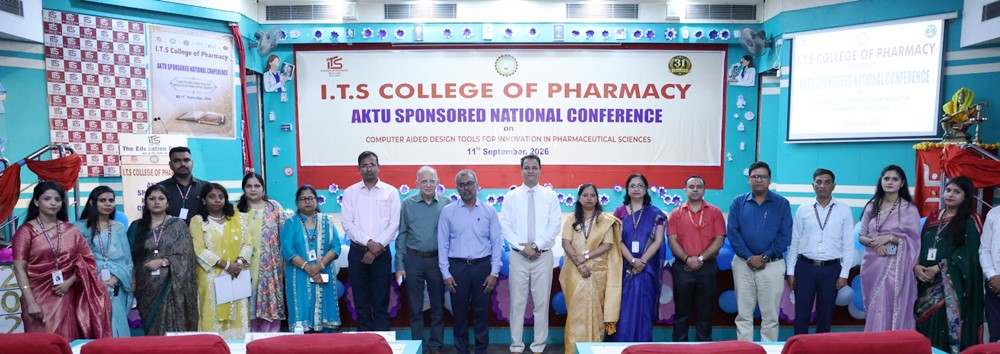
Greater Noida News (12 September 2026): I.T.S College of Pharmacy organised an AKTU-sponsored National Conference on “Computer Aided Design Tools for Innovation in Pharmaceutical Sciences” on September 11, bringing together academicians, researchers, pharmaceutical professionals and students to discuss the growing role of computational technologies and Artificial Intelligence in drug research and development.
The conference provided an academic platform for participants from nearly 30 colleges, with around 250 delegates attending the inaugural programme. The event focused on emerging computer-aided technologies and their applications across formulation development, drug discovery, molecular modelling, ligand-based drug design, QSAR, target identification and molecule optimisation.
The programme was conducted at the Vikram Sarabhai Auditorium, while registration took place at the Activity Hall.
Focus on AI-Enabled Pharmaceutical Research
The event began with the arrival of the chief guest and other dignitaries, followed by the ceremonial lighting of the lamp. Dr. S. Sadish Kumar, Director, I.T.S College of Pharmacy, welcomed the dignitaries, keynote speakers, faculty members, delegates and participants.
Addressing the gathering, Dr. Kumar underlined the importance of combining pharmaceutical expertise with emerging technologies. He highlighted the growing relevance of AI and computer-aided design tools in pharmaceutical research and stressed the need for collaboration between technology specialists, pharmacists, researchers and healthcare professionals.
He particularly emphasised the principle of “AI with pharmacists, not AI instead of pharmacists,” pointing towards a future in which artificial intelligence strengthens professional decision-making rather than replacing human expertise.
Arpit Chadha, Vice Chairman, I.T.S – The Education Group, congratulated the organising team for successfully conducting the conference. He encouraged students, researchers and faculty members to adopt innovative and interdisciplinary approaches to address emerging challenges in pharmaceutical research and development.
IPC Scientific Director Highlights AI’s Role in Pharmacy
Dr. Vivekanandan Kalaiselvan, Secretary-cum-Scientific Director, Indian Pharmacopoeia Commission (IPC), Ghaziabad, attended the programme as Guest of Honour. He appreciated the academic initiatives and continued growth of I.T.S College of Pharmacy.
Dr. Kalaiselvan highlighted the relevance of technology in areas including pharmacovigilance, drug quality, safety and pharmaceutical analysis. He noted that AI and IT-enabled systems can support researchers and pharmacists by improving efficiency, accuracy and speed across various stages of drug discovery and development.
He also pointed to the emerging career opportunities for pharmacy graduates and professionals who develop technological capabilities alongside their core pharmaceutical knowledge.
Industry Perspective on AI and Drug Discovery
Dr. Vimal Gupta, Director, ABYSS Pharma Pvt. Ltd., also attended as Guest of Honour and discussed the evolution of computer technology and its expanding applications in pharmaceutical sciences.
He explained that AI should be viewed as a supportive technology that works alongside human knowledge and expertise. According to him, advanced computational systems can help researchers analyse large volumes of existing data and accelerate activities such as drug discovery, vaccine development and pharmaceutical research.
Dr. Gupta encouraged students to strengthen their technological skills while continuing to build a strong foundation in pharmaceutical sciences, enabling them to adapt to the changing requirements of the industry.
Experts Discuss Computer-Aided Formulation Design
The scientific sessions featured experts from India and abroad who discussed different aspects of computational pharmaceutical research.
Dr. Mohd Yasir, Associate Professor, Department of Pharmacy, College of Health Sciences, Arsi University, Asella, Ethiopia, delivered the first scientific session on “Computer-Aided Formulation Design and Optimization of Advanced Drug Delivery Systems: From Quality by Design (QbD) to Artificial Intelligence.”
His presentation focused on the application of Quality by Design (QbD) principles in formulation development and explained how computational methods can help identify critical formulation and process variables.
The session also examined how AI and computational tools can support formulation optimisation, reduce the dependence on extensive experimentation and facilitate more informed decisions during the development of advanced drug delivery systems.
Computational Strategies in Drug Discovery
The second scientific session was delivered by Dr. Ozair Alam, Professor, School of Pharmaceutical Education and Research, Jamia Hamdard.
His session, titled “Target Identification to Molecule Development: Computational Strategies in Recent Drug Discovery,” examined the role of computational techniques in identifying therapeutic targets and developing potential drug candidates.
Dr. Alam discussed the contribution of medicinal chemistry, molecular modelling and computational analysis in understanding molecular interactions and selecting promising molecules for further investigation. He also highlighted how computational methods can complement laboratory-based approaches and potentially reduce time, resources and experimental efforts during the early stages of drug development.
QSAR and Ligand-Based Drug Design Explained
The third scientific session was conducted by Dr. Vaishali M. Patil, Principal, Charak School of Pharmacy, Chaudhary Charan Singh University, Meerut.
She delivered a lecture on “Ligand-Based Drug Design and QSAR: From Molecular Structure to Drug Discovery.” The session explained how information from known biologically active molecules can be used to establish relationships between molecular structures and biological activity.
Dr. Patil elaborated on the role of Quantitative Structure-Activity Relationship (QSAR) approaches, molecular descriptors and physicochemical properties in predicting the potential activity of new molecules.
The discussion provided participants with an understanding of how ligand-based computational approaches can help researchers prioritise promising drug candidates before proceeding to extensive experimental studies.
Interactive Q&A and Research Presentations
An interactive question-and-answer session followed the expert presentations, allowing students, researchers and faculty members to engage directly with the speakers. Discussions covered AI applications in pharmacy, QbD, QSAR, molecular modelling, formulation optimisation, ligand-based drug design, target identification and computational drug discovery.
The post-lunch programme featured oral and poster presentations, where students, research scholars and researchers presented their findings, research ideas and scientific work before an academic audience.
The presentation sessions provided participants with an opportunity to exchange knowledge, receive academic feedback and showcase research related to pharmaceutical sciences.
Top Presenters Felicitated
Participants who secured first, second and third positions in the presentation categories were recognised with awards for their scientific contribution, originality, presentation quality and overall performance.
The conference highlighted the expanding potential of Artificial Intelligence, computer-aided design, molecular modelling and data-driven technologies in making pharmaceutical research more systematic, predictive and efficient.
Conference Concludes with Appreciation for Organising Team
The programme concluded with closing remarks by Dr. Madhu Verma, Professor and Convener.
The conference was anchored by Mr. Manish Kumar (PDP Trainer), Ms. Sakshi Chauhan and Ms. Nidhi Sharma (Assistant Professors). The registration and certificate committee facilitated the distribution of conference kits and certificates to the participants.
The event was coordinated by Dr. Raj Kumari, Dean and Professor, with joint coordination by Dr. Iti Chauhan, Dr. Sagarika Majhi, Ms. Meenakshi Sharma and Mr. Gaurav Chaudhary.
The organising team expressed gratitude to the Honourable Vice Chancellor of Dr. A.P.J. Abdul Kalam Technical University (AKTU), invited dignitaries, speakers, faculty members, delegates, student volunteers and members of the organising committee for their contribution to the successful conduct of the national conference.
With its focus on AI, computational modelling and interdisciplinary pharmaceutical research, the conference provided participants with insights into the changing technological landscape of drug discovery, formulation development and pharmaceutical innovation.
Dear Readers and Viewers, Please note that tennews.in: National News Portal daily publishes latest and top ten news from government, politics, national, business, education, technology, lifestyle, entertainment, health etc ten categories. You may submit your e mail and subscribe it to get updates on your e mail. Please also subscribe TEN NEWS NATIONAL YouTube Channel.

Comments are closed.