
In the rich tradition of ancient Indian thought, human values were not just something added to learning, they were the very essence of knowledge. The knowledge, the Janana, was considered to be the purest of the pure on planet Mother Earth. It required the purity of mind and righteousness of intent and actions to translate the power of knowledge to unleash creativity in abundance and innovation infinite. The knowledge cultivated in the Gurukuls of Ancient India provided to its seekers the environment to comprehend the secret of creation, it’s sustenance and dissolution, if that is so required. The teachers, the Gurus, the Mentors, for this reason were considered to be most revered, even were placed at the pedestal higher than the respect reserved for the God Almighty. Gurur Brahma, Gurur Vishnu, Gurur Devo Maheshwara was echoed by the seekers as well as by the people in the society and also in power and authority.
The holy places of learning in ancient India were the campuses that recited and practiced the Vedic philosophy of “Na hi Jnanen Sadrashyam Pavitram hi Vidhyate” as in Bhagwat Gita (4.38) and thus mandated strict self-discipline, aatmasanyam as the necessary condition to cultivate knowledge and unleash the power of ingenuity and excellence. No wonder, the Gurukuls, the universities of ancient India like Maharishi Vishwamitra’s Gurukul in Tapowan, Maharishi Bharadwaj Gurukul at Chitrakut and the Gurukul of Maharishi Sandeepni at Ujjaini in central India were the finest examples that produced people of competence and character and cultivated the enormous power of science and technology advancements, so well depicted in the wars with evil in the famous Ramayana and Mahabharata. The digitally secured, multi-warhead missiles like Brahmastras, Agniastras, Nagastras fired from remote locations using mind to machine communication and self-guided Sudershana Chakra are still a mystery for the modern day scientists and technologists to advance the communication systems from man to machine to mind to machine and secure the actions with the highest levels of cyber security.

In the ancient system of knowledge or Vidya, was never sought for just economic gain or power. Instead, it was a combined pursuit for prosperity, happiness and fulfilment of meaning and purpose of human life in service of the Divine and its creation, the Shristi. Such a system of education, research and innovation while on hand advanced the frontier of science and technology to scale the unscalable, yet ensured that the rich bio-diversity and the beauty of nature, compliance of sustainability in all aspects of human endeavours including the purity of air, soil and water is upheld all the time as the mandate for practicing knowledge and scientific power.
As such the work philosophy in Vedic Sanatan tradition was based on devotion in action, making work as worship of the Divine and thus the life journey followed the pathways of material as well as spiritual path to attain name, fame and glory but also mukti from lust and greed, so essential to free the mind from unnecessary anxieties and stresses and to please the soul within. This idea is beautifully captured in the ancient Vedic saying, “Sa Vidya Ya Vimuktaye“, which means that true knowledge is what liberates us from ignorance, greed and self-centeredness and enables us to devote ourselves to the service of the society and Mother Nature with humility and integrity.
At the centre of this ancient system was a deep bond between the teacher and the student, that was nurtured in the peaceful settings of Gurukuls in ancient India and later in great universities like Takshashila and Nalanda. In these temples of learning and research, the students not only mastered subjects like science, mathematics, aerospace, defence technologies, astronomy and metallurgy but also developed inner qualities like truthfulness, righteousness, compassion, happiness and forgiveness. The students were also taught to see themselves not as separate from the world, but as an integral part of a larger whole, with deep respect for nature and a strong belief in “Vasudhaiva Kutumbakam“, the idea that the entire world is one family. As such the educated and enlightened mind worked without fear or favour for the larger collective good of the humanity and practicing highest levels of sustainability, care and compassion as the hallmark of their enlightenment. They also respected the diversity, identifying the “Unity in Vast Diversity” and also the “Diversity of Oneness”
Today, as we face a major turning point in human history, this ancient wisdom is more important than ever, now that the new age of AI and smart machines has descended with the ever-expanding frontiers of science and technology.
The Fourth Industrial Revolution, driven by fast-growing technologies like Generative AI and advanced robotics, is changing every part of our lives. As machines become more capable of doing complex tasks, the levels of quality, productivity and precision shall surpass human imagination, giving a tough time for human excellence to compete with the intelligent and smart machines becoming capable of critical thinking and decision making based on large data analytics. Naturally in this new age of AI and Smart Machines, the education and research ecosystem in the modern universities requires a thorough reimagining to foster both the cultivation of knowledge and capabilities and unleash the power of human ingenuity and innovative infinite to retain the supremacy of human resources as the threats coming from AI and smart machines to millions of job losses is truly real, as being witnessed from massive layoffs by mega industries and the MNCs.
In this time of smart and intelligent machines, our approach to education must change completely from mere dissemination of knowledge to developing skills to learn and understand the use of knowledge for creating solutions to the current and future problems as also to be the co-creators of new technologies and scientific discoveries to fire human imagination beyond smart machines and intelligent systems. The university campuses thus have to be redesigned to retain their supremacy as the sovereign engines of curiosity, creativity and innovation in plenty. This shift must be rooted in our ancient values, ethical standards, and a sense of responsibility towards the global aspirations for peace, harmony and development. This requires functioning of the universities both as the “Global Knowledge Entreprises” as well as the “Guardians of Global Humanity”.
Actions Needed:
1. Hyper-Personalization and Smart-Tech Integrated Ecosystems
In today’s world, we can’t rely on a single approach to prepare professionals for the future. Universities need to use AI to enhance, not replace, the human aspect of education as also to develop capabilities to use AI tools for pathbreaking scientific research and technology innovations.
By using AI-driven e-Portfolios, Learning Analytics Dashboards, and tools like our adaptive learning assistants, we can monitor a student’s performance, understanding their learning and creative level growth in real time while mentoring them to outperform the algorithms by their ingenuity and the fire of their intuitive faculty. In such a system, the real role of faculty shall be to do what machines cannot, offer personalized guidance, share their own experiences, encourage creativity, mentor research pathways and support the intellectual and behavioural growth of students. The teachers would then move from simply delivering classroom lecture and conducting examinations to becoming mentors who inspire, creativity, ideation, innovation and character development.
2. Breaking Academic Silos: The Multidisciplinary Imperative
The challenges of today’s world do not fit neatly into separate subjects, domains and specialized academic silos. Issues like climate change, renewable energy, molecular medicine, herbal drug design and drug discovery and automation using AI and Smart-Techs, all need a multidisciplinary team environment both for studies as well as research and innovations. The realization that engineering is interdisciplinary and so is science, management and all disciplines of study and research. They all need a sustained focus on a multidisciplinary approach to advancement and development. The solution research that we badly need today to take the monumental challenges head on also requires multidisciplinary environment for developing cost effective, often path breaking solutions.
At Amity University Haryana, we’ve created a multidisciplinary environment for education and research that combines essential intellectual and technical skills with three important areas:
- Behavioural Sciences: Helping students understand themselves, control their emotions and develop a broader awareness of the world around them.
- Communication Skills and Languages: Equipping students to express themselves clearly and work effectively in a global environment.
Ethics and Spiritual Metaphysics: Bridging science with humanism and sustainability to ensure that technology is used in a way that supports the idea of a bright and blissful future for the humanity at large with the realization that the world is one family, “Vasudhaiva Kutumbakam” as the Vedas say.
3. Shifting from Classroom Teaching to Technology Incubation
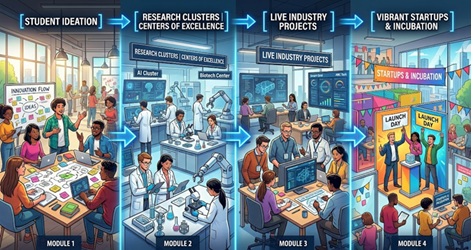
For our young, inspired graduates to succeed in a futuristic work environment alongside with their intelligent and smart robots and humanoid colleagues, university campuses need to become lively places where knowledge is created and shared at all levels and capabilities are created to work in integrated environment. Learning should focus on solving real problems and finding the best possible solutions under existing conditions. This requires a major shift from learning to know to learning to do and technology and product development. Rather than starting the semester with classroom teaching, it would be better to start with a project based learning and create curiosity and a deep research mindset.
By creating specialized Centres of Excellence in areas like AI, Machine Learning, Robotics, Drug Design and Development, Big Data Analytics, Environmental Sustainability and Green Hydrogen, learning should be driven by research. Students should be encouraged through Outcome-Based Education (OBE), moving from initial ideas to developing real products and better processes, the outcome thus should be measured in terms of levels of curiosity and innovative mind mapping rather than just the performance in examinations as of today.
To gain real-world experience, strong partnerships between industry and academia must be established with required internships and live projects ensuring students tackle real industrial, business and societal issues before they finish their studies. A strong integration of the university learning environment with industry and society would do a great good to produce future ready professionals needed for today’s smart-tech driven work environment. The industry partnered specialized Centres of Excellence would then become the growth engines of new and innovative technology and product development, making the universities to rise to the levels of global knowledge enterprises.
4. Cultivating Lifetech: Aligning Science with Human Values
As an engineering professor with more than 50 years of experience in universities from the University of Birmingham to IIT Delhi, DCE, DTU, and Amity, Prof PB Sharma, strongly believe that engineering without Science, Mathematics, Ethical and Human Values is dangerous and can lead to disastrous consequences. As technology advances and machines become more intelligent and smart, humans need to become more conscious of their responsibility to use the technology with care and cation to uphold high ethical and professional morals at the workplace and in their transaction of personal and professional responsibilities. This means using science and technology to help people live happy, healthy lives in a sustainable environment where prosperity, happiness and responsible behaviour melt into a composite moral compass for professionals of the new age.
This vision is already becoming a reality through the efforts of our talented young researchers, who are working in the new and advanced technologies in areas of AI, Robotics, Cyber Security, Life Sciences, Nature based Pharmacy, Aerospace Engineering, Environmental Sustainability, Automation within our academic community. Securing autonomous systems and protecting digital spaces in university tech-savvy campus environment shows how modern technology can be combined with ethical and moral responsibilities of all stake holders including those in authority. By making sure that smart systems are secure, our scientists and researchers are helping to build trust in digital systems, AI and Automation, allowing science to support overall well-being without harming human safety or our time-tested values of trust and transparency.
The Call to the Youth and Academics
Let’s make sure our universities don’t turn into just places to train people for big companies. Our goal should be to build a knowledge-based society that follows the idea of “Sarve Bhavantu Sukhinah” may all beings be happy, healthy, and free from pain and live in sustainable and healthy environments.
We need to develop a group of young, smart minds who can come up with new ideas in the modern world, while also having the ancient Sanatan values to serve nature and people with dignity, humility and integrity while ensuring compliance of sustainability as we grow strong economically and in science and technology capabilities. Let this rethinking help in shaping the future of higher education in the age uncertainty and disruption.
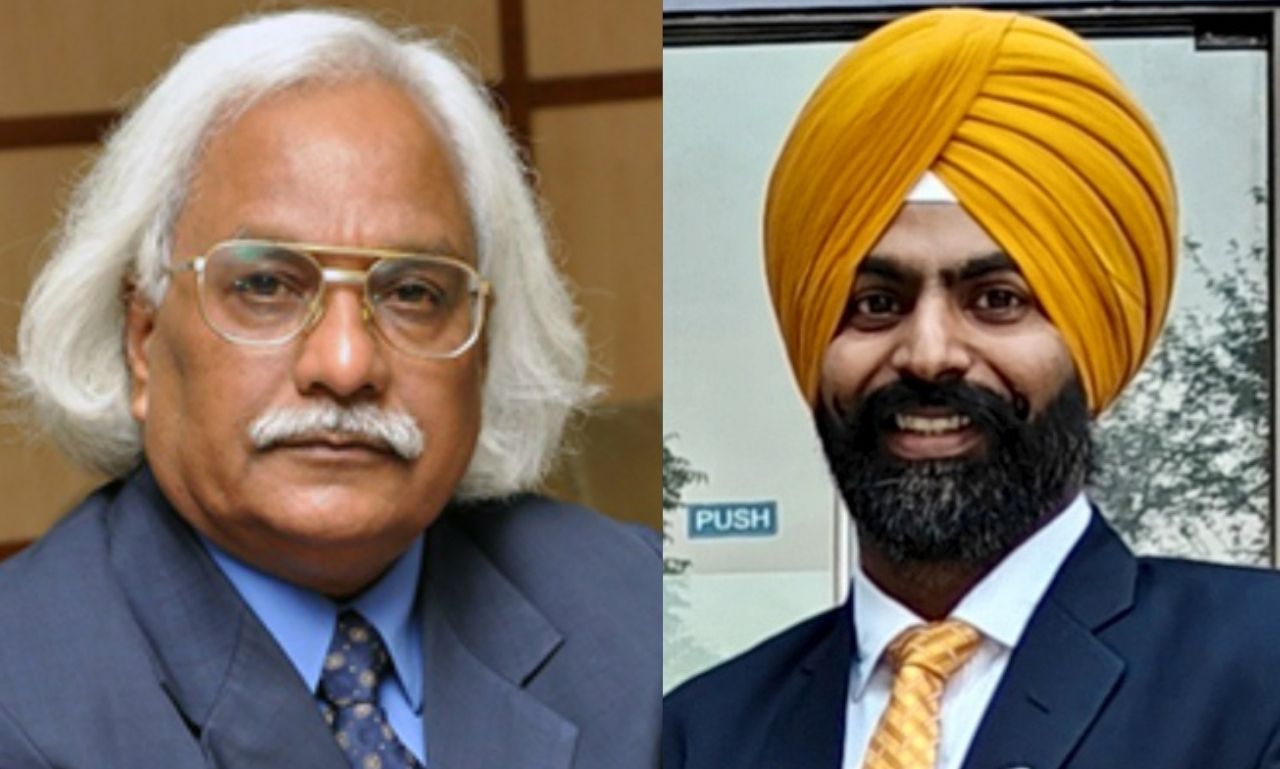
The authors: Prof PB Sharma is a renowned thought leader, former President of AIU, founder Vice Chancellor DTU and currently the Vice Chancellor of Amity University Gurugram, Sandeep Singh is a research scholar pursuing his PhD in Cyber Security and AI at Amity University Gurugram.

Comments are closed.