
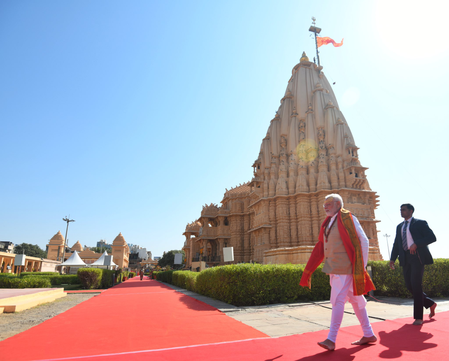
From repeated destruction to revivals: Gujarat’s Somnath Temple reflects centuries of faith and resilience

Gir Somnath (Gujarat), May 9 (IANS) Somnath Temple, regarded as the first among the 12 Jyotirlingas of Lord Shiva, is set to mark 75 years since its reopening in independent India, with Prime Minister Narendra Modi scheduled to visit the shrine on May 11 as part of the ‘Somnath Amrut Mahotsav’ commemorations.
The observance coincides with two milestones linked to the temple’s history — 1,000 years since the first recorded attack on Somnath in 1026 and the 75th anniversary of its ceremonial reopening on May 11, 1951, when India’s first President, Dr Rajendra Prasad, dedicated the reconstructed temple to the nation.
Located on the Arabian Sea coast at Prabhas Patan in Gujarat’s Saurashtra region, Somnath is among India’s most revered pilgrimage destinations and occupies a central place in Hindu religious tradition.
Mentioned in the Shiva Purana, the temple enshrines one of the 12 Jyotirlingas and is associated with the worship of Lord Shiva, Lord Krishna and Shakti traditions.
The Dwadasha Jyotirlinga Stotram places Somnath first among the 12 Jyotirlingas, underlining its significance in India’s spiritual and civilisational heritage.
Over centuries, the temple has become identified not only with religious devotion but also with repeated cycles of destruction and reconstruction.
According to historical accounts and traditional narratives, the temple’s most turbulent period began in January 1026, when it faced its first recorded attack by invading forces.
Between the 11th and 18th centuries, the shrine was repeatedly attacked and rebuilt.
Successive reconstructions were undertaken by rulers and devotees, including King Kumarapala in the 12th century, the ruler of Junagadh in the 13th century and later by the Maratha queen of Indore, Ahilyabai Holkar, in the 18th century.
The temple’s modern reconstruction began after Independence, when Deputy Prime Minister Sardar Vallabhbhai Patel visited the ruins in 1947 and supported rebuilding efforts as a symbol of restoring national confidence and cultural continuity.
Constructed in the Kailash Mahameru Prasad architectural style, the present temple was consecrated on May 11, 1951.
Officials associated with the commemorative events said the Somnath Swabhiman Parv seeks to reflect both the destruction faced by the temple and its repeated revival over centuries.
The reopening of the temple in 1951, they said, came to symbolise a wider civilisational resurgence in post-Independence India.
Prime Minister Modi, who also serves as chairman of the Somnath Trust, is expected to participate in ceremonies marking the anniversary.
Ahead of the visit, he described Somnath as a “symbol of India’s unconquerable spirit” and referred to its journey “from ruin to renewal”.
He also spoke about the “Vikas Bhi, Virasat Bhi” approach, linking development with heritage preservation, and announced special pujas at the temple for the next 1,000 days in honour of Somnath’s history.
Earlier this year, the Prime Minister participated in the Somnath Swabhiman Parv celebrations held on January 10 and 11.
The programme included a 72-hour Omkar mantra chanting ceremony, rituals and prayers for national welfare, along with a Shaurya Yatra at Prabhas Patan featuring a symbolic procession of 108 horses in tribute to warriors associated with the defence of Somnath through the centuries.
One figure remembered in local tradition is Veer Hamirji Gohil, a regional warrior believed to have sacrificed his life defending the temple during Zafar Khan’s invasion in 1299 A.D.
Though his story survives largely through oral tradition and regional memory rather than official chronicles, he continues to be associated with the idea of rajadharma, or the duty to protect sacred places and society.
As part of the commemorative year, the Somnath Swabhiman Parv Yatra was launched from Safdarjung Railway Station on April 30 under the campaign “Chalo Chalein Somnath”.
The special train carried more than 1,300 devotees to Somnath and arrived on May 1. The programme included devotional events, temple visits, aarti ceremonies and a light-and-sound show over subsequent days.
The present temple complex includes the Garbhagriha, Sabha mandap and Nritya mandap overlooking the Arabian Sea.
The structure is crowned by a 150-foot shikhar topped with a 10-tonne kalash and a 27-foot dhwajdand. The temple complex also features 1,666 gold-plated kalash and 14,200 dhwajas.
Somnath continues to attract lakhs of pilgrims annually, with yearly footfall estimated between 92 lakh and 97 lakh devotees.
Rituals such as Bilva Pooja alone draw more than 13 lakh participants every year. Cultural initiatives at the temple include a light-and-sound show first introduced in 2003 and upgraded in 2017 with 3D laser technology, as well as the ‘Vande Somnath Kala Mahotsav’, which seeks to revive classical dance traditions linked to the site.
The Shree Somnath Trust has also expanded its activities beyond temple administration into education, healthcare, skill development and environmental initiatives in nearby communities.
Programmes include vocational training in digital literacy, tailoring and beauty services, scholarship support for students, and a “School on Wheels” initiative providing mobile computer education in villages.
The trust operates daily food distribution programmes and has also undertaken medical assistance projects, including physiotherapy facilities and free dental and eye treatment camps.
During the COVID-19 pandemic, the trust provided relief assistance that included financial aid, food distribution and medical support, including oxygen infrastructure.
Environmental measures introduced in recent years include vermicomposting of temple flowers, plastic waste recycling into paver blocks under Mission LiFE, rainwater harvesting systems and the development of a Miyawaki forest spread across 72,000 square feet.
Temple authorities said the forest absorbs an estimated 93,000 kilograms of carbon dioxide annually.
Women’s participation in temple-linked activities has also increased. Of the 906 employees associated with the Somnath Temple Trust, 262 are women, while women-led teams manage activities including the Bilva Van, prasad distribution and dining services.
Declared a “Swachh Iconic Place” in 2018, Somnath has increasingly combined religious tourism with sustainability and community welfare initiatives while continuing to serve as one of India’s most prominent centres of pilgrimage and cultural heritage.
–IANS
mys/uk

Comments are closed.