
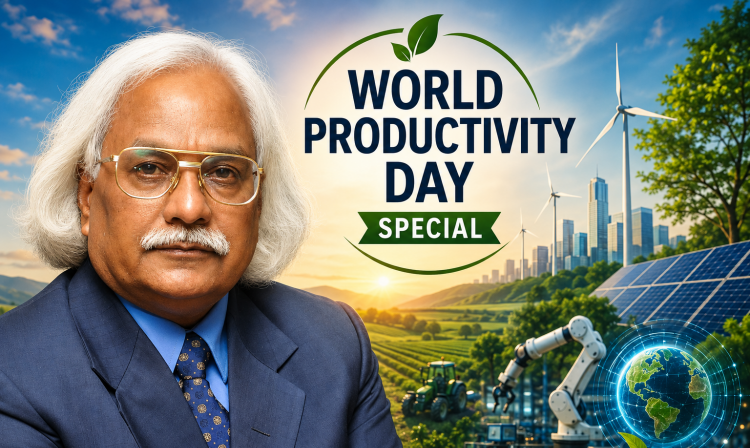
Productivity: The Master Key for Sustainable Development and Healthy Humanity
Authored by: Prof. P.B Sharma
For generations, the productivity movement focused strictly on a narrow formula: maximizing production and profits across factories and service sectors. Workers were viewed merely as economic units, with their worth calculated purely by output per head. Because of this rigid legacy, the word “productivity” today instantly conjures up corporate buzzwords—optimizing spreadsheets, clearing out inboxes, or squeezing more widgets out of a factory floor. We have inherited a mindset that treats productivity not as a tool for progress, but as a stressful, hyper-capitalist race against the clock.
But if we scale that the concept up—shifting from workers’ optimization to global survival, productivity makes on a completely different meaning. True productivity isn’t about doing morethings faster; it is about doing things better with fewer resources.
When defined this way, productivity transforms from a corporate metric into the single most important lever we have for achieving two of the 21st century’s greatest goals: sustainable development and a healthy humanity. This new perspective calls for redefining Productivity as the Master Key for Sustainable Development and at the same time assuring Good Health of the Humanity and the Good Heath of the Environment.

1. Redefining Productivity: The Shift from “More” to “Better”
For decades, economic productivity was measured by sheer volume. If a country or company produced more goods this year than last, it would be a win. But this old model forgot a crucial math problem: the input cost. If you double your output but triple your consumption of fossil fuels, water, and deteriorate human health, you are not actually being productive, you are just liquidating your future. This is exactly the context in which redefining Productivity becomes a dire need of the day as the World Celebrates the Productivity Day Today, 20th June, 2026. It is ironical that the UN has scheduled the World Productivity Day today, 20th June and tomorrow 21st June as the World Yoga Day ! The message is loud and clear that We need to be high on Productivity in Work Life, but also Happy and Healthy. That is why increasingly we need to advocate for ‘Sustainable Productivity’ that focuses on resource efficiency. It asks a much smarter question: How can we maximize human well-being while minimizing ecological damage?
By focusing on this equation, productivity stops being an enemy of the planet and becomes its ultimate shield ensuring both economic as well as human well being. We may reimaginingsustainable productivity as Geen Productivity, utilizing Green Technology and maximizing output. The heath of the environment and the health of the workers begin to work for a common advantage, that is maximizing GDP and also optimizing environment and human wellbeing. This is the need of the hour.
2. Green Productivity: The Engine for Sustainable Development
Sustainable development is often described as a balancing act between the economy and the environment. Productivity is the engine that keeps that balance from collapsing. The focus wouldnow on should be on:
• Agricultural Productivity: Global pop ulations continue to grow, but our agriculture landis fixed (and often shrinking due to increased urbanization and soil degradation). Traditional farming would demand clearing more forests for crops. However, by using high-yield, drought-resistant crops and precision agriculture (using drones and sensors to apply the exact amount of water and nutrients needed), we produce more food on less land. That way we are in a position to maximize agriculture productivity and alsomaintain good health of environment and people. This is way productivity becomes a savior of agriculture ecosystems.
• Green Manufacturing: Manufacturing is currently focusing on automation and intelligence integrated by robotics and AI, This will work wonders, but for the means like electricity and water for large data centers and hyper connectivity, both consuming enormous electric power and water. As such the green transition to generate electricity from renewables offers a viable way out. India’s rapid track transition to green energy offers a great gateway of opportunity for many a nation around the globe. Currently India has achieved the target of just over 50% installed electric power generation from renewables.
• The Circular Economy: In a standard economy, we take resources, make a product, and throw it away. A productive, sustainable system focuses on “circularity.” It designs products to be easily disassembled, repaired, or recycled. When waste becomes a resource, resource productivity sky-rockets, and landfills shrink. The race to circular economy is not just desirable, it is the dire need to address the global challenge of Climate Change and the enormous difficulties that shall arise out, if the challenge is not met with firm resolve and robust strategies to foster a new era of Circular Economy.
• Energy Transition: Shifting to renewable energy is essentially a massive upgrade in energy productivity. Fossil fuels require constant extraction, transport, and burning (all highly inefficient). Solar panels and wind turbines capture free, abundant ambient energy. Improving the efficiency of these technologies means we get more electricity out of every square meter of sunshine. For this to make a big sense we need to power our manufacturing and supply chain as well as the service sector with green energy. It iddoable and we cannot wait as the time is running out.
3. The Foundation of a Healthy Humanity
The second half of the equation is us: humanity. A society running on toxic productivity is fundamentally unhealthy. It leads to burnout, chronic stress, and a decay of social fabrics. True productivity, however, actively fosters a healthier human race.
We have cultivated during the years of the productivity movement a toxic habit of equating “busy” with “productive.” Science consistently shows that after a certain point—usually around 40 to 45 hours a week—human productivity sharply declines. Errors increase, creativity dies, and health deteriorates.
When organizations focus on output quality rather than hours logged, magic happens. Experiments with four-day workweeks around the world have shown that shorter, more focused bursts of work maintain or even increase total output, while drastically reducing employee burnout, anxiety, and sleep disorders.
Historically, human labor was brutal, repetitive, and dangerous. Think of assembly lines or manual data entry. By leveraging technology, automation, and AI to handle these low-level tasks, we boost systemic productivity.
More importantly, we free human beings to do what they do best: solve complex problems, innovate, care for others, and engage in creative expression. Productive societies have the surplus wealth and time to invest in universal healthcare, robust education, and robust mental health support systems.
4. The Path Forward: A Shared Responsibility
Achieving this harmonious state requires a shift in mindset at every level of society:
• For Businesses: Companies must pivot toward sustainable supply chains and invest in their employees’ long-term health, recognizing that a rested, fulfilled workforce is ultimately amore innovative and productive one.
• For Individuals: We must reclaim “productivity” for ourselves. It means setting boundaries, sleeping well, and recognizing that taking care of your health is not a distraction from your work—it is the very foundation of it.
As such as we celebrate the World Productivity Day today, 20th June and the International Yoga Day tomorrow, 21st June 2026, let us all unite for ushering a new era of Green Productivity, making productivity not a whip to drive humanity to work faster under the threat of exhaustionbut as the master key to for Sustainable Development and Healthy Humanity, infect the master key to our future. When we learn to create immense value out of minimal resources, we protect the fragile planet we call home. And when we design our systems to respect human limits, we unlock the true, vibrant potential of humanity. Sustainability and health are not hurdles to productivity; they are its ultimate rewards. Let the Productivity movements around the globe recognize this dire necessity and respond with the firm resolve and strategic interventions, the time is right and the global humanity is looking as a us the learned quarters in government, corporate and academia to act with a sense of urgency.
The Author Prof PB Sharma, is a renowned thought leader, Fellow of World Academy of Productivity Science, WAPS, Senior Vice President of WCPS(India) and President of World Academy of Higher Education and Development, W-AHEAD, Founder Vice Chancellor of DTU and currently Vice Chancellor of Amity University Gurugram.

Comments are closed.