

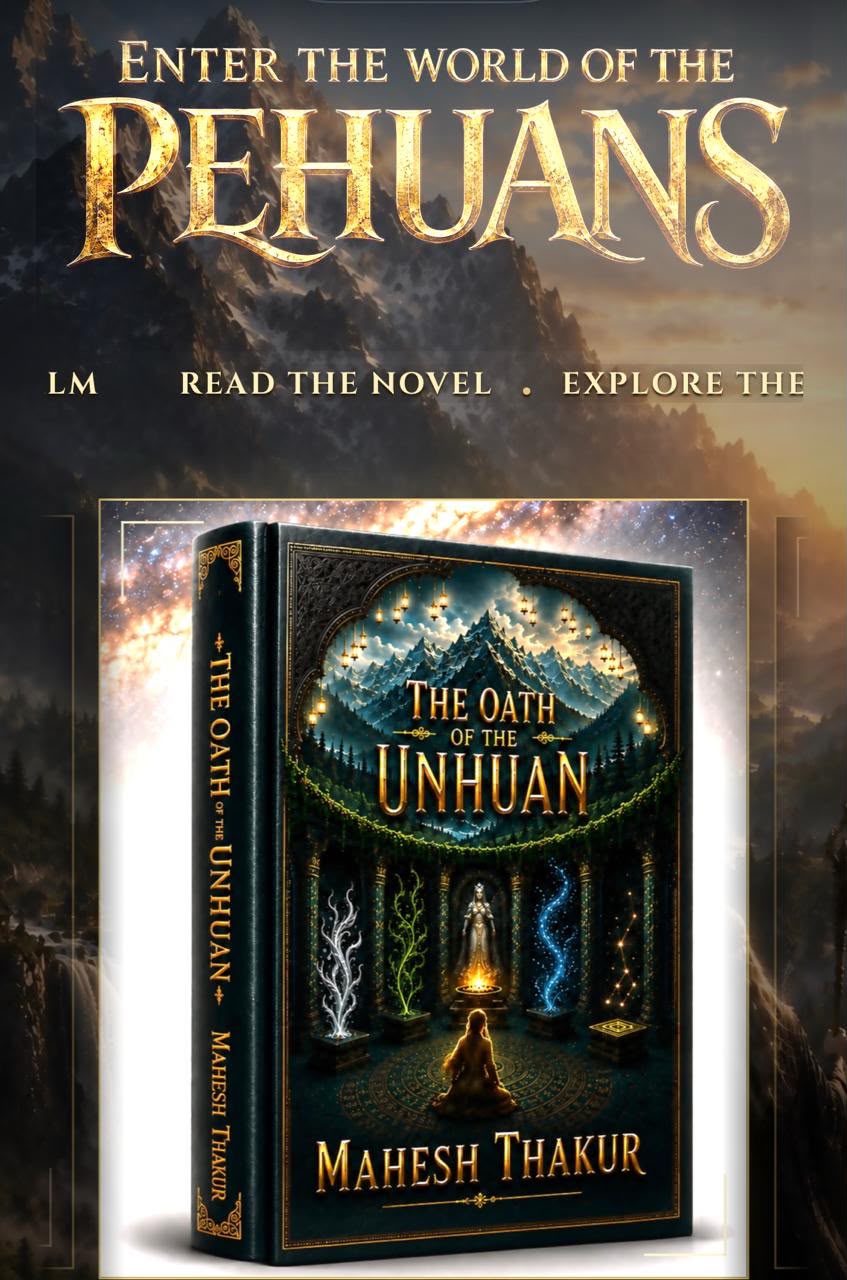
Having read countless books and interviewed many notable personalities over the years, I’ve developed a sense for what stands out. The Oath of the Unhuan is worth noting for several reasons.
Two things stand out immediately. First, despite this being Mahesh Thakur’s debut as an author, the writing doesn’t read like a first attempt. The pacing, confidence, and command of the story feel more assured than one might expect from a first-time novelist. Second, the world he has built around the Pehuans, a tribe hidden deep within the Himalayan region, is vivid, immersive, and refreshingly original. Central to it are the Sulie, luminous flowering plants said to possess the power to heal, preserve life, and awaken elemental gifts, so potent that only a select handful of elders are ever entrusted with knowledge of their existence. Equally compelling is Harnuba, a lost ancestral language whose fragments are etched into temple walls and marble tablets, understood by almost no one alive. Details like these give the setting a genuine sense of history and depth rather than serving as mere decoration.
Thakur says the story emerged through what he describes as a communion with an unknown force. Whether readers interpret that as inspiration, intuition, or something more mysterious, the result is a fantasy world that is entirely his own creation rather than an adaptation of existing mythology. From the Pehuans to inventions such as the Sulie and Harnuba, the mythology feels distinct and self-contained. The prose itself remains clear, accessible, and easy to follow, making the novel approachable for readers across a wide age range.
Adding a further layer, the first three chapters pair the printed text with a QR code companion experience. Readers still experience each chapter in full, but scanning the code unlocks Thakur’s own narration alongside AI-generated animated characters performing the same scenes with dialogue, emotion, and cinematic presentation. It functions as a companion to the written narrative rather than a replacement for it, offering readers an additional way to experience the story. The approach remains highly unusual in contemporary trade publishing and gives the novel an identity that extends beyond the printed page.
In the end, The Oath of the Unhuan is as much an experiment in storytelling as it is an original work of fantasy. It introduces readers to a richly imagined world shaped by forgotten plants, a forgotten language, and an expansive mythology that feels wholly its own. For a debut novel, it displays a level of confidence and imagination that suggests the work of an author with far more experience than a first publication would imply.

Comments are closed.